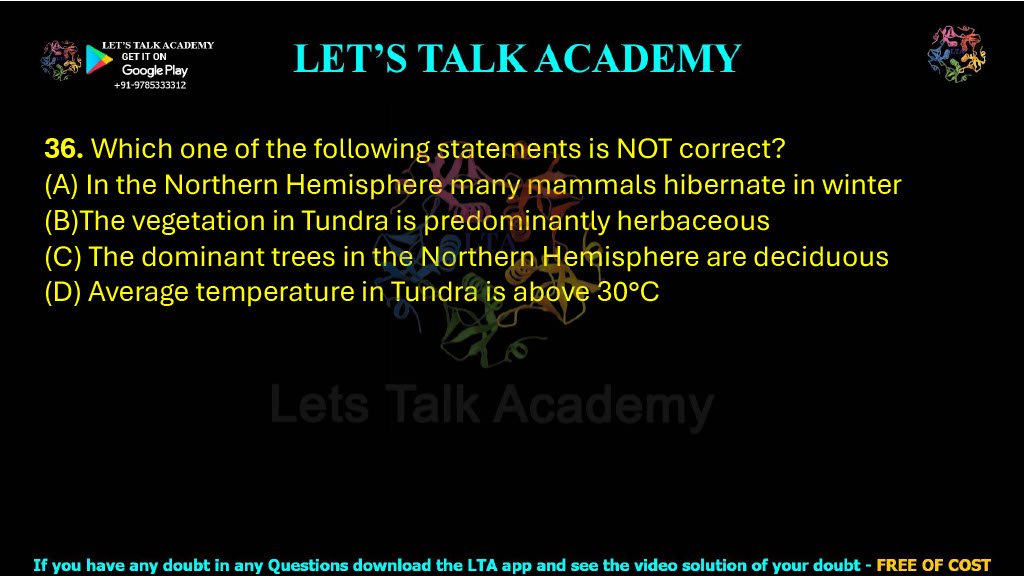
36. Which one of the following statements is NOT correct?
(A) In the Northern Hemisphere many mammals hibernate in winter
(B)The vegetation in Tundra is predominantly herbaceous
(C) The dominant trees in the Northern Hemisphere are deciduous
(D) Average temperature in Tundra is above 30°C
Incorrect Statement About the Northern Hemisphere and Tundra Biome
Detailed Explanation of the Correct Answer
The statement “Average temperature in Tundra is above 30°C” is NOT correct. Therefore, option (D) is the correct answer.
The tundra is one of the coldest terrestrial biomes on Earth. It is characterized by extremely low temperatures, a short growing season, strong winds, low precipitation, and the presence of permanently frozen subsoil known as permafrost in many tundra regions. An average temperature above 30°C would be completely inconsistent with the climatic conditions that define the tundra biome.
The remaining statements describe broad ecological characteristics associated with cold or temperate regions of the Northern Hemisphere. Many mammals use hibernation or similar winter dormancy strategies to survive periods of severe cold and food shortage. Tundra vegetation is predominantly low-growing and herbaceous because the harsh climate prevents the development of extensive forests. Deciduous trees are also major components of broad temperate regions of the Northern Hemisphere.
Therefore, the clearly incorrect statement among the given options is option (D).
What Is the Tundra Biome?
The tundra is a cold, largely treeless terrestrial biome found mainly at high latitudes and high elevations. It occurs in regions where low temperatures and short growing seasons strongly restrict plant growth.
The word tundra is commonly associated with vast open landscapes containing mosses, lichens, grasses, sedges, herbs, and low-growing shrubs. Large trees are generally absent because environmental conditions are unsuitable for deep root development and prolonged plant growth.
Two major types of tundra are commonly recognized: Arctic tundra and alpine tundra. Arctic tundra occurs at high northern latitudes, while alpine tundra occurs at high elevations above the natural tree line.
Both types experience cold conditions and short growing seasons, although the presence of permafrost is particularly characteristic of Arctic tundra.
Climate of the Tundra Biome
Extremely Low Temperatures
Cold temperature is the most important climatic feature of the tundra. Winters are long and severe, while summers are short and cool.
In Arctic tundra regions, winter temperatures can remain far below freezing for extended periods. Even during the summer, temperatures are generally too low to support the dense forests found in warmer regions.
Therefore, an average temperature above 30°C is completely incompatible with the tundra climate.
Short Growing Season
The growing season in tundra regions is extremely short. Plants have only a limited period in which temperatures are suitable for active growth and reproduction.
Because of this short growing season, tundra plants often grow rapidly when conditions become favorable. Many are perennial species that survive from one growing season to the next rather than completing their entire life cycle from seed each year.
The short growing season is one of the major reasons why tall trees cannot dominate the tundra landscape.
Low Precipitation
The tundra receives relatively low annual precipitation. Much of this precipitation falls as snow.
Despite the low precipitation, tundra soils can become waterlogged during the warmer season because low temperatures reduce evaporation and frozen subsoil can prevent water from draining deeply into the ground.
Thus, tundra ecosystems may contain wetlands, ponds, and water-saturated soils during the short summer period.
Permafrost
Permafrost is ground that remains frozen for extended periods and is a major feature of many Arctic tundra regions.
During the short summer, only the upper surface layer of soil may thaw. The deeper soil remains frozen, limiting drainage and restricting the depth to which plant roots can grow.
The presence of permafrost is one of the main reasons why large, deeply rooted trees are generally absent from tundra ecosystems.
Option (A): In the Northern Hemisphere Many Mammals Hibernate in Winter
Option (A) is generally considered a correct statement in the context of this question.
Winter in many parts of the Northern Hemisphere brings low temperatures, shorter days, and reduced food availability. Some mammals survive these unfavorable conditions by entering hibernation or other forms of prolonged winter dormancy.
During hibernation, an animal greatly reduces its metabolic activity. Body temperature, heart rate, and breathing rate may decrease, allowing the animal to conserve energy when food is scarce.
Mammals that use hibernation or deep winter dormancy include several species of bats, ground squirrels, and other small mammals. Bears are also commonly described as hibernating, although the physiology of their winter dormancy differs from that of small mammalian deep hibernators.
Not every mammal in the Northern Hemisphere hibernates. Many remain active, migrate, store food, develop thick insulation, or use other survival strategies. However, the statement says that many mammals hibernate, not that all mammals do so.
Therefore, option (A) is treated as correct.
Option (B): The Vegetation in Tundra Is Predominantly Herbaceous
Option (B) is a correct statement.
Tundra vegetation is predominantly low-growing because the environment is too cold and the growing season is too short for extensive tree development.
Common tundra plants include grasses, sedges, herbs, mosses, lichens, and dwarf shrubs. Many of these plants grow close to the ground, where they are better protected from strong winds and extreme temperatures.
Low-growing plants can also take advantage of the slightly warmer conditions near the soil surface. Their shallow root systems are suitable for environments where frozen ground prevents deep root penetration.
The term herbaceous refers to plants that do not produce large, persistent woody stems. A large part of tundra vegetation fits this description.
Therefore, option (B) is correct.
Option (C): The Dominant Trees in the Northern Hemisphere Are Deciduous
Option (C) is considered a correct statement in the intended context of this question.
Large regions of the temperate Northern Hemisphere support deciduous forests. These forests are particularly widespread in parts of eastern North America, Europe, and Asia.
Deciduous trees shed their leaves during an unfavorable season, usually before winter. This adaptation reduces water loss and helps plants avoid damage during periods of cold temperature and limited water availability.
Typical deciduous trees include oak, maple, beech, and birch. These trees form important forest communities across temperate regions of the Northern Hemisphere.
However, the Northern Hemisphere also contains enormous coniferous forests, particularly the boreal or taiga biome. Therefore, this statement should be interpreted in the broad ecological context intended by the question rather than as a claim that every forest or region in the Northern Hemisphere is dominated by deciduous trees.
Among the given options, option (D) remains the clearly incorrect statement.
Option (D): Average Temperature in Tundra Is Above 30°C
Option (D) is incorrect and is therefore the correct answer to the question.
The tundra is defined by its extremely cold climatic conditions. Average temperatures are not above 30°C. Such high temperatures are more characteristic of hot tropical or desert environments, not tundra ecosystems.
The tundra experiences long, cold winters and short, cool summers. Low temperatures restrict decomposition, slow nutrient cycling, shorten the growing season, and prevent the development of tall forests.
If the average temperature of a region were above 30°C, it would not possess the climatic conditions characteristic of the tundra biome.
Therefore, option (D) is the statement that is NOT correct.
Why Tundra Vegetation Is Low-Growing
The absence of tall forests in the tundra results from several interacting environmental factors.
Low temperatures slow plant metabolism and growth. The short growing season provides insufficient time for large trees to develop. Strong winds can damage tall vegetation, while frozen soil limits the penetration of deep root systems.
As a result, tundra plants commonly remain close to the ground. This growth form helps them avoid strong winds and take advantage of the relatively warmer microenvironment near the soil surface.
Many tundra plants also have small leaves, compact growth forms, and perennial life cycles that help them survive under severe climatic conditions.
Animal Adaptations to Cold Northern Environments
Animals living in cold regions of the Northern Hemisphere use several strategies to survive winter.
Some mammals hibernate and reduce their metabolic demands. Others migrate to warmer regions or areas with better food availability. Many develop thick fur or layers of fat that reduce heat loss.
Some animals store food before winter, while others change their diet according to seasonal availability. Certain species also change coat color, which may improve camouflage in snowy environments.
These adaptations demonstrate how strongly temperature and seasonality influence animal survival in cold ecosystems.
Tundra Compared with Warmer Terrestrial Biomes
The tundra differs greatly from tropical forests, savannas, and deserts.
Tropical forests are warm and receive abundant rainfall, supporting dense vegetation and extremely high biodiversity. Savannas are generally warm and dominated by grasses with scattered trees. Hot deserts may experience temperatures above 30°C but have severe water limitations.
The tundra, in contrast, is characterized primarily by cold temperatures, a short growing season, and low-growing vegetation.
Therefore, the statement that the average tundra temperature is above 30°C is ecologically inconsistent with the defining features of this biome.
Final Answer
The statement “Average temperature in Tundra is above 30°C” is NOT correct because the tundra is one of the coldest terrestrial biomes and is characterized by long, severe winters and short, cool summers.
Therefore, the correct answer is:
(D) Average temperature in Tundra is above 30°C


