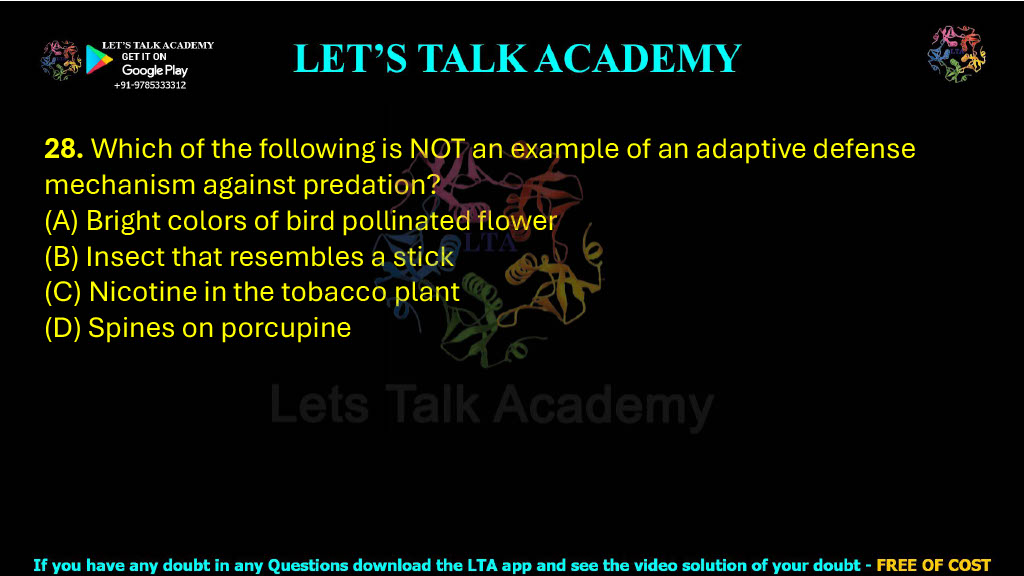
28. Which of the following is NOT an example of an adaptive defense mechanism against predation?
(A) Bright colors of bird pollinated flower
(B) Insect that resembles a stick
(C) Nicotine in the tobacco plant
(D) Spines on porcupine
Which Is NOT an Adaptive Defense Mechanism Against Predation?
Explanation of the Correct Answer
The correct answer is (A) bright colors of bird-pollinated flower because bright floral coloration is primarily an adaptation for attracting pollinators rather than an adaptive defense mechanism against predation. Bird-pollinated flowers often possess conspicuous colors that help birds detect and locate flowers containing nectar or other rewards. The function of these visual signals is to increase the probability of pollination and therefore improve plant reproductive success.
In contrast, the other three options represent genuine defensive adaptations. An insect that resembles a stick uses camouflage to avoid detection by predators. Nicotine in the tobacco plant functions as a chemical defense that can deter or harm herbivores. Spines on a porcupine provide a physical or mechanical defense that makes attack difficult and potentially dangerous for predators.
The key to solving this question is to identify the biological function of each trait. A trait may be an adaptation, but not every adaptation is a defense against predation. Bright flower colors are certainly adaptive, but their major function in bird-pollinated flowers is attraction of pollinators rather than protection from consumers.
Therefore, bright colors of bird-pollinated flowers are NOT an example of an adaptive defense mechanism against predation.
What Is an Adaptive Defense Mechanism Against Predation?
An adaptive defense mechanism is a heritable characteristic that increases an organism’s chances of surviving interactions with predators or herbivores. Such defenses evolve through natural selection when individuals possessing effective protective traits survive and reproduce more successfully than individuals lacking those traits.
Predation creates strong selective pressure because being captured and consumed directly reduces survival and reproductive success. Over evolutionary time, prey species can develop characteristics that reduce the probability of being detected, recognized, captured, killed, or consumed.
Defensive adaptations can be morphological, chemical, behavioural, or visual. Examples include camouflage, mimicry, toxic chemicals, protective armor, spines, quills, rapid escape behaviour, warning coloration, and group defense.
Plants can also possess defenses against herbivores. In ecological terms, herbivory is commonly treated as a form of predation because the consumer obtains nutrients by feeding on living plant tissues. Plants may therefore evolve chemical compounds, thorns, spines, tough leaves, or other traits that reduce herbivore damage.
Why Bright Colors of Bird-Pollinated Flowers Are Not an Anti-Predator Defense
Bird-pollinated flowers often possess bright and conspicuous colors because visual signals help attract birds. These colors function as advertisements that make flowers easier for pollinators to locate.
When a bird visits a flower to obtain nectar, pollen may become attached to its body. As the bird moves to another flower, some of the pollen may be transferred, contributing to pollination.
The plant benefits because successful pollination supports sexual reproduction and seed formation. The bird may benefit by obtaining a food reward such as nectar.
Therefore, the primary adaptive significance of bright floral coloration is associated with pollinator attraction and reproduction, not defense against predators.
This distinction is essential because the question does not ask which trait is non-adaptive. Bright flower color is an adaptation, but it is an adaptation for attracting pollinators rather than an adaptation for avoiding predation.
Major Types of Adaptive Defense Against Predation
Organisms have evolved a wide range of defensive strategies because predators differ in how they locate, capture, and consume prey. Some defenses prevent detection, while others make prey difficult or dangerous to attack.
Camouflage and Crypsis
Camouflage reduces the probability that an organism will be detected by a predator. An organism may resemble its physical environment in color, shape, pattern, or texture.
A stick-like insect is a classic example. Its elongated body and appearance resemble twigs or branches, making it difficult for visually hunting predators to distinguish the insect from its surroundings.
This defense acts before an attack begins because a predator that fails to detect the prey cannot easily capture it.
Chemical Defense
Chemical defenses involve substances that deter, poison, repel, or reduce the feeding efficiency of consumers. These defenses are especially important in plants because plants cannot escape physically from herbivores.
Nicotine in tobacco plants is a well-known example of a chemical defense. It is a biologically active alkaloid that can affect the nervous systems of many herbivores and insects.
By making plant tissues harmful or less suitable for consumption, chemical defenses can reduce herbivore damage.
Mechanical and Structural Defense
Mechanical defenses physically reduce the ability of a predator to capture or consume prey. These defenses may include shells, armor, thorns, spines, quills, or other protective structures.
Porcupine spines are an example of structural defense. The sharp quills make physical attack difficult and can injure a predator attempting to bite or capture the animal.
Such structures increase the potential cost of attack and can cause predators to avoid the defended prey.
Detailed Explanation of Every Option
Option (A): Bright Colors of Bird-Pollinated Flower — Correct Answer
Bright colors of bird-pollinated flowers are not primarily an adaptive defense mechanism against predation. Instead, they function as visual signals that attract bird pollinators.
Flowers depend on effective pollen transfer for sexual reproduction. Conspicuous coloration can help pollinating animals detect flowers and associate particular visual signals with nectar or other rewards.
The interaction increases the likelihood that pollen will be transported between flowers. Therefore, the adaptive value of the bright coloration lies mainly in improving pollination success.
This trait does not primarily reduce the probability of detection by predators, deter consumers chemically, or make the organism physically difficult to attack.
Therefore, option (A) is the correct answer because it is NOT an adaptive defense mechanism against predation.
Option (B): Insect That Resembles a Stick — Incorrect
An insect that resembles a stick is a classic example of camouflage or crypsis. Its body shape, color, and behaviour may closely resemble a twig or branch.
This resemblance reduces the probability that a predator will detect and recognize the insect as potential prey. Visually hunting predators may overlook the insect because it blends with the surrounding vegetation.
Individuals that are more difficult to detect have a greater chance of surviving and reproducing. Over generations, natural selection can favor characteristics that improve resemblance to the environment.
Therefore, stick resemblance is a genuine adaptive defense against predation.
Thus, option (B) is incorrect as the answer to the NOT question.
Option (C): Nicotine in the Tobacco Plant — Incorrect
Nicotine in tobacco plants is an example of chemical defense. Plants are exposed to herbivores that consume leaves, stems, seeds, and other tissues. Since plants cannot escape by movement, many species produce defensive chemicals.
Nicotine is an alkaloid that affects the nervous systems of many animals and insects. Its presence in plant tissues can make feeding harmful or undesirable for herbivores.
By reducing herbivore feeding or survival, nicotine can decrease damage to the plant and improve the plant’s chances of growth and reproduction.
Therefore, nicotine represents a genuine adaptive defense mechanism against herbivory, which is commonly considered a form of predation in ecological interactions.
Thus, option (C) is incorrect as the answer to the NOT question.
Option (D): Spines on Porcupine — Incorrect
Spines or quills on a porcupine are a clear example of a physical and mechanical defense against predators.
When threatened, a porcupine can present its sharp quills toward an attacker. A predator attempting to bite or capture the animal may experience painful injury.
The quills therefore increase the cost and risk associated with attacking the porcupine. Predators that have experienced or recognize this danger may avoid attacking porcupines.
This structural defense directly reduces the probability of successful predation.
Therefore, option (D) is incorrect as the answer to the NOT question.
Camouflage in Stick Insects as an Anti-Predator Adaptation
Stick insects provide one of the clearest examples of protective resemblance. Their bodies often resemble the shape and color of twigs, stems, or branches.
Predators frequently depend on visual information to locate prey. When the outline, color, and movement of an insect resemble the background, detection becomes more difficult.
Some stick insects also remain motionless or move slowly in ways that resemble vegetation moving in the wind. This behavioural component can strengthen the effectiveness of the visual camouflage.
The adaptive advantage is straightforward: individuals that are overlooked by predators are more likely to survive and reproduce.
Nicotine as a Chemical Defense in Tobacco Plants
Plants produce many chemical compounds that are not directly required for basic processes such as photosynthesis or respiration but can play important ecological roles. Many of these compounds function in defense.
Nicotine is a nitrogen-containing alkaloid associated with tobacco plants. It can interfere with nervous system function in susceptible herbivores and insects.
When herbivores feed on chemically defended tissues, they may experience toxic or unpleasant effects. This can reduce continued feeding and protect plant tissues from excessive damage.
Therefore, nicotine illustrates how plants can use chemical compounds as adaptive defenses against consumers.
Porcupine Spines as a Mechanical Defense
Porcupines rely on specialized quills as a major defensive adaptation. These structures are modified hairs that are stiff and sharp.
The quills create a physical barrier between the predator and the vulnerable body of the porcupine. A predator attempting an attack risks injury, making the porcupine a difficult and costly prey item.
Mechanical defenses can be highly effective because they act directly during an attempted capture. Even if the predator successfully detects the prey, the structural defense can prevent or discourage the attack.
Thus, porcupine spines are a clear example of an adaptive defense against predation.
Difference Between Pollinator Attraction and Predator Defense
The central conceptual distinction in this question is between traits that attract beneficial organisms and traits that discourage harmful organisms.
Bright flower colors increase visibility. This can be beneficial when the target organism is a pollinator because attracting pollinators improves reproductive success.
Camouflage, in contrast, decreases visibility to predators. Chemical defenses make consumption harmful or unpleasant, while structural defenses make attack physically difficult.
Therefore, although all four traits can have adaptive value, they do not perform the same ecological function.
Bright colors in bird-pollinated flowers primarily promote reproduction through attraction, while the other three traits primarily increase survival by reducing predation or herbivory.
Predation as an Evolutionary Selective Pressure
Predators can exert strong natural selection on prey populations. Individuals that possess traits reducing the probability of capture may survive longer and produce more offspring.
Over generations, alleles associated with effective defense mechanisms can increase in frequency. This evolutionary process can produce increasingly specialized anti-predator adaptations.
At the same time, predators may evolve improved methods for detecting and capturing prey. This reciprocal evolutionary pressure can contribute to ongoing evolutionary change between predators and prey.
Camouflage, chemical defense, and physical protection are all outcomes that can be favored under strong predation pressure.
Plant Defenses Against Herbivory
Plants experience attacks from insects, mammals, and other herbivores. Because plants cannot escape through rapid movement, they depend heavily on structural and chemical defenses.
Structural defenses may include thorns, spines, tough leaves, hairs, or thick protective tissues. Chemical defenses may include alkaloids, terpenes, phenolic compounds, and other substances that reduce feeding.
Nicotine in tobacco plants belongs to the chemical category. Its biological activity can deter or harm consumers and thereby reduce herbivore pressure.
This is why the nicotine example is correctly classified as a defensive adaptation rather than the answer to the NOT question.
How to Identify the Correct Answer Conceptually
Each option can be evaluated by asking whether the trait primarily reduces the risk of being detected, attacked, or consumed.
An insect resembling a stick becomes more difficult for predators to detect. Nicotine makes tobacco tissues chemically defended against herbivores. Porcupine spines make physical attack dangerous.
Bright flower colors perform a different function. They increase the probability that pollinators will notice and visit the flower.
Therefore, the first option differs functionally from all the others and is the correct answer.
Final Answer
Adaptive defenses against predation improve survival by reducing detection, discouraging attack, or making consumption difficult or harmful.
An insect that resembles a stick uses camouflage. Nicotine in the tobacco plant provides chemical defense against herbivores. Porcupine spines provide mechanical protection against predators.
Bright colors of bird-pollinated flowers, however, primarily function to attract pollinators and improve reproductive success. They are not primarily an anti-predator defense.
Therefore, the correct answer is (A) Bright colors of bird-pollinated flower.


