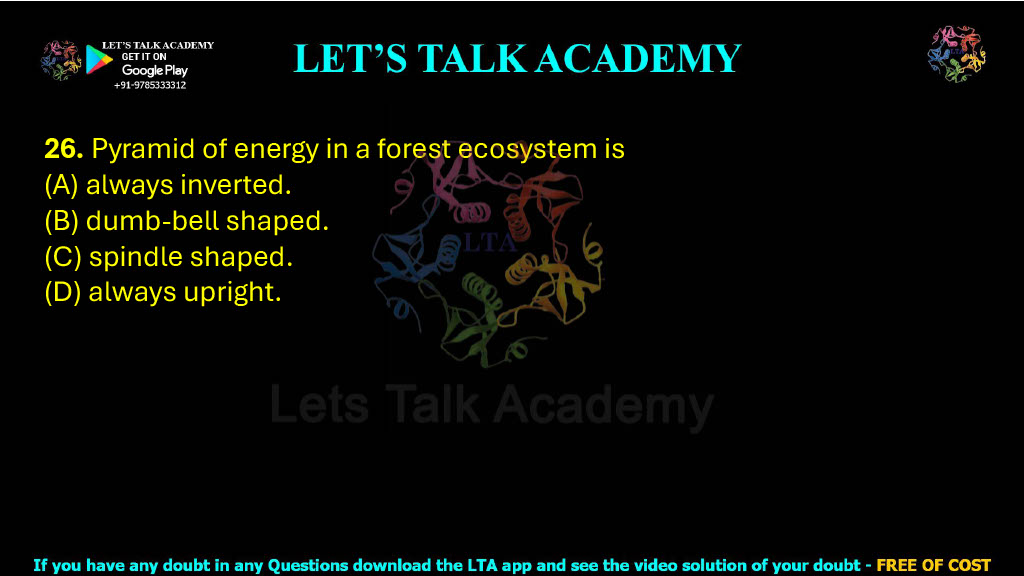
26. Pyramid of energy in a forest ecosystem is
(A) always inverted.
(B) dumb-bell shaped.
(C) spindle shaped.
(D) always upright.
Pyramid of Energy in a Forest Ecosystem Is Always Upright
Detailed Explanation of the Correct Answer
The pyramid of energy in a forest ecosystem is always upright. Therefore, option (D) is the correct answer.
A pyramid of energy represents the amount of energy available or transferred through different trophic levels of an ecosystem during a specified period. In a forest ecosystem, green plants form the producer level and contain the greatest amount of available energy. Herbivores obtain only a fraction of this energy by feeding on plants, while primary and secondary carnivores receive progressively smaller amounts of energy.
Energy decreases at every successive trophic level because organisms use much of the energy they obtain for respiration, movement, growth, maintenance, reproduction, and other metabolic activities. A substantial amount is ultimately dissipated as heat. Therefore, the amount of energy available to the next trophic level is always lower than the amount available at the preceding level.
This continuous decrease in energy from producers toward top consumers gives the pyramid of energy its characteristic upright shape. Unlike pyramids of numbers or biomass, an energy pyramid cannot become inverted under normal ecological conditions.
What Is a Pyramid of Energy?
A pyramid of energy is a graphical representation of the flow of energy through the trophic levels of an ecosystem. It shows how much energy is available at the producer level and how progressively less energy becomes available to herbivores, carnivores, and higher-level consumers.
In a typical forest ecosystem, the trophic organization can be represented as:
Producers → Primary consumers → Secondary consumers → Tertiary consumers
Green trees, shrubs, herbs, and other photosynthetic organisms occupy the producer level. Herbivorous animals form the primary consumer level. Carnivores feeding on herbivores form the secondary consumer level, while higher predators may occupy the tertiary consumer level.
The producer level forms the broad base of the energy pyramid because producers capture solar energy and convert it into chemical energy through photosynthesis. As this energy moves upward through the food chain, the available quantity decreases continuously.
Energy Flow in a Forest Ecosystem
Producers Form the Broadest Energy Base
The base of the energy pyramid in a forest ecosystem consists of producers such as trees, shrubs, herbs, grasses, and other photosynthetic organisms. These organisms capture solar radiation and convert a portion of it into chemical energy stored in organic compounds.
Because producers introduce energy into the biological component of the ecosystem, the producer trophic level contains the largest amount of energy available to the food chain.
A forest may contain massive trees with extensive leaves and other photosynthetic tissues. Collectively, these producers support herbivores and, indirectly, all higher trophic levels.
Primary Consumers Receive Less Energy
Primary consumers are herbivores that obtain energy by feeding directly on producers. In a forest ecosystem, these may include insects, deer, rodents, and many other plant-eating animals.
However, herbivores do not receive all the energy originally available at the producer level. Some plant material is never consumed, some consumed material is not assimilated, and much of the assimilated energy is used by plants and herbivores in metabolic processes.
Therefore, the energy available at the primary consumer level is lower than the energy available at the producer level.
Secondary Consumers Receive Still Less Energy
Secondary consumers obtain energy by feeding on primary consumers. These organisms may include insect-eating birds, reptiles, small carnivorous mammals, and other predators.
Only a fraction of the energy present at the herbivore level becomes available to secondary consumers. Again, much of the energy is used in respiration and other life processes or is lost from the food chain.
Consequently, the secondary consumer level is narrower than the primary consumer level in an energy pyramid.
Top Consumers Have the Least Available Energy
Tertiary consumers and top predators occupy the highest trophic levels of the forest food chain. Because energy has already passed through several trophic transfers before reaching them, only a relatively small amount remains available.
This progressive reduction in energy explains why ecosystems generally support fewer organisms at higher trophic positions and why food chains usually contain a limited number of trophic levels.
Thus, the energy pyramid becomes progressively narrower from its base toward its top.
Why Is the Pyramid of Energy Always Upright?
The pyramid of energy is always upright because energy transfer between trophic levels is inefficient. Energy cannot be transferred from one trophic level to another with 100% efficiency.
At each trophic level, organisms use energy for essential biological functions such as respiration, movement, active transport, maintenance, growth, and reproduction. During these processes, energy is transformed and a substantial portion is dissipated as heat.
Therefore:
Energy at producers > Energy at primary consumers > Energy at secondary consumers > Energy at tertiary consumers
Since each higher trophic level contains less available energy than the trophic level below it, the pyramid must always have a broad base and a narrow top.
The 10 Percent Law and the Energy Pyramid
The progressive reduction of energy across trophic levels is often explained using the 10 percent law of energy transfer. According to this ecological principle, only a relatively small fraction of the energy available at one trophic level is transferred to the next trophic level.
For example, if producers contain:
10,000 units of energy
then primary consumers may receive approximately:
1,000 units of energy
secondary consumers may receive approximately:
100 units of energy
and tertiary consumers may receive approximately:
10 units of energy
This can be represented as:
Producers = 10,000 units
Primary consumers = 1,000 units
Secondary consumers = 100 units
Tertiary consumers = 10 units
The exact transfer efficiency can vary among ecosystems and trophic interactions, but the general pattern remains the same: energy availability decreases at successive trophic levels.
This is why the pyramid of energy is always upright.
Option (A): Always Inverted
Option (A), always inverted, is incorrect.
An inverted ecological pyramid would mean that higher trophic levels contain more energy than the trophic levels below them. This cannot occur in an energy pyramid because energy is progressively lost from the biological system during each trophic transfer.
If producers contain a certain quantity of energy, consumers cannot receive more usable energy than is available from the trophic level supporting them. Such a pattern would contradict the basic principles of energy transfer and thermodynamics.
Some ecological pyramids, particularly pyramids of numbers or biomass, may be inverted under particular ecological conditions. However, the pyramid of energy is not inverted.
Therefore, option (A) is incorrect.
Option (B): Dumb-Bell Shaped
Option (B), dumb-bell shaped, is also incorrect.
A dumb-bell-shaped ecological pyramid would suggest relatively broad lower and upper trophic levels with a narrow intermediate level. Such a pattern does not represent the continuous decrease in energy that occurs during trophic transfer.
Energy does not decrease at one trophic level and then increase again at a higher trophic level. Instead, the amount of available energy progressively decreases as it moves through the food chain.
Therefore, a dumb-bell shape cannot correctly represent the pyramid of energy in a forest ecosystem.
Hence, option (B) is incorrect.
Option (C): Spindle Shaped
Option (C), spindle shaped, is incorrect.
A spindle-shaped pyramid is broader in the middle than at the base and top. Such a shape may be discussed in relation to certain pyramids of numbers, depending on the structure of the food chain.
For example, a small number of large producers may support a larger number of herbivores, which in turn may support fewer predators. This can produce a spindle-like pattern in a pyramid of numbers.
However, the energy pyramid does not depend on the number or size of individual organisms. It represents the amount of energy available at each trophic level.
Because available energy continuously decreases toward higher trophic levels, the energy pyramid cannot become spindle shaped.
Therefore, option (C) is incorrect.
Option (D): Always Upright
Option (D), always upright, is the correct answer.
The producer level contains the greatest amount of energy because producers capture solar energy and convert it into chemical energy. Primary consumers receive less energy, secondary consumers receive still less, and top consumers receive the smallest amount.
The resulting pattern has a broad producer base and progressively narrower consumer levels.
Therefore:
Producers > Primary consumers > Secondary consumers > Tertiary consumers
This continuous reduction in available energy ensures that the pyramid of energy is always upright in a forest ecosystem and in other ecosystems.
Hence, option (D) is correct.
Difference Between Pyramids of Energy, Biomass, and Numbers
Ecological pyramids can represent different characteristics of trophic structure. The three major types are the pyramid of numbers, the pyramid of biomass, and the pyramid of energy.
The pyramid of numbers represents the number of organisms at each trophic level. Depending on the ecosystem, it may be upright, inverted, or show other shapes.
The pyramid of biomass represents the total mass of living material at each trophic level. It is generally upright in many terrestrial ecosystems but may be inverted in some aquatic ecosystems.
The pyramid of energy represents the flow of energy through trophic levels over time. Because energy decreases during every trophic transfer, it is always upright.
This makes the energy pyramid the most consistent representation of the functional organization of an ecosystem.
Why the Forest Energy Pyramid Cannot Be Inverted
A forest ecosystem may sometimes show unusual patterns in a pyramid of numbers. For example, a relatively small number of large trees can support a much larger number of herbivorous insects. Therefore, the pyramid of numbers in a forest can differ in shape from a simple upright pyramid.
However, this does not apply to the pyramid of energy. A large tree can store and provide substantial energy even though it counts as only one individual. Energy pyramids measure energy flow rather than the number of organisms.
As energy passes from trees to herbivores and then to carnivores, the amount of available energy declines. Therefore, regardless of the number or biomass of organisms at each trophic level, the energy pyramid remains upright.
Final Answer
The pyramid of energy in a forest ecosystem is always upright because the amount of available energy decreases at every successive trophic level.
Therefore, the correct answer is:
(D) Always upright


