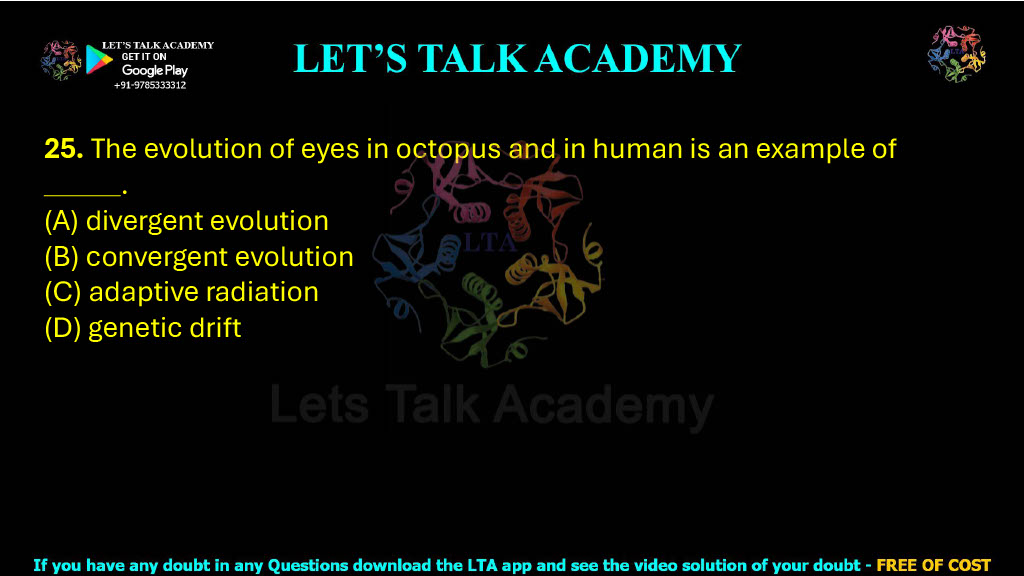
25. The evolution of eyes in octopus and in human is an example of .
(A) divergent evolution
(B) convergent evolution
(C) adaptive radiation
(D) genetic drift
Evolution of Eyes in Octopus and Humans: A Classic Example of Convergent Evolution
Correct Answer: (B) Convergent evolution
The evolution of complex eyes in octopuses and humans is a classic example of convergent evolution. Therefore, the correct answer is option (B).
Octopuses and humans belong to evolutionarily distant animal lineages. Humans are vertebrates belonging to the phylum Chordata, whereas octopuses are cephalopod molluscs belonging to the phylum Mollusca. Despite this distant evolutionary relationship, both groups possess remarkably similar camera-type eyes with structures such as a lens, iris, pupil, and retina.
The important point is that these complex eyes were not inherited in their fully developed camera-like form from a recent common ancestor. Instead, similar visual systems evolved independently in the vertebrate and cephalopod lineages. Similar environmental challenges and the need for efficient vision favored comparable functional solutions. This independent evolution of similar adaptations in different evolutionary lineages is known as convergent evolution.
What Is Convergent Evolution?
Convergent evolution is the independent evolution of similar biological characteristics in organisms that are not closely related with respect to the trait being compared. It usually occurs when different evolutionary lineages experience similar environmental conditions or face similar functional challenges.
Natural selection can favor comparable solutions when organisms must solve similar biological problems. As a result, distantly related organisms may evolve structures that resemble each other in function and sometimes even in overall appearance.
The evolution of camera-type eyes in octopuses and humans demonstrates this principle clearly. Both organisms require the ability to detect light, form images, recognize objects, and respond effectively to their surroundings. Although their evolutionary histories are very different, similar demands associated with vision resulted in independently evolved complex eyes.
Therefore:
Different evolutionary lineages + independent origin + similar functional adaptation = convergent evolution
Why Are Octopus and Human Eyes an Example of Convergent Evolution?
The octopus and human eye both function as highly developed image-forming systems. Light enters through an opening, passes through a lens, and is focused onto a light-sensitive retinal surface. The visual information is then converted into nerve signals and processed by the nervous system.
At first glance, these similarities might suggest that the eyes were inherited directly from a recent common ancestor with the same type of complex camera eye. However, the evolutionary histories of cephalopods and vertebrates are deeply separated.
The lineage leading to humans and the lineage leading to octopuses evolved complex camera-type eyes independently. Their distant ancestors possessed much simpler light-sensitive systems rather than the fully developed eyes seen in modern humans and octopuses.
Similar selective pressures favored better detection of objects, prey, predators, movement, and environmental features. Over evolutionary time, both lineages independently developed sophisticated image-forming eyes.
This is why the octopus and human eye represent one of the best-known examples of convergent evolution.
Similarities Between Octopus and Human Eyes
The eyes of octopuses and humans show striking functional similarities. Both possess a camera-like optical organization designed to produce a focused image.
In both organisms, light enters through a pupil. The amount of incoming light can be regulated, and a lens helps focus light onto a retina containing photoreceptor cells. The resulting signals are transmitted to the nervous system, where visual information is processed.
The major similarities include:
Pupil for the entry of light
Lens for focusing light
Retina containing light-sensitive cells
Ability to form detailed images
Neural pathways for processing visual information
These similarities are especially remarkable because octopuses and humans belong to distant branches of animal evolution. Their comparable eye designs therefore demonstrate how evolution can independently produce similar functional solutions.
Important Differences Between Octopus and Human Eyes
Although octopus and human eyes are superficially similar, their internal organization reveals important differences. These differences provide strong evidence that the two camera-type eyes evolved independently.
In the human eye, the retina is often described as inverted. Light passes through layers of neural tissue before reaching the photoreceptor cells. The optic nerve exits through the retina, producing a region without photoreceptors known as the blind spot.
The octopus eye has a different arrangement. Its photoreceptor cells face incoming light more directly, and the nerve fibres do not pass through the retinal surface in the same manner as in vertebrates. Consequently, the octopus eye does not have the same type of blind spot produced by the vertebrate optic nerve arrangement.
These anatomical differences are important because they show that evolution reached a similar functional outcome through different developmental and structural pathways.
Thus, the eyes are similar in overall function but differ in important details of construction. This pattern strongly supports convergent evolution.
Detailed Explanation of Option (A): Divergent Evolution
Option (A) is incorrect.
Divergent evolution occurs when organisms or structures derived from a common ancestral condition become increasingly different over evolutionary time. This usually happens because different populations or lineages adapt to different environments or perform different functions.
A classic example of divergent evolution is the vertebrate forelimb. The human arm, whale flipper, bat forelimb, and horse foreleg share the same basic ancestral skeletal pattern but have become modified for different functions.
The evolution of eyes in octopuses and humans does not fit this pattern. The question is not describing one ancestral complex camera eye that became modified into two very different structures. Instead, similar complex visual organs evolved independently in two distantly related lineages.
Therefore, the evolutionary pattern is convergence rather than divergence.
Detailed Explanation of Option (B): Convergent Evolution
Option (B) is correct.
Convergent evolution occurs when different evolutionary lineages independently develop similar adaptations in response to similar functional requirements or environmental pressures.
Humans are vertebrates, while octopuses are cephalopod molluscs. Despite their distant evolutionary relationship, both possess complex camera-type eyes capable of producing detailed images.
The similarity did not arise because both inherited the complete camera-type eye from a recent common ancestor. Instead, sophisticated eyes evolved independently in the vertebrate and cephalopod lineages.
The independent origin of similar complex structures is the defining feature of convergent evolution.
Therefore:
Cephalopod lineage → independent evolution of camera-type eye
Vertebrate lineage → independent evolution of camera-type eye
Similar final adaptation → convergent evolution
For this reason, option (B) is the correct answer.
Detailed Explanation of Option (C): Adaptive Radiation
Option (C) is incorrect.
Adaptive radiation is the evolutionary diversification of a single ancestral lineage into multiple descendant species adapted to different ecological niches.
During adaptive radiation, one ancestral group gives rise to several forms that become specialized for different habitats, resources, or ways of life. The classic examples include Darwin’s finches and the diversification of cichlid fishes in African lakes.
The evolution of octopus and human eyes does not represent the diversification of one recent ancestral lineage into several ecological forms. Instead, it involves the independent appearance of similar visual adaptations in two distantly related lineages.
Therefore, adaptive radiation does not explain the similarity between octopus and human eyes.
Detailed Explanation of Option (D): Genetic Drift
Option (D) is incorrect.
Genetic drift is the random change in allele frequencies within a population. Unlike natural selection, genetic drift does not necessarily produce adaptations because it operates through chance.
Its effects are particularly strong in small populations, where random sampling can cause alleles to become more common, disappear, or eventually become fixed.
The independent evolution of complex camera-type eyes in octopuses and humans cannot be described simply as genetic drift. These highly organized visual systems involve many coordinated features that contribute to image formation and visual performance.
The similarity between the two eye types is interpreted as independent adaptation under comparable functional demands, making convergent evolution the appropriate answer.
Convergent Evolution and Analogous Structures
Convergent evolution frequently produces analogous structures. Analogous structures perform similar functions but evolved independently rather than being inherited as the same specialized structure from a recent common ancestor.
The camera-type eyes of octopuses and humans are often discussed as an example of analogous similarity because both perform highly similar visual functions but evolved independently in separate evolutionary lineages.
The relationship can be summarized as:
Independent evolutionary origin + similar function = analogous similarity
Process responsible for independent similarity = convergent evolution
Thus, when a question asks for the evolutionary process involved in the origin of octopus and human eyes, the answer is convergent evolution.
Convergent Evolution vs Divergent Evolution
Convergent and divergent evolution describe opposite broad evolutionary patterns.
In convergent evolution, different lineages independently become more similar because they face similar functional demands or selective pressures. The evolution of camera-type eyes in octopuses and humans is an example.
In divergent evolution, related lineages become increasingly different as they adapt to different environments or functions. The modification of the basic vertebrate forelimb into an arm, wing, flipper, or running limb is an example.
Therefore:
Unrelated or distantly related lineages becoming functionally similar → Convergent evolution
Related lineages becoming increasingly different → Divergent evolution
The octopus-human eye comparison clearly matches the first pattern.
Why Similar Environmental Challenges Can Produce Similar Adaptations
Natural selection does not work toward a predetermined goal, but similar functional problems can repeatedly favor comparable solutions.
An animal that depends heavily on vision benefits from accurately detecting movement, locating food, avoiding predators, recognizing objects, and navigating through its environment. A camera-type eye is an effective solution for producing focused images.
Both active cephalopods and vertebrates experienced evolutionary conditions in which sophisticated vision provided major advantages. As visual systems became increasingly refined, each lineage independently evolved structures capable of focusing light and producing detailed images.
This does not mean that the evolutionary pathways were identical. The structural and developmental differences between octopus and human eyes show that each lineage reached a similar functional outcome through its own evolutionary history.
Role of Natural Selection in the Evolution of Complex Eyes
The evolution of complex eyes can occur through the gradual accumulation of changes that improve visual performance. Simple light-sensitive cells can provide information about the presence or direction of light. Further modifications can improve directional sensitivity, image formation, focusing ability, and visual resolution.
If such changes improve survival or reproductive success, natural selection can favor them. Over long evolutionary periods, increasingly sophisticated visual systems may evolve.
In the cephalopod and vertebrate lineages, these processes occurred independently. The result was the evolution of camera-type eyes with striking functional similarities.
This repeated evolution of similar solutions in separate lineages is a powerful example of how natural selection can produce convergent outcomes.
Final Answer
The correct answer is (B) Convergent evolution.
The complex camera-type eyes of octopuses and humans evolved independently in two distantly related evolutionary lineages. Although both eyes contain functionally similar features such as a pupil, lens, and retina, important anatomical differences reveal their separate evolutionary histories.
Because similar visual adaptations evolved independently in cephalopods and vertebrates, the evolution of eyes in octopus and humans is a classic example of convergent evolution.
Correct Answer: (B) Convergent evolution


