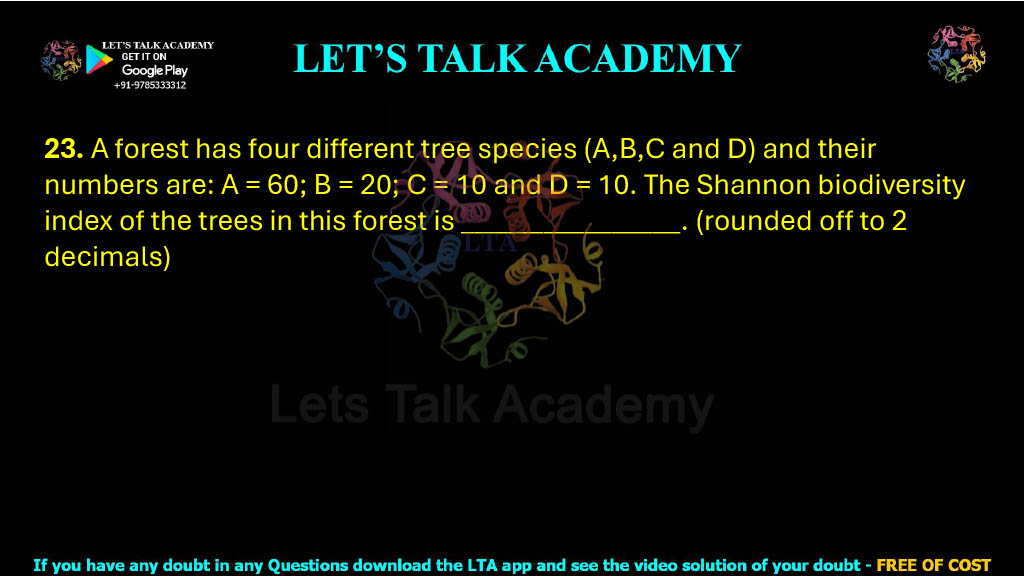
23. A forest has four different tree species (A,B,C and D) and their numbers are: A = 60; B = 20; C = 10 and D = 10. The Shannon biodiversity index of the trees in this forest is ________________. (rounded off to 2 decimals)
Shannon Biodiversity Index Calculation for Four Tree Species
Detailed Explanation of the Shannon Biodiversity Index Calculation
The Shannon biodiversity index, also called the Shannon diversity index or Shannon-Wiener index, is widely used in ecology to measure species diversity within a community. It considers two important aspects of biodiversity: the number of species present and the relative abundance of each species.
In the given forest, there are four different tree species, but they are not equally abundant. Species A is the dominant species with 60 individuals, species B has 20 individuals, and species C and species D have 10 individuals each. To calculate the Shannon biodiversity index, we first determine the total number of trees and then calculate the proportional abundance of each species.
The Shannon biodiversity index is calculated using the formula:
H′ = −Σ (pᵢ ln pᵢ)
where H′ represents the Shannon biodiversity index, pᵢ represents the proportion of individuals belonging to the ith species, ln represents the natural logarithm, and Σ means that the values for all species are added together.
Step 1: Calculate the Total Number of Trees
The forest contains four tree species with the following numbers:
Species A = 60
Species B = 20
Species C = 10
Species D = 10
The total number of trees is calculated by adding the abundance of all four species:
Total number of trees = 60 + 20 + 10 + 10
Total number of trees = 100
Therefore, the total population size of the tree community is 100 individuals.
Step 2: Calculate the Proportional Abundance of Each Species
Proportional Abundance of Species A
Species A contains 60 individuals out of a total of 100 trees. Therefore, its proportional abundance is:
pₐ = 60/100 = 0.60
Thus, species A represents 60% of the total tree population.
Proportional Abundance of Species B
Species B contains 20 individuals out of 100 trees. Therefore:
pᵦ = 20/100 = 0.20
Thus, species B represents 20% of the total tree population.
Proportional Abundance of Species C
Species C contains 10 individuals out of 100 trees. Therefore:
p꜀ = 10/100 = 0.10
Thus, species C represents 10% of the total tree population.
Proportional Abundance of Species D
Species D also contains 10 individuals out of 100 trees. Therefore:
pᴅ = 10/100 = 0.10
Thus, species D also represents 10% of the total tree population.
The proportional abundances are therefore:
A = 0.60
B = 0.20
C = 0.10
D = 0.10
The sum of all proportional abundances must be equal to 1:
0.60 + 0.20 + 0.10 + 0.10 = 1.00
Therefore, the calculated proportions are correct.
Step 3: Apply the Shannon Biodiversity Index Formula
The Shannon biodiversity index formula is:
H′ = −Σ (pᵢ ln pᵢ)
Substituting the proportional abundance of each species:
H′ = −[(0.60 ln 0.60) + (0.20 ln 0.20) + (0.10 ln 0.10) + (0.10 ln 0.10)]
Now, each term is calculated separately.
Step 4: Calculate the Contribution of Each Tree Species
Contribution of Species A
For species A:
pₐ = 0.60
The natural logarithm of 0.60 is:
ln(0.60) = −0.5108
Therefore:
0.60 × (−0.5108) = −0.3065
Contribution of Species B
For species B:
pᵦ = 0.20
The natural logarithm of 0.20 is:
ln(0.20) = −1.6094
Therefore:
0.20 × (−1.6094) = −0.3219
Contribution of Species C
For species C:
p꜀ = 0.10
The natural logarithm of 0.10 is:
ln(0.10) = −2.3026
Therefore:
0.10 × (−2.3026) = −0.2303
Contribution of Species D
For species D:
pᴅ = 0.10
Therefore:
0.10 × ln(0.10) = 0.10 × (−2.3026)
= −0.2303
Step 5: Add All the Values
Now, substitute all the calculated values into the Shannon index formula:
H′ = −[(−0.3065) + (−0.3219) + (−0.2303) + (−0.2303)]
Adding the values inside the brackets:
H′ = −(−1.0890)
Therefore:
H′ = 1.0890
When rounded off to two decimal places:
H′ = 1.09
Thus, the Shannon biodiversity index of the trees in this forest is 1.09.
Why the Shannon Index Is 1.09
The calculated Shannon diversity index is 1.09 because the four species are not equally distributed in the forest. Species A alone accounts for 60% of all trees, making it the dominant species. Species B contributes 20%, while species C and species D each contribute only 10%.
The Shannon index increases when a community contains more species and when the individuals are distributed more evenly among those species. Although this forest contains four species, the strong dominance of species A reduces the overall diversity value.
If all four species had equal abundances, each species would have a proportional abundance of 0.25, and the Shannon index would be higher. Therefore, the value of 1.09 reflects a community with four species but unequal species abundances.
Maximum Possible Shannon Diversity for Four Species
For a community containing four species, the maximum possible Shannon diversity occurs when all four species are equally abundant.
The maximum Shannon index is calculated as:
H′ₘₐₓ = ln(S)
where S is the total number of species.
Since there are four species:
H′ₘₐₓ = ln(4)
H′ₘₐₓ = 1.3863
The actual Shannon index of the forest is:
H′ = 1.09
Since 1.09 is lower than the maximum possible value of 1.3863, the forest has substantial species diversity, but its diversity is reduced by the unequal distribution of individuals among the four species.
Role of Species Richness and Species Evenness
The Shannon biodiversity index is influenced by both species richness and species evenness.
Species richness refers to the number of different species present in a community. In this forest, the species richness is 4 because species A, B, C, and D are present.
Species evenness refers to how equally individuals are distributed among the species. The forest has relatively low evenness because species A contains 60 individuals, while species C and D contain only 10 individuals each.
Therefore, although the forest has four species, the unequal abundance of these species prevents the Shannon index from reaching its maximum possible value.
Final Calculation
The proportional abundances of the four tree species are:
A = 60/100 = 0.60
B = 20/100 = 0.20
C = 10/100 = 0.10
D = 10/100 = 0.10
Using the Shannon biodiversity index formula:
H′ = −Σ (pᵢ ln pᵢ)
H′ = −[(0.60 ln 0.60) + (0.20 ln 0.20) + (0.10 ln 0.10) + (0.10 ln 0.10)]
H′ = 1.0890
Rounded off to two decimal places:
H′ = 1.09
Final Answer
The Shannon biodiversity index of the trees in the forest is 1.09.
Correct Answer: 1.09


