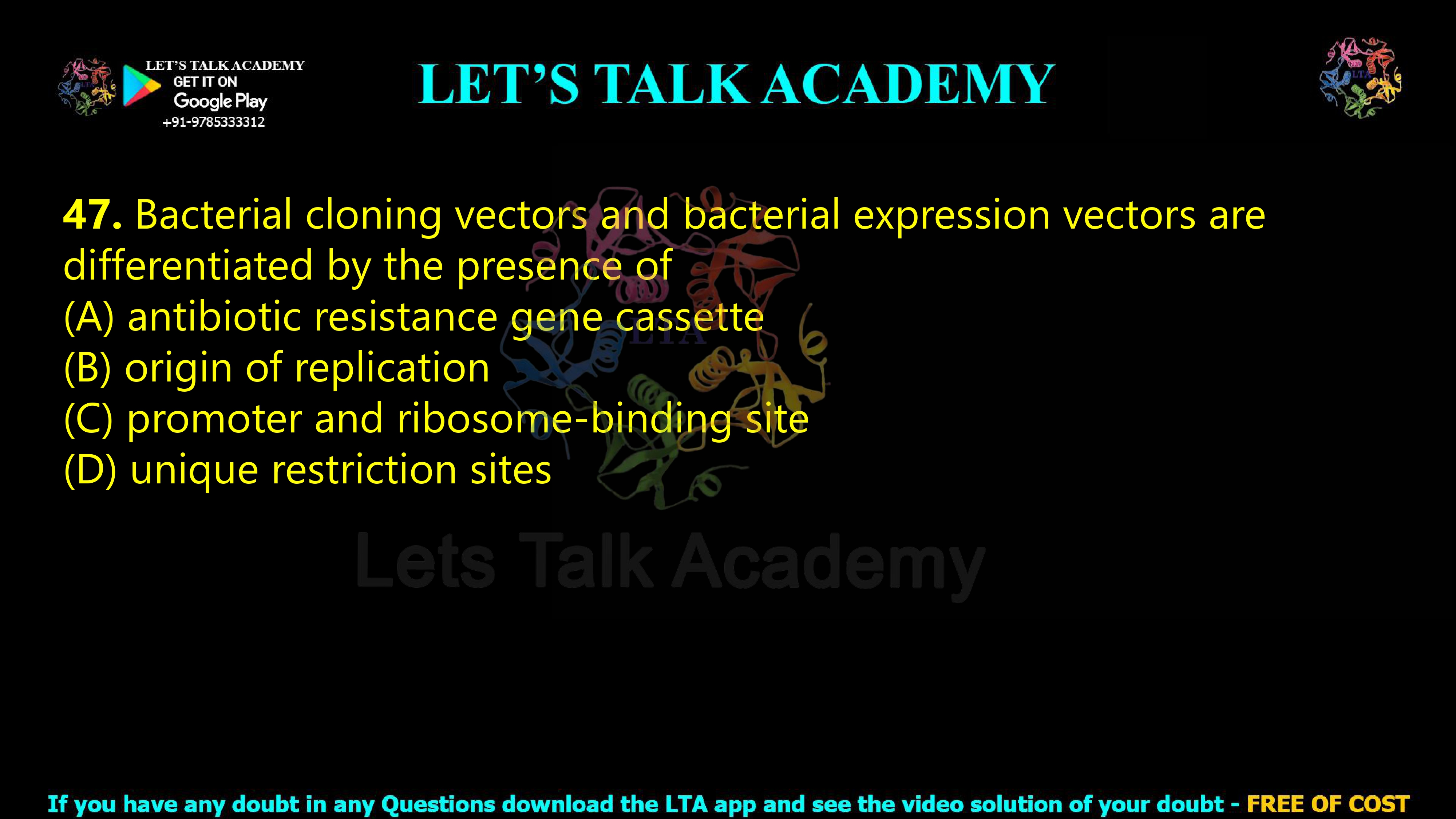
46. Bacterial cloning vectors and bacterial expression vectors are differentiated by the presence of
(A) antibiotic resistance gene cassette
(B) origin of replication
(C) promoter and ribosome-binding site
(D) unique restriction sites
Bacterial Cloning Vectors and Bacterial Expression Vectors: What Differentiates Them?
Correct Answer
Correct Option: (C) Promoter and ribosome-binding site
Bacterial cloning vectors and bacterial expression vectors are primarily differentiated by the presence of regulatory sequences required for gene expression. A basic cloning vector is designed mainly to carry, maintain, and amplify a foreign DNA fragment inside a bacterial host. In contrast, a bacterial expression vector is designed not only to carry a foreign gene but also to produce its RNA and usually its protein product.
For efficient production of a recombinant protein in bacteria, the inserted coding sequence must be transcribed into messenger RNA and the resulting mRNA must be translated by bacterial ribosomes. A bacterial expression vector therefore contains a suitable promoter to initiate transcription and a ribosome-binding site to facilitate translation initiation.
Antibiotic resistance genes, origins of replication, and unique restriction sites may be present in both cloning vectors and expression vectors. Therefore, these features do not provide the fundamental distinction between the two types of vectors.
Final Answer: (C) Promoter and ribosome-binding site
Understanding the Basic Difference Between Cloning and Expression Vectors
Vectors are DNA molecules used to carry foreign genetic material into a host cell. Plasmids are among the most widely used bacterial vectors because they can replicate independently of the bacterial chromosome and can be manipulated relatively easily in the laboratory.
However, not every vector is designed for the same purpose. A cloning vector is primarily used to introduce a DNA fragment into a host cell so that the fragment can be maintained and amplified. The main objective is to obtain many copies of the inserted DNA. Production of the protein encoded by that DNA is not necessarily required.
An expression vector, on the other hand, is specifically engineered to allow an inserted gene to be expressed in the host cell. In a bacterial expression system, this usually means that the foreign gene must first be transcribed into mRNA and then translated into protein.
Therefore, an expression vector requires additional regulatory elements that ensure efficient transcription and translation. The two elements highlighted in this question are the promoter and the ribosome-binding site.
What Is a Bacterial Cloning Vector?
A bacterial cloning vector is a DNA molecule designed primarily for the propagation of an inserted DNA fragment in a bacterial host. After the foreign DNA is inserted into the vector, the recombinant DNA molecule is introduced into bacterial cells. As the bacteria grow and divide, the vector replicates, producing many copies of the inserted DNA sequence.
A functional bacterial cloning vector generally requires an origin of replication so that it can replicate inside the host, a selectable marker so that cells containing the vector can be identified, and suitable restriction sites or a multiple cloning site for insertion of foreign DNA.
These components are sufficient when the main objective is DNA cloning. The inserted sequence does not necessarily need to be actively transcribed or translated.
What Is a Bacterial Expression Vector?
A bacterial expression vector contains the basic features needed for vector maintenance and DNA cloning, but it also includes regulatory sequences that allow the inserted coding sequence to be expressed efficiently in bacterial cells.
To produce a recombinant protein, the gene must be positioned correctly relative to transcriptional and translational control elements. A suitable promoter is required so that bacterial RNA polymerase can transcribe the inserted gene. A suitable ribosome-binding site is required so that the bacterial ribosome can recognize the mRNA and initiate translation.
Thus, a bacterial expression vector can be understood as a vector specifically engineered to convert genetic information in the inserted gene into a functional gene product.
The essential conceptual difference is:
Cloning vector → designed primarily for DNA propagation
Expression vector → designed for production of RNA and usually protein from the inserted gene
Why the Promoter Is Essential in a Bacterial Expression Vector
Role of the Promoter in Transcription
A promoter is a regulatory DNA sequence located upstream of a gene. It provides a site where the transcription machinery can assemble and initiate RNA synthesis. In bacteria, RNA polymerase, together with the appropriate sigma factor, recognizes promoter sequences and begins transcription.
If a foreign coding sequence is inserted into a vector without an appropriate promoter, the bacterial transcription machinery may not efficiently produce mRNA from that gene. The DNA may be successfully cloned and maintained in the cell, but the desired protein may not be produced.
An expression vector therefore places the gene of interest under the control of a promoter that functions in the bacterial host. Depending on the design of the vector, the promoter may be constitutive or regulated.
Controlled Expression of Recombinant Proteins
Many bacterial expression vectors use regulated promoters because continuous production of a foreign protein can place a heavy metabolic burden on bacterial cells. Some recombinant proteins may also interfere with bacterial growth or become toxic when produced at high levels.
A regulated promoter allows the bacterial culture to grow before strong expression of the recombinant gene is initiated. Once sufficient cell density has been achieved, expression can be induced under suitable experimental conditions.
Therefore, the promoter is a defining functional component of an expression vector because it controls transcription of the inserted gene.
Why the Ribosome-Binding Site Is Essential in a Bacterial Expression Vector
Role of the Ribosome-Binding Site in Translation
Transcription alone is not sufficient for protein production. After mRNA has been synthesized, the bacterial ribosome must bind to the mRNA and identify the correct position at which translation should begin.
The ribosome-binding site, commonly associated with the Shine-Dalgarno sequence in bacteria, is located upstream of the translation initiation codon. It helps position the ribosome correctly on the mRNA so that protein synthesis can begin at the appropriate start codon.
Without a functional ribosome-binding site, an mRNA molecule may be produced, but translation can be inefficient or may fail to initiate effectively. Therefore, the presence of an appropriate ribosome-binding site is a major characteristic of bacterial vectors designed for protein expression.
Relationship Between the Shine-Dalgarno Sequence and the Ribosome
The bacterial ribosome-binding site contains a sequence that can base-pair with a complementary region near the 3′ end of the 16S ribosomal RNA in the small ribosomal subunit. This interaction helps align the start codon in the correct position for translation initiation.
The spacing between the ribosome-binding site and the start codon is also important because proper positioning influences the efficiency of translation. Expression vectors are therefore designed so that the inserted coding sequence is placed in an appropriate context for efficient protein synthesis.
Why Option (C) Is Correct
Option (C), promoter and ribosome-binding site, is correct. These regulatory elements allow the inserted gene to progress through the two fundamental stages required for protein production.
The promoter controls the first stage:
DNA → mRNA through transcription
The ribosome-binding site supports the second stage:
mRNA → protein through translation
A conventional cloning vector is mainly intended to maintain and amplify DNA and therefore does not necessarily require regulatory elements arranged to express the inserted sequence. A bacterial expression vector is specifically constructed so that the inserted coding sequence can be transcribed and translated.
Therefore:
Promoter + ribosome-binding site = defining expression-related features
This makes option (C) the correct answer.
Detailed Explanation of Every Option
Option (A): Antibiotic Resistance Gene Cassette
Option (A) is incorrect. An antibiotic resistance gene is commonly used as a selectable marker. Its purpose is to help researchers identify bacterial cells that have successfully received the vector.
For example, if a plasmid carries a gene providing resistance to a particular antibiotic, transformed bacterial cells can be grown on a medium containing that antibiotic. Cells without the plasmid generally fail to grow, while cells containing the plasmid survive and form colonies.
However, antibiotic resistance genes are not unique to expression vectors. Both bacterial cloning vectors and bacterial expression vectors commonly contain selectable markers. In both cases, researchers need a method to identify cells that carry the vector.
A cloning vector may contain an antibiotic resistance gene even when the inserted DNA is not intended to produce any protein. Similarly, an expression vector may contain an antibiotic resistance marker to maintain selection for plasmid-containing cells.
Therefore:
Antibiotic resistance gene = selection of vector-containing cells
It does not provide the fundamental distinction between a cloning vector and an expression vector. Hence, option (A) is incorrect.
Option (B): Origin of Replication
Option (B) is incorrect. The origin of replication, often abbreviated as ori, is a DNA sequence that allows the vector to replicate inside the host cell.
Without a functional origin of replication, a conventional plasmid vector would not be stably propagated through repeated bacterial cell divisions. The vector could be lost because it would not be copied efficiently along with the host cell’s genetic material.
The origin of replication is therefore required in both ordinary bacterial cloning plasmids and bacterial expression plasmids. A cloning vector needs to replicate so that the inserted DNA can be amplified. An expression vector also needs to replicate and be maintained so that bacterial cells continue to carry the recombinant gene.
The origin of replication may also influence plasmid copy number and host compatibility, but it does not by itself cause expression of the inserted gene.
Therefore:
Origin of replication = vector replication and maintenance
Since both cloning and expression vectors generally require this feature, option (B) is incorrect.
Option (C): Promoter and Ribosome-Binding Site
Option (C) is correct. A promoter and ribosome-binding site are directly associated with expression of the inserted gene.
The promoter allows transcription of the inserted DNA into mRNA. The ribosome-binding site allows the bacterial translation machinery to recognize the mRNA and initiate protein synthesis efficiently. Together, these sequences provide the regulatory framework required for production of a recombinant protein.
A basic cloning vector is designed primarily for DNA amplification and does not necessarily contain a promoter and ribosome-binding site positioned appropriately for expression of the inserted gene. An expression vector must provide suitable expression signals if the goal is production of the encoded protein.
Therefore:
Promoter → transcription
Ribosome-binding site → translation initiation
Promoter + ribosome-binding site → expression of the inserted coding sequence
This is why option (C) is the correct answer.
Option (D): Unique Restriction Sites
Option (D) is incorrect. Unique restriction sites are DNA sequences recognized by specific restriction enzymes that occur only once within a vector. They provide convenient locations for inserting foreign DNA.
Many vectors contain a cluster of unique restriction sites known as a multiple cloning site or polylinker. This region allows researchers to choose from several restriction enzymes when designing a cloning experiment.
However, unique restriction sites are useful in both cloning vectors and expression vectors. A cloning vector needs a location for insertion of the DNA fragment to be propagated. An expression vector also needs a suitable cloning region so that the coding sequence can be inserted in the correct position relative to the promoter and translational control elements.
Therefore:
Unique restriction sites = insertion of foreign DNA
They do not represent the fundamental feature that differentiates a bacterial expression vector from a bacterial cloning vector. Hence, option (D) is incorrect.
Comparison of the Four Vector Components
The four features given in the question perform different functions. An antibiotic resistance gene provides selection, the origin of replication permits vector replication, unique restriction sites facilitate insertion of foreign DNA, and the promoter together with the ribosome-binding site allows expression of the inserted coding sequence.
The distinction becomes clear when each component is connected with its primary role:
Antibiotic resistance gene cassette → Selection
Origin of replication → Replication
Promoter and ribosome-binding site → Gene expression
Unique restriction sites → DNA insertion
Both cloning vectors and expression vectors need to be maintained in host cells and generally require methods for inserting DNA and selecting transformed cells. The distinctive additional requirement of an expression vector is the presence of regulatory elements that enable the inserted gene to be expressed.
Step-by-Step Analysis of the Question
Step 1: Identify the Purpose of a Cloning Vector
The primary function of a cloning vector is to carry and amplify a DNA fragment. Therefore, it requires features for replication, selection, and DNA insertion.
Step 2: Identify the Additional Purpose of an Expression Vector
An expression vector must do more than carry DNA. It must allow the genetic information within the inserted gene to be converted into a gene product, usually a recombinant protein.
Step 3: Determine Which Option Controls Gene Expression
An antibiotic resistance gene selects transformed cells, an origin of replication allows plasmid replication, and unique restriction sites allow insertion of DNA. None of these features directly provides transcription and translation of the inserted gene.
The promoter initiates transcription, while the ribosome-binding site supports translation initiation. Therefore, these are the features most directly associated with a bacterial expression vector.
Step 4: Select the Correct Answer
Because the promoter and ribosome-binding site provide the regulatory signals required for expression of the inserted gene, the correct answer is:
Option (C) Promoter and ribosome-binding site
How Gene Expression Occurs in a Bacterial Expression Vector
The process begins when bacterial RNA polymerase recognizes the promoter associated with the inserted gene. RNA polymerase then transcribes the coding sequence and produces an mRNA molecule.
The bacterial ribosome subsequently recognizes the ribosome-binding site on the mRNA. Correct interaction between the mRNA and the ribosomal machinery positions the translation initiation region appropriately. Translation begins at the start codon, and the amino acid sequence encoded by the inserted gene is synthesized.
The overall process can therefore be represented as:
Promoter → Transcription → mRNA → Ribosome-binding site → Translation → Recombinant protein
This complete pathway explains why expression vectors require regulatory elements that ordinary DNA cloning alone does not necessarily require.
Essential Features of a Typical Bacterial Expression Vector
A typical bacterial expression vector combines features required for plasmid maintenance with features required for gene expression. The origin of replication allows the plasmid to replicate in the bacterial host, while a selectable marker helps identify and maintain cells containing the plasmid.
A cloning region permits insertion of the coding sequence. The expression system then requires a suitable promoter and a bacterial ribosome-binding site. Many expression vectors also contain additional regulatory features depending on their experimental purpose, such as transcription termination signals or sequences encoding affinity tags.
The central point is that the promoter and ribosome-binding site distinguish a vector designed to express an inserted coding sequence from a vector intended mainly for DNA propagation.
Why Both Cloning and Expression Vectors Can Have an Origin of Replication
The presence of an origin of replication does not indicate whether a plasmid is a cloning vector or an expression vector. It simply allows the plasmid to be copied inside a compatible bacterial host.
A cloning vector requires replication because the objective is to amplify the inserted DNA. An expression vector also requires replication and stable maintenance so that the host cells retain the gene that is being expressed.
Therefore, the origin of replication is a fundamental plasmid maintenance element rather than a specific expression element.
Why Both Cloning and Expression Vectors Can Have Selectable Markers
After transformation, only a fraction of bacterial cells may successfully receive the vector. Researchers therefore require a method to distinguish vector-containing cells from cells that did not take up the DNA.
Selectable markers, including antibiotic resistance genes, solve this problem. Because both cloning experiments and protein expression experiments require identification and maintenance of transformed cells, selectable markers are commonly found in both types of vectors.
Thus, the presence of an antibiotic resistance gene does not specifically indicate that a vector is an expression vector.
Why Both Cloning and Expression Vectors Can Have Unique Restriction Sites
Foreign DNA must be introduced into a suitable position within the vector. Unique restriction sites provide convenient locations for opening the vector and inserting the desired DNA fragment.
A cloning vector uses these sites to accept DNA that will be propagated. An expression vector uses them to accept a coding sequence that will be positioned relative to the promoter and translation control signals.
Therefore, unique restriction sites support recombinant DNA construction in both types of vectors and cannot serve as the primary distinguishing feature.
Cloning Vector Versus Expression Vector
The difference between these vectors is best understood by focusing on their final objective. A cloning vector answers the question, “Can the DNA fragment be carried and amplified?” An expression vector answers an additional question, “Can the inserted gene be actively expressed in the host?”
For simple DNA propagation, the vector needs to replicate, accept foreign DNA, and allow selection of cells carrying the recombinant molecule. For protein production, the vector must additionally provide the signals required to transcribe the gene and translate its mRNA.
Therefore, the promoter and ribosome-binding site represent the most important distinguishing features among the options provided.
Importance of Bacterial Expression Vectors in Biotechnology
Bacterial expression vectors are widely used for recombinant protein production. A gene encoding a desired protein can be inserted downstream of an appropriate bacterial promoter and in the correct relationship to a ribosome-binding site. The recombinant plasmid is then introduced into a suitable bacterial host.
Once gene expression is activated under appropriate conditions, the bacterial cells produce the encoded protein. The protein can then be isolated and analyzed for research, industrial, diagnostic, or other biotechnological purposes.
The success of such a system depends heavily on effective transcription and translation. This is why promoters and ribosome-binding sites are central to the design of bacterial expression vectors.
Why This Question Is Important for Life Science and Biotechnology Exams
Questions comparing cloning vectors and expression vectors frequently appear in molecular biology and biotechnology examinations because they test whether students understand the function of individual vector components.
This topic is especially relevant for CSIR NET Life Science, DBT JRF, GATE Biotechnology, IIT JAM Biotechnology, ICMR JRF, and other life science entrance examinations. Similar questions may ask about origins of replication, selectable markers, multiple cloning sites, promoters, operators, ribosome-binding sites, transcription terminators, fusion tags, and other components of recombinant DNA vectors.
The most effective approach is to connect each vector element with its function. An origin of replication is associated with replication, a selectable marker with selection, a restriction site with DNA insertion, a promoter with transcription, and a ribosome-binding site with translation initiation.
Concept Summary
A bacterial cloning vector is primarily designed to carry, maintain, and amplify foreign DNA. It commonly contains an origin of replication, a selectable marker such as an antibiotic resistance gene, and unique restriction sites for DNA insertion.
A bacterial expression vector contains these basic vector features but additionally provides regulatory elements required for expression of the inserted coding sequence. The promoter allows transcription of the gene into mRNA, while the ribosome-binding site allows efficient initiation of translation.
Since antibiotic resistance genes, origins of replication, and unique restriction sites may occur in both cloning and expression vectors, they do not provide the key distinction asked in the question.
Final Answer
Correct Option: (C) Promoter and ribosome-binding site
(A) Antibiotic resistance gene cassette — Incorrect, because it can be present in both cloning and expression vectors for selection.
(B) Origin of replication — Incorrect, because both types of vectors require replication and maintenance in the host.
(C) Promoter and ribosome-binding site — Correct, because these elements are required for transcription and translation of the inserted gene.
(D) Unique restriction sites — Incorrect, because both cloning and expression vectors can contain sites for insertion of foreign DNA.
Final Answer: (C) Promoter and ribosome-binding site


