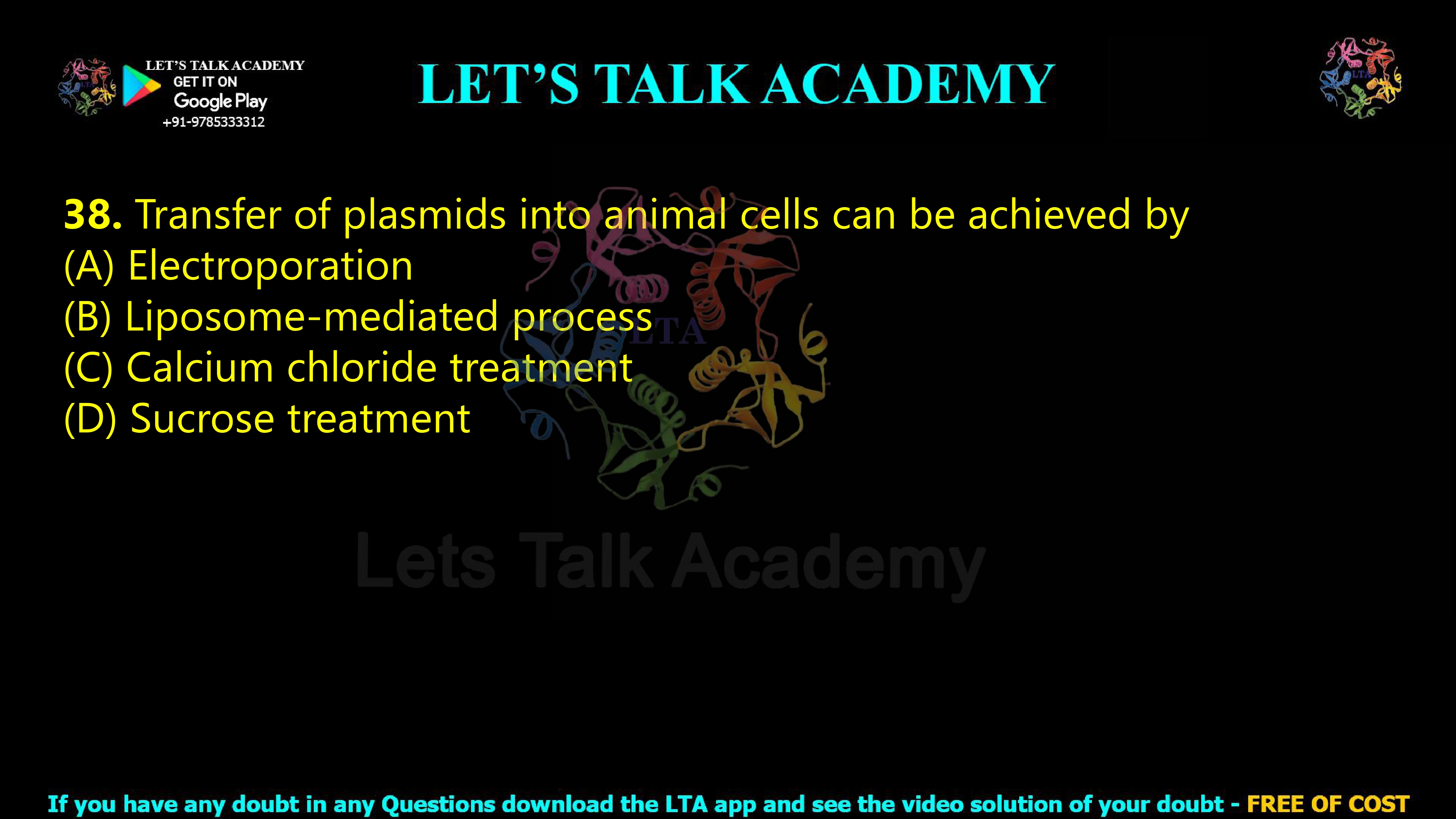
37. Transfer of plasmids into animal cells can be achieved by
(A) Electroporation
(B) Liposome-mediated process
(C) Calcium chloride treatment
(D) Sucrose treatment
Transfer of Plasmids into Animal Cells: Which Methods Are Used?
Detailed Explanation
The transfer of plasmid DNA into animal cells is an important technique in molecular biology, biotechnology, genetic engineering, and biomedical research. Plasmids are small, usually circular DNA molecules that can be engineered to carry a gene of interest. When researchers introduce a plasmid into an animal cell, the cell may express the gene carried by that plasmid, allowing scientists to study gene function, protein production, cellular pathways, and gene regulation.
Among the methods listed in this question, electroporation and the liposome-mediated process can be used to transfer plasmids into animal cells. Both techniques help plasmid DNA cross the plasma membrane, which normally acts as a major barrier to the entry of large, negatively charged DNA molecules.
Electroporation uses short electrical pulses to temporarily increase the permeability of the cell membrane, whereas the liposome-mediated process packages or complexes DNA with lipid-based particles that facilitate its entry into the cell. Therefore, options (A) and (B) are correct.
Why Is Electroporation Used to Transfer Plasmids into Animal Cells?
Option (A): Electroporation — Correct
Electroporation is a widely used physical method for introducing plasmid DNA and other molecules into animal cells. The technique is based on the application of short, controlled electrical pulses to cells suspended in a suitable solution containing the DNA that needs to be transferred.
The plasma membrane of an animal cell is composed mainly of a phospholipid bilayer. Under normal conditions, this membrane prevents large and highly charged molecules such as plasmid DNA from freely entering the cell. During electroporation, an external electric field temporarily disrupts the organization of the cell membrane and increases its permeability.
This transient increase in membrane permeability allows plasmid DNA present in the surrounding medium to enter the cell. After the electrical pulse is removed, the membrane can reseal, trapping some of the introduced DNA inside the cell. The transferred plasmid may then reach the nucleus, where the gene carried by the plasmid can be expressed.
Electroporation is particularly useful because it can be applied to many different types of animal cells. It is often used for cells that are difficult to transfect efficiently using chemical methods. Researchers may use electroporation to introduce plasmid DNA, RNA, proteins, and other macromolecules into cells.
The efficiency of electroporation depends on several factors, including the strength of the electric field, pulse duration, number of pulses, cell type, DNA concentration, and composition of the electroporation medium. If the electrical conditions are too weak, plasmid entry may be inefficient. If the conditions are too harsh, excessive membrane damage can reduce cell survival.
Despite this limitation, electroporation remains an important and effective method of plasmid transfer into animal cells. Therefore, option (A) is correct.
How Does the Liposome-Mediated Process Transfer Plasmids into Animal Cells?
Option (B): Liposome-Mediated Process — Correct
The liposome-mediated process is another widely used method for transferring plasmid DNA into animal cells. This method is commonly associated with lipofection, a form of chemical transfection in which lipid-based materials help DNA cross the cell membrane.
Liposomes are small vesicular structures composed of lipid molecules. Because the plasma membrane of animal cells is also primarily composed of lipids, lipid-based delivery systems can interact efficiently with the cell surface.
Plasmid DNA carries a negative charge because of the phosphate groups present in its backbone. In many transfection procedures, positively charged or cationic lipids interact with the negatively charged DNA and form lipid–DNA complexes. These complexes are often called lipoplexes.
The lipid–DNA complexes interact with the plasma membrane and can enter the animal cell through processes such as endocytosis. After entering the cell, the DNA must escape from intracellular vesicles and eventually reach the nucleus. Once the plasmid DNA reaches the appropriate cellular compartment, the gene present on the plasmid can be expressed.
Liposome-mediated transfection is popular in animal cell culture because it is relatively convenient and does not require the application of electrical pulses. It is widely used for gene expression studies, reporter gene assays, analysis of protein function, gene regulation experiments, and many other applications in molecular and cellular biology.
The efficiency of liposome-mediated plasmid transfer depends on factors such as the type of lipid reagent, amount of DNA, ratio of lipid to DNA, cell type, cell density, and incubation conditions. Nevertheless, it is one of the standard methods used to introduce plasmid DNA into animal cells.
Therefore, option (B) is correct.
Why Is Calcium Chloride Treatment Not the Correct Answer?
Option (C): Calcium Chloride Treatment — Incorrect
Calcium chloride treatment is a classical technique mainly associated with the introduction of plasmid DNA into bacterial cells, especially Escherichia coli. It is not a standard method for transferring plasmids into animal cells.
In bacterial transformation, cells are treated with calcium chloride to make them competent for DNA uptake. Both DNA and the bacterial cell surface carry negative charges, which can create electrostatic repulsion. Calcium ions help reduce this repulsion and facilitate the interaction between plasmid DNA and the bacterial cell surface.
The calcium chloride-treated bacterial cells are commonly subjected to a brief heat shock. This process promotes the uptake of plasmid DNA into the bacterial cells. After recovery in a suitable growth medium, the transformed bacteria can be selected using an appropriate selectable marker, such as an antibiotic resistance gene carried by the plasmid.
The key point is that the classical calcium chloride treatment followed by heat shock is primarily a bacterial transformation method. Animal cells have a fundamentally different membrane structure and cellular organization, so this standard bacterial transformation protocol is not used as the conventional method for plasmid delivery into animal cells.
Animal cell plasmid transfer is more commonly achieved by techniques such as electroporation, lipid-mediated transfection, calcium phosphate-mediated transfection, microinjection, or viral delivery systems. Calcium chloride treatment should not be confused with calcium phosphate transfection, which is a distinct method that can be used with animal cells.
Therefore, option (C) is incorrect.
Why Is Sucrose Treatment Not Used for Plasmid Transfer into Animal Cells?
Option (D): Sucrose Treatment — Incorrect
Sucrose treatment is not a standard method for transferring plasmid DNA into animal cells. Sucrose is commonly used in biological laboratories for purposes related to osmotic balance, density gradients, cell fractionation, and the separation of cellular components.
For example, sucrose density gradient centrifugation can be used to separate organelles, macromolecular complexes, ribosomal particles, viruses, and other biological materials according to differences in their density or sedimentation properties. Sucrose may also be included in buffers to help maintain appropriate osmotic conditions.
However, simply treating animal cells with sucrose does not provide a standard mechanism for efficiently introducing plasmid DNA across the plasma membrane and into the cell. Unlike electroporation, sucrose treatment does not use an electrical field to transiently permeabilize the membrane. Unlike liposome-mediated transfection, it does not form lipid–DNA complexes that facilitate cellular uptake.
Therefore, sucrose treatment is not considered a standard plasmid transfer method for animal cells, making option (D) incorrect.
Electroporation vs Liposome-Mediated Plasmid Transfer
Electroporation and liposome-mediated transfection achieve the same broad objective but use fundamentally different mechanisms. Electroporation is a physical gene transfer method because electrical pulses are used to increase membrane permeability. The liposome-mediated process is a chemical or lipid-based transfection method because lipid complexes facilitate the cellular uptake of plasmid DNA.
During electroporation, cells and plasmid DNA are exposed to carefully controlled electrical pulses. These pulses transiently increase membrane permeability and allow DNA to enter the cell. In liposome-mediated transfection, plasmid DNA forms complexes with lipid molecules, and these complexes interact with the cell membrane and enter the cell, often through endocytic pathways.
Both methods are widely relevant to animal cell research. The choice between them depends on the type of cells being used, the desired transfection efficiency, cell viability, experimental conditions, and the purpose of the study.
Transformation and Transfection: An Important Difference
The terminology used for DNA transfer can sometimes create confusion. The introduction of foreign DNA into bacterial cells is generally called transformation, whereas the introduction of nucleic acids into animal or other eukaryotic cells is commonly called transfection.
For example, the calcium chloride and heat-shock method is widely used for the transformation of bacterial cells with plasmid DNA. In contrast, electroporation and lipid-mediated methods are commonly used for the transfection of animal cells.
Electroporation is versatile because it can be used with both prokaryotic and eukaryotic cells under appropriate conditions. Liposome-mediated transfection, however, is especially associated with nucleic acid delivery into eukaryotic cells, including cultured animal cells.
Final Answer
The transfer of plasmids into animal cells can be achieved by electroporation and the liposome-mediated process.
Correct Option: (A) and (B)
Electroporation uses controlled electrical pulses to temporarily increase the permeability of the animal cell membrane, allowing plasmid DNA to enter. The liposome-mediated process uses lipid-based complexes to facilitate the delivery of plasmid DNA across the cell membrane. Calcium chloride treatment is primarily associated with bacterial transformation, while sucrose treatment is not a standard method for plasmid transfer into animal cells.


