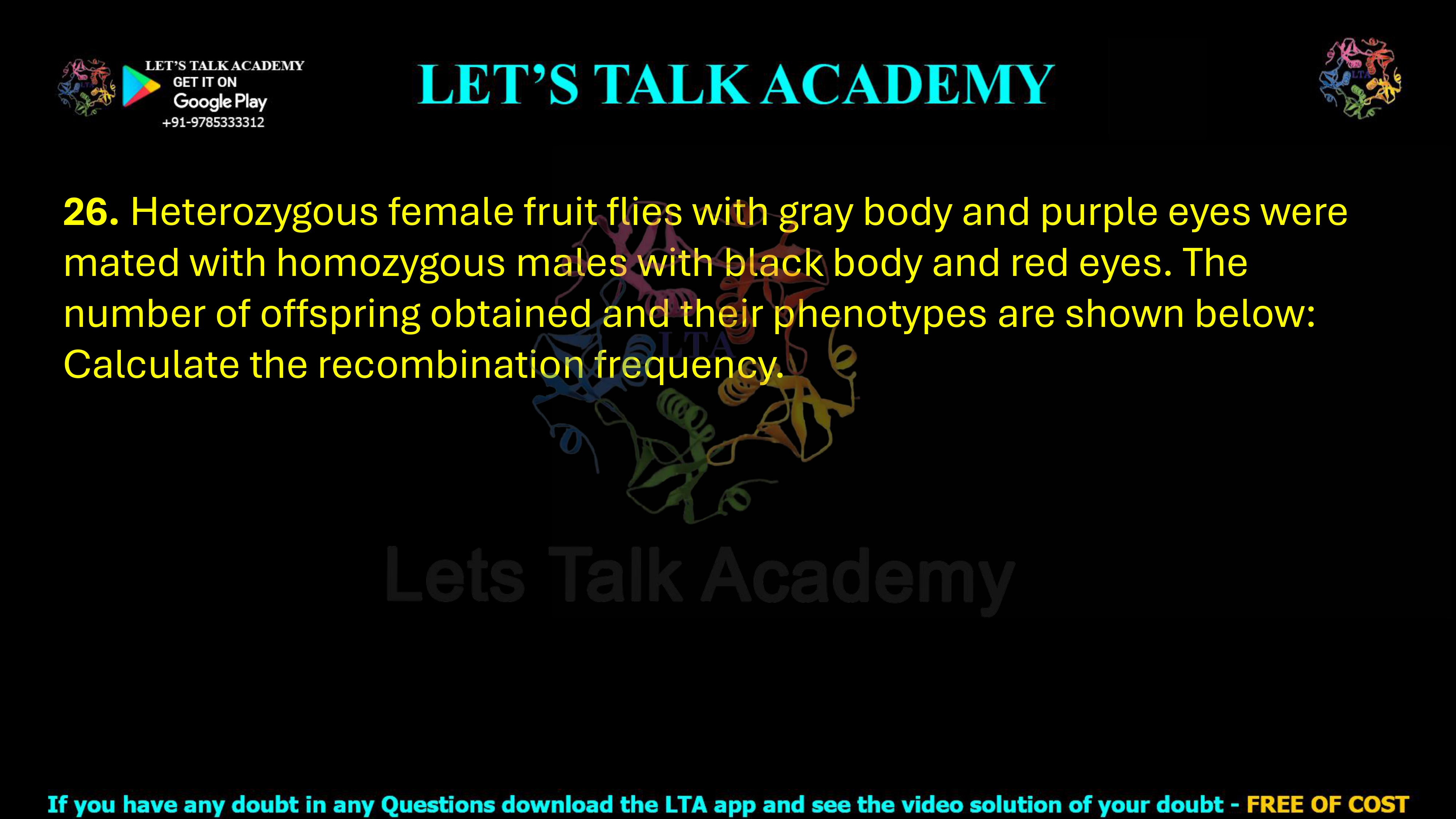
26. Heterozygous female fruit flies with gray body and purple eyes were mated with homozygous males with black body and red eyes. The number of offspring obtained and their phenotypes are shown below:
| Phenotype | Number of offspring |
|---|---|
| Gray body, Purple eyes | 300 |
| Black body, Red eyes | 347 |
| Gray body, Red eyes | 61 |
| Black body, Purple eyes | 55 |
Calculate the recombination frequency.
Recombination Frequency Calculation in a Test Cross of Fruit Flies
Introduction
Recombination frequency is one of the most fundamental concepts in classical genetics because it allows geneticists to determine how far apart two genes are located on the same chromosome. During meiosis, homologous chromosomes exchange corresponding segments through a process called crossing over. This exchange creates new combinations of alleles known as recombinant chromosomes. The greater the distance between two genes, the higher the probability that crossing over will occur between them, resulting in a higher recombination frequency.
The fruit fly Drosophila melanogaster has served as one of the most important model organisms in genetics. Thomas Hunt Morgan first demonstrated genetic linkage using Drosophila and established that genes located on the same chromosome are inherited together more frequently than genes located on different chromosomes. Today, recombination frequency remains the basis of genetic linkage mapping and chromosome analysis.
In a test cross, a heterozygous individual is crossed with a homozygous recessive individual. Since the recessive parent contributes only recessive alleles, the phenotype of every offspring directly reflects the gamete produced by the heterozygous parent. This makes the test cross the most powerful method for estimating recombination frequency and identifying linked genes.
Correct Answer
Correct Answer: 15.2% (approximately 15 cM)
Detailed Explanation
In a linkage analysis, the offspring occurring in the highest numbers are considered the parental (non-recombinant) classes because they retain the original combination of alleles inherited from the parents. Offspring occurring in smaller numbers arise due to crossing over during meiosis and are called recombinant classes.
From the given data, the two largest classes are:
- Gray body, Purple eyes = 300
- Black body, Red eyes = 347
These represent the parental combinations.
The two smaller classes are:
- Gray body, Red eyes = 61
- Black body, Purple eyes = 55
These represent recombinant offspring produced because of crossing over between the linked genes.
Step-by-Step Calculation
Step 1: Calculate Total Recombinant Offspring
Recombinant offspring = 61 + 55 = 116
Step 2: Calculate Total Number of Offspring
Total offspring = 300 + 347 + 61 + 55 = 763
Step 3: Apply the Formula
Recombination Frequency (%) = (Recombinant Offspring / Total Offspring) × 100
= (116 / 763) × 100
= 15.20%
Therefore, the recombination frequency is:
15.2%
Calculation Summary
| Parameter | Value |
|---|---|
| Parental Offspring | 300 + 347 = 647 |
| Recombinant Offspring | 61 + 55 = 116 |
| Total Offspring | 763 |
| Recombination Frequency | 15.20% |
| Genetic Distance | 15.2 cM |
Formula Used
Recombination Frequency (%) =
(Number of Recombinant Offspring ÷ Total Number of Offspring) × 100
Identification of Parental and Recombinant Types
| Phenotype | Classification | Reason |
|---|---|---|
| Gray body, Purple eyes | Parental | High frequency |
| Black body, Red eyes | Parental | High frequency |
| Gray body, Red eyes | Recombinant | Produced by crossing over |
| Black body, Purple eyes | Recombinant | Produced by crossing over |
Relationship Between Recombination Frequency and Map Distance
| Recombination Frequency | Genetic Distance |
|---|---|
| 1% | 1 centimorgan (1 cM) |
| 10% | 10 cM |
| 15.2% | 15.2 cM |
| 20% | 20 cM |
| 50% | Independent assortment |
Why Do Recombinant Offspring Appear Less Frequently?
Linked genes are located on the same chromosome and therefore tend to be inherited together. Recombinant offspring are produced only when crossing over occurs between the linked genes during Prophase I of meiosis. Since crossing over is less frequent than normal chromosome segregation, recombinant phenotypes are generally observed in smaller numbers than parental phenotypes. The closer two genes are on a chromosome, the lower the recombination frequency and the stronger their genetic linkage.
Biological Significance
Recombination is one of the primary mechanisms responsible for generating genetic variation in sexually reproducing organisms. It produces new allele combinations that contribute to adaptation and evolution while also providing a powerful tool for genetic mapping. By measuring recombination frequencies, scientists can estimate the relative positions of genes on chromosomes, identify disease-associated genes, assist plant and animal breeding programmes, and construct detailed linkage maps used in modern genomics.
Final Answer
Recombinant offspring = 61 + 55 = 116
Total offspring = 763
Recombination Frequency = (116 ÷ 763) × 100
= 15.20%
Genetic Distance = 15.2 centimorgans (cM)
Correct Answer: 15.2% (approximately 15 cM)


