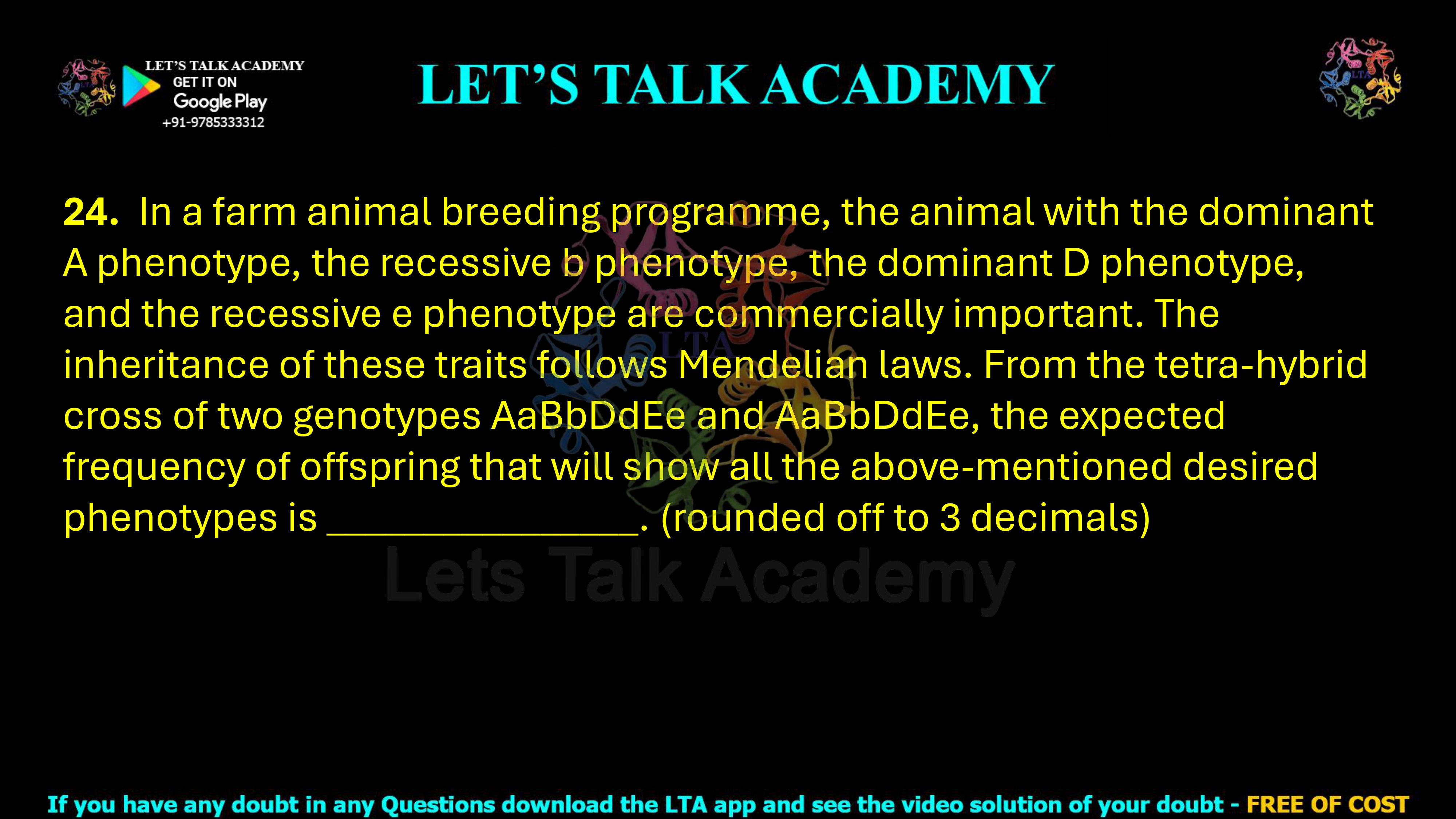
24. In a farm animal breeding programme, the animal with the dominant A phenotype, the recessive b phenotype, the dominant D phenotype, and the recessive e phenotype are commercially important. The inheritance of these traits follows Mendelian laws. From the tetra-hybrid cross of two genotypes AaBbDdEe and AaBbDdEe, the expected frequency of offspring that will show all the above-mentioned desired phenotypes is ________________. (rounded off to 3 decimals)
Tetrahybrid Cross Probability Explained: Calculating the Frequency of Desired Offspring
Introduction
Mendel’s Law of Independent Assortment states that genes located on different chromosomes, or genes that are sufficiently far apart on the same chromosome, assort independently during gamete formation. This principle allows geneticists to calculate the probability of obtaining any desired combination of traits by multiplying the probabilities of each individual trait. Such probability-based questions are extremely common in competitive examinations because they test conceptual understanding of Mendelian inheritance rather than simple memorization.
In livestock and crop breeding, breeders often aim to combine several desirable dominant and recessive traits into a single individual. Instead of constructing enormous Punnett squares for multiple genes, probability rules provide a much faster and more efficient approach. In this question, four independently assorting genes are involved, making it a classic tetrahybrid probability problem.
Correct Answer
Correct Answer: 0.035
Detailed Explanation
Since the problem states that all traits follow Mendelian inheritance, each gene segregates independently. Therefore, the probability of obtaining the required phenotype for each gene can be calculated separately and then multiplied together according to the multiplication rule of probability.
The required phenotypes are:
- A (Dominant phenotype)
- bb (Recessive phenotype)
- D (Dominant phenotype)
- ee (Recessive phenotype)
Step 1: Probability of Dominant A Phenotype
Cross:
Aa × Aa
Phenotypic ratio:
3 Dominant : 1 Recessive
Therefore,
P(A−) = 3/4
Step 2: Probability of Recessive b Phenotype
Cross:
Bb × Bb
Only genotype bb expresses the recessive phenotype.
P(bb) = 1/4
Step 3: Probability of Dominant D Phenotype
Cross:
Dd × Dd
Phenotypic ratio:
3 Dominant : 1 Recessive
P(D−) = 3/4
Step 4: Probability of Recessive e Phenotype
Cross:
Ee × Ee
Only genotype ee produces the recessive phenotype.
P(ee) = 1/4
Step 5: Multiply the Independent Probabilities
Since all four genes assort independently:
Required Probability
= (3/4) × (1/4) × (3/4) × (1/4)
= 9/256
= 0.03515625
Rounded to three decimal places:
0.035
Step-by-Step Calculation
| Trait | Required Phenotype | Probability |
|---|---|---|
| A | Dominant | 3/4 |
| B | bb | 1/4 |
| D | Dominant | 3/4 |
| E | ee | 1/4 |
Total Probability
= (3/4) × (1/4) × (3/4) × (1/4)
= 9/256
= 0.03515625
Rounded Answer = 0.035
Calculation Summary
| Parameter | Value |
|---|---|
| Probability of A− | 3/4 |
| Probability of bb | 1/4 |
| Probability of D− | 3/4 |
| Probability of ee | 1/4 |
| Combined Probability | 9/256 |
| Decimal Frequency | 0.035 |
Why the Multiplication Rule is Used
According to Mendel’s Law of Independent Assortment, each gene pair segregates independently of the others. Therefore, the probability of obtaining multiple desired traits simultaneously is calculated by multiplying the individual probabilities. This rule greatly simplifies complex genetic calculations involving multiple genes.
General Formula for Independent Mendelian Traits
| Desired Phenotype | Probability from Heterozygous Cross |
|---|---|
| Dominant phenotype | 3/4 |
| Recessive phenotype | 1/4 |
| Dominant genotype (AA) | 1/4 |
| Heterozygous genotype (Aa) | 1/2 |
| Recessive genotype (aa) | 1/4 |
Applications in Animal Breeding
Probability calculations are extensively used in animal breeding programmes to predict the likelihood of obtaining offspring with economically valuable traits. By estimating expected frequencies before performing crosses, breeders can design efficient breeding strategies, reduce selection time, and improve desirable characteristics such as growth rate, milk production, disease resistance, fertility, and meat quality.
Biological Significance
Mendelian probability forms the mathematical basis of modern genetics. Whether predicting inherited diseases in humans, selecting superior crop varieties, or improving livestock breeds, probability calculations allow geneticists to estimate the expected distribution of traits in future generations. These principles remain fundamental to quantitative genetics, breeding programmes, and molecular genetics.
Final Answer
Required phenotype:
A− bb D− ee
Probability:
(3/4) × (1/4) × (3/4) × (1/4)
= 9/256
= 0.03515625
Rounded to three decimal places = 0.035
Correct Answer: 0.035


