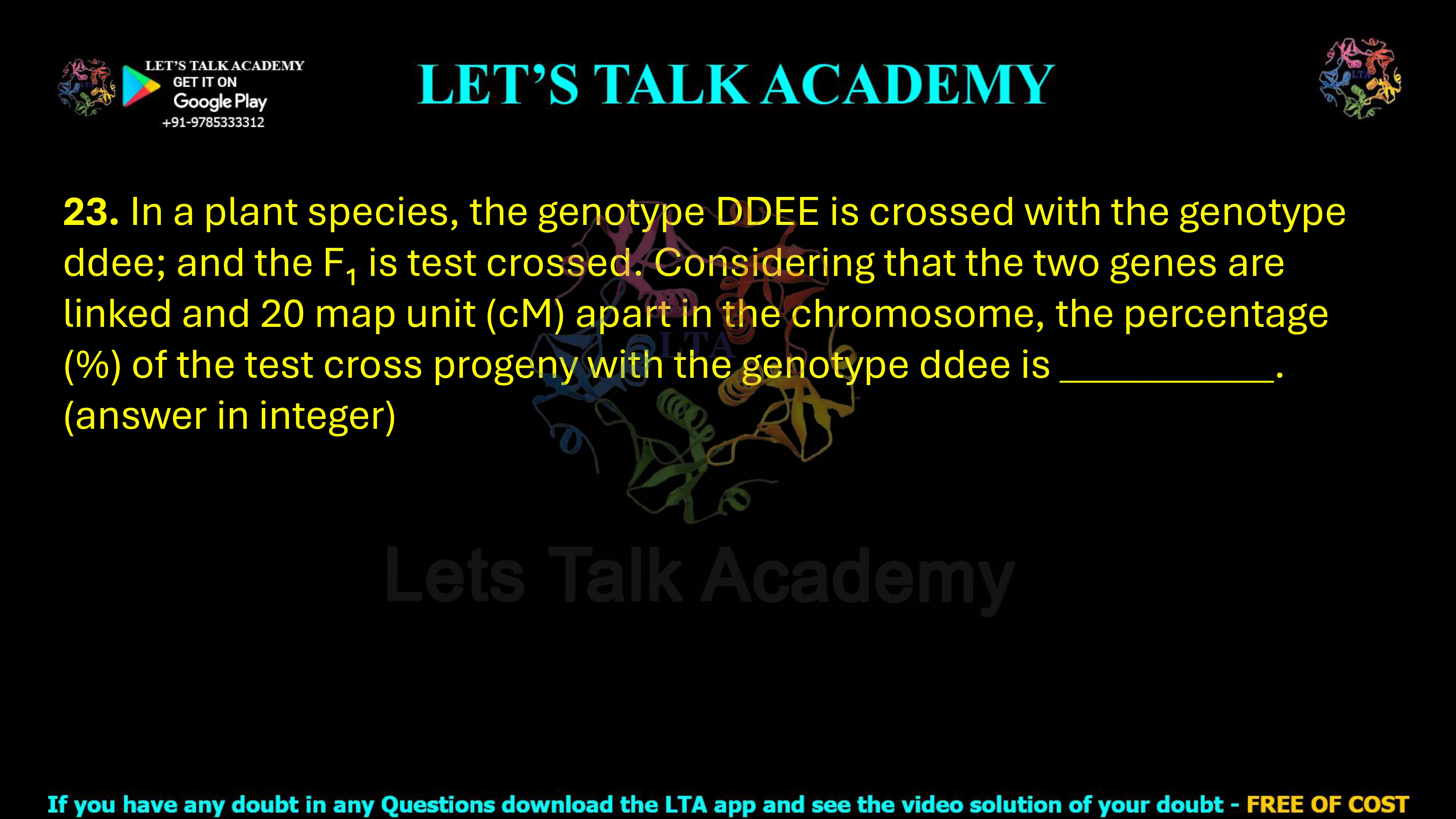
23. In a plant species, the genotype DDEE is crossed with the genotype ddee; and the F₁ is test crossed. Considering that the two genes are linked and 20 map unit (cM) apart in the chromosome, the percentage (%) of the test cross progeny with the genotype ddee is ___________. (answer in integer)
Linked Genes and Test Cross Explained: Calculating the Percentage of ddee Progeny
Introduction
Genetic linkage is one of the most important concepts in classical genetics because genes located on the same chromosome do not assort independently. Instead, they tend to be inherited together unless crossing over occurs during meiosis. The closer two genes are on a chromosome, the lower the probability that recombination will occur between them. This relationship forms the basis of genetic linkage mapping and chromosome analysis.
A test cross is an extremely useful genetic tool for studying linkage because it reveals the types and frequencies of gametes produced by a heterozygous individual. When a heterozygote is crossed with a homozygous recessive individual, the phenotype or genotype of the offspring directly reflects the gametes produced by the heterozygous parent. Therefore, linkage, recombination frequency, and gene order can all be determined using test cross data.
In this question, two linked genes are separated by 20 centimorgans (20 cM), meaning the recombination frequency between them is 20%. The remaining 80% of gametes are parental (non-recombinant).
Correct Answer
Correct Answer: 40%
Detailed Explanation
The parental cross is:
DDEE × ddee
The F₁ offspring receive one chromosome from each parent and therefore have the genotype:
DdEe
Since the dominant alleles originate from one parent and the recessive alleles originate from the other, the F₁ chromosomes are arranged in the coupling (cis) configuration:
DE / de
The F₁ individual is then test crossed with:
ddee
Because the recombination frequency between D and E is 20%, the proportion of recombinant gametes is 20%, while the remaining 80% are parental gametes.
Step 1: Calculate the Parental Gametes
The parental gametes are:
- DE
- de
Total parental gametes = 80%
Since both parental gametes occur equally:
DE = 40%
de = 40%
Step 2: Calculate the Recombinant Gametes
Total recombinant frequency = 20%
The recombinant gametes are:
- De
- dE
Each recombinant gamete occurs at:
10%
Step 3: Determine the ddee Offspring
The test cross parent (ddee) always contributes the gamete de.
To obtain offspring with genotype ddee, the F₁ parent must also contribute the de gamete.
The frequency of the de parental gamete is:
40%
Therefore,
Percentage of ddee progeny = 40%
Step-by-Step Calculation
Parental Cross
DDEE × ddee
F₁ = DE/de
Recombination Frequency
20 cM = 20% recombination
Gamete Distribution
| Gamete Type | Gamete | Frequency |
|---|---|---|
| Parental | DE | 40% |
| Parental | de | 40% |
| Recombinant | De | 10% |
| Recombinant | dE | 10% |
Test Cross
DE/de × de/de
The genotype ddee is produced only when the F₁ contributes the de gamete.
Percentage = 40%
Calculation Summary
| Parameter | Value |
|---|---|
| Distance Between Genes | 20 cM |
| Recombination Frequency | 20% |
| Parental Gametes | 80% |
| Each Parental Gamete | 40% |
| Percentage of ddee Offspring | 40% |
Relationship Between Map Distance and Recombination
| Map Distance | Recombination Frequency |
|---|---|
| 1 cM | 1% |
| 10 cM | 10% |
| 20 cM | 20% |
| 50 cM | Independent assortment |
Why Test Crosses are Important
Test crosses are widely used because they directly reveal the gametes produced by a heterozygous individual. They help geneticists estimate recombination frequencies, construct linkage maps, identify gene order, calculate crossover frequencies, and study chromosome behavior during meiosis. Since the recessive parent contributes only recessive alleles, every offspring genotype reflects the gamete contributed by the heterozygous parent.
Biological Significance
Genetic linkage demonstrates that genes located close together on the same chromosome tend to be inherited together. Crossing over introduces new allele combinations, increasing genetic variation while simultaneously allowing researchers to determine gene order and chromosome structure. Linkage analysis remains an essential tool in plant breeding, animal genetics, disease gene mapping, and genome research.
Final Answer
Given:
Genes linked = 20 cM apart
Recombination frequency = 20%
Parental gametes = 80%
Frequency of de parental gamete = 40%
Therefore, the percentage of test cross progeny with genotype ddee is:
40%
Correct Answer: 40%


