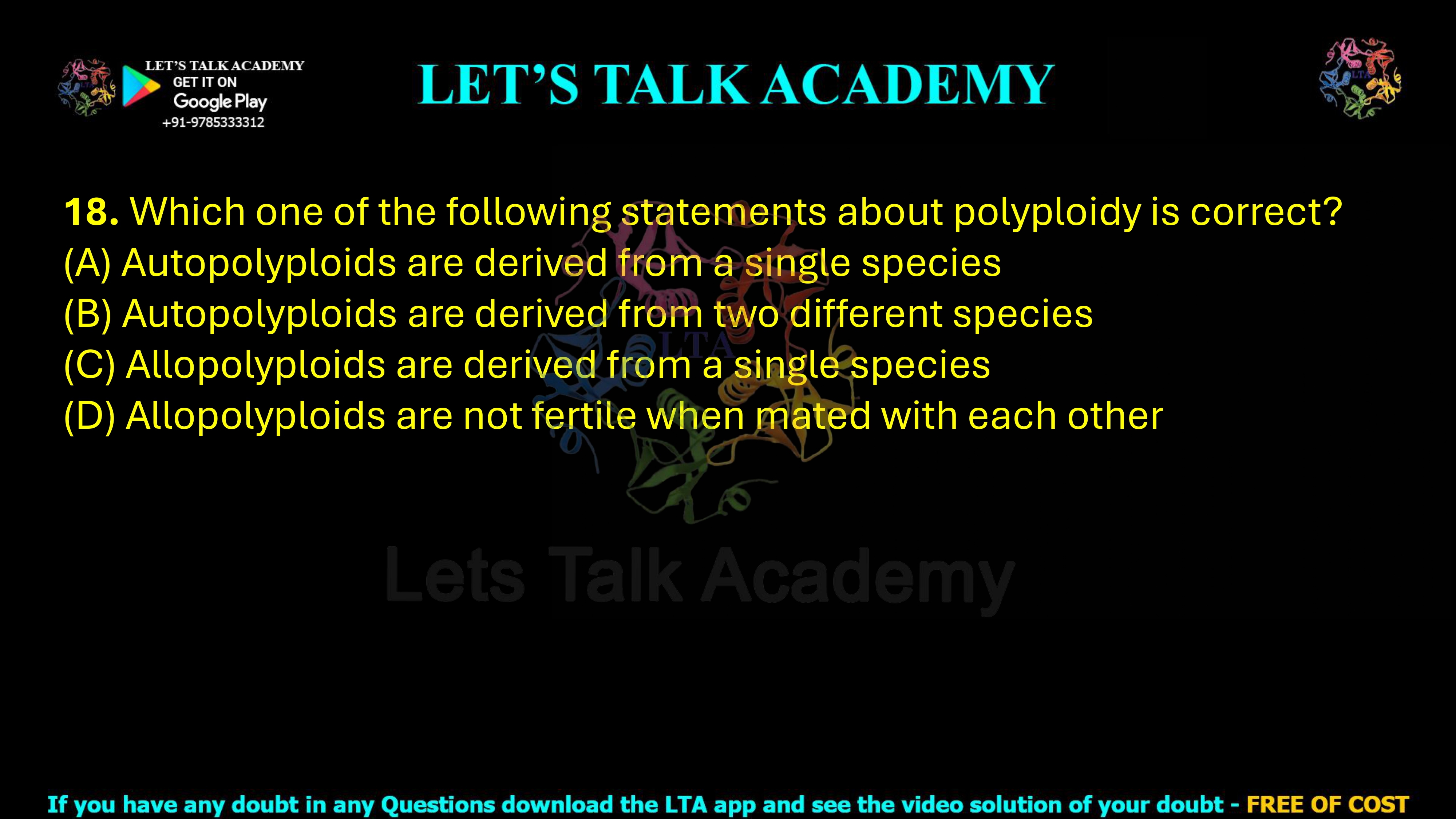
18. Which one of the following statements about polyploidy is correct?
(A) Autopolyploids are derived from a single species
(B) Autopolyploids are derived from two different species
(C) Allopolyploids are derived from a single species
(D) Allopolyploids are not fertile when mated with each other
Polyploidy Explained: Difference Between Autopolyploidy and Allopolyploidy
Introduction
Polyploidy is one of the most significant mechanisms of genome evolution, particularly in plants. It refers to the presence of more than two complete sets of chromosomes in an organism. While most animals are diploid (2n), many plant species naturally possess three, four, six, or even eight complete chromosome sets. Polyploidy has played a major role in the evolution of flowering plants, crop improvement, adaptation to different environments, and the origin of new species.
Based on the origin of the extra chromosome sets, polyploidy is classified into two major types: autopolyploidy and allopolyploidy. Understanding the difference between these two forms is essential because they differ in chromosome origin, meiotic behavior, fertility, and evolutionary significance.
Correct Answer
Correct Option: (A) Autopolyploids are derived from a single species
Detailed Explanation
Polyploid organisms possess multiple complete chromosome sets. When all chromosome sets originate from the same species, the organism is called an autopolyploid. Autopolyploids arise through chromosome duplication within a single species, usually due to errors in mitosis or meiosis that prevent chromosome separation. Since all chromosome sets are homologous, meiosis often produces multivalent chromosome pairing, which may reduce fertility in some cases.
In contrast, allopolyploids originate through hybridization between two different species. Initially, such hybrids are often sterile because chromosomes from the two species cannot pair properly during meiosis. However, if chromosome doubling occurs, each chromosome gains a homologous partner, restoring normal meiosis and fertility. Many economically important crops, including bread wheat, cotton, tobacco, and canola, are fertile allopolyploids.
Therefore, the defining characteristic of an autopolyploid is that all chromosome sets originate from a single species.
Understanding Autopolyploidy
An autopolyploid develops when the chromosome number doubles within the same species. This usually occurs because spindle fibers fail to separate chromosomes during cell division, resulting in unreduced gametes or chromosome doubling.
For example, if a diploid plant (2n) undergoes chromosome doubling, it becomes a tetraploid (4n) without involving another species.
Examples include:
- Potato
- Banana
- Alfalfa
- Sugarcane (partly autopolyploid)
Understanding Allopolyploidy
An allopolyploid originates when two closely related species hybridize. The hybrid initially contains one chromosome set from each parent and is often sterile because homologous chromosomes cannot pair properly during meiosis. Chromosome doubling restores homologous pairing and produces a fertile polyploid.
Classical examples include:
- Bread wheat (Triticum aestivum)
- Cotton (Gossypium hirsutum)
- Tobacco (Nicotiana tabacum)
- Triticale (Wheat × Rye)
Explanation of Each Option
Option (A): Autopolyploids are derived from a single species
This option is correct. Autopolyploids arise through chromosome duplication within a single species, resulting in multiple copies of the same genome.
Option (B): Autopolyploids are derived from two different species
This option is incorrect. Polyploids originating from two different species are called allopolyploids, not autopolyploids.
Option (C): Allopolyploids are derived from a single species
This option is incorrect. Allopolyploids always arise through hybridization between different species followed by chromosome doubling.
Option (D): Allopolyploids are not fertile when mated with each other
This option is incorrect. Once chromosome doubling restores homologous chromosome pairing, allopolyploids generally become fertile. Many agricultural crops are fertile allopolyploids and reproduce successfully.
Why Option (A) is Correct
The term autopolyploid literally means “many chromosome sets from the same species.” Since chromosome duplication occurs within a single species, all chromosome sets are genetically similar. Therefore, Option (A) correctly defines autopolyploidy.
Autopolyploidy vs Allopolyploidy
| Feature | Autopolyploid | Allopolyploid |
|---|---|---|
| Origin | Single species | Two or more different species |
| Genome Composition | Multiple identical genomes | Different parental genomes |
| Chromosome Pairing | Often multivalents | Mainly bivalents after chromosome doubling |
| Fertility | May be reduced | Usually restored after chromosome doubling |
| Example | Potato | Bread wheat |
Importance of Polyploidy
| Application | Significance |
|---|---|
| Plant Evolution | Formation of new species |
| Crop Improvement | Higher yield and larger fruits |
| Stress Tolerance | Improved environmental adaptation |
| Genetic Diversity | Increased variation for breeding |
| Agriculture | Development of superior cultivars |
Biological Significance
Polyploidy has been one of the most powerful evolutionary mechanisms in flowering plants. Whole-genome duplication provides additional copies of genes that can evolve new functions, increasing genetic diversity and adaptive potential. Many important food crops are polyploids because extra chromosome sets often result in larger plant organs, increased vigor, enhanced disease resistance, and improved productivity. Polyploidy has therefore played a central role in both natural evolution and modern plant breeding.
Final Answer
Autopolyploids originate through chromosome duplication within a single species, whereas allopolyploids arise through hybridization between different species followed by chromosome doubling.
Correct Option: (A) Autopolyploids are derived from a single species


