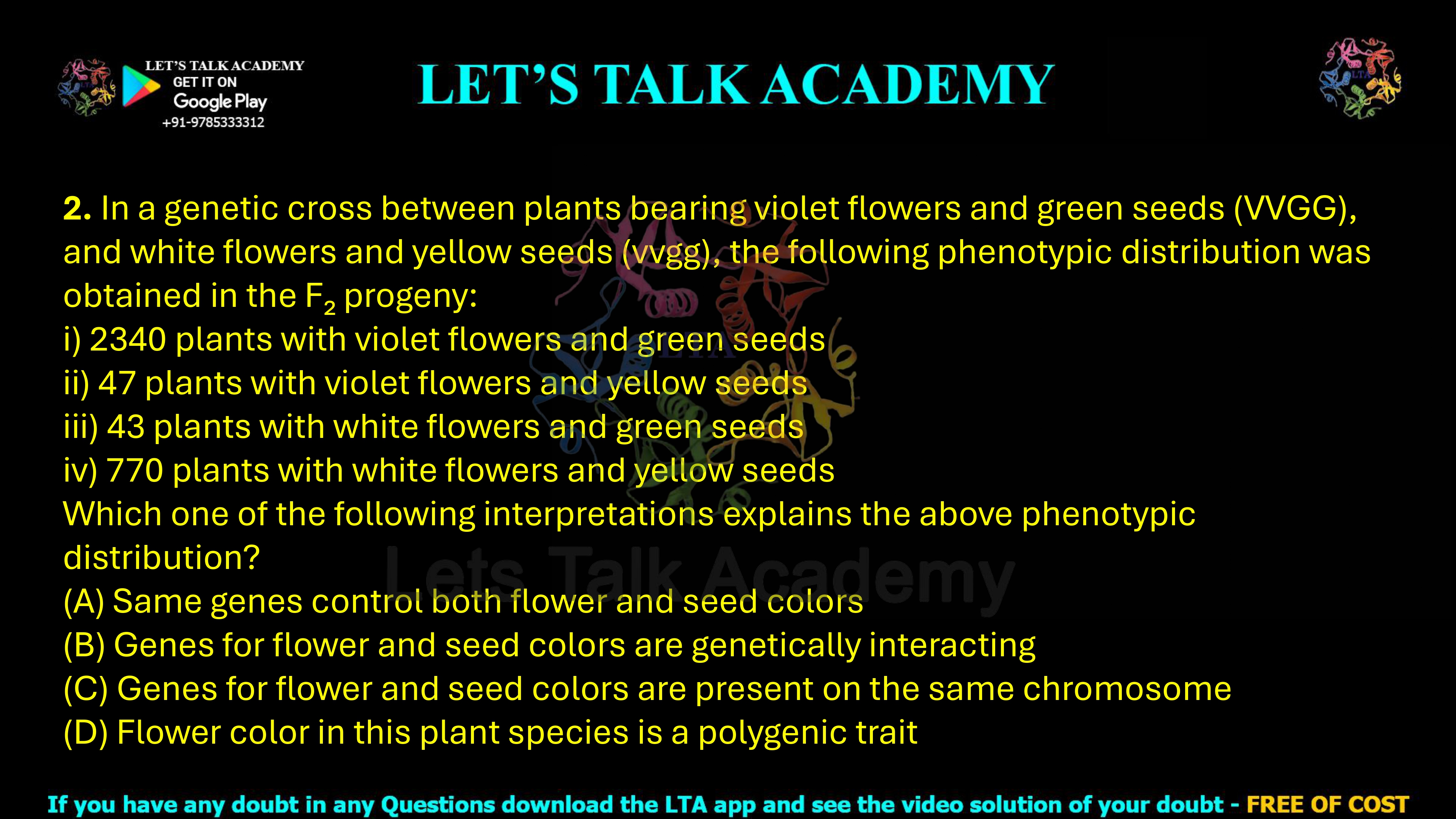
2. In a genetic cross between plants bearing violet flowers and green seeds (VVGG), and white flowers and yellow seeds (vvgg), the following phenotypic distribution was obtained in the F₂ progeny:
i) 2340 plants with violet flowers and green seeds
ii) 47 plants with violet flowers and yellow seeds
iii) 43 plants with white flowers and green seeds
iv) 770 plants with white flowers and yellow seeds
Which one of the following interpretations explains the above phenotypic distribution?
(A) Same genes control both flower and seed colors
(B) Genes for flower and seed colors are genetically interacting
(C) Genes for flower and seed colors are present on the same chromosome
(D) Flower color in this plant species is a polygenic trait
Genetic Linkage Explained: Interpretation of F₂ Phenotypic Distribution in a Dihybrid Cross
Introduction
One of the most important discoveries after Mendel’s laws was that not all genes assort independently. Mendel proposed the Law of Independent Assortment, which states that genes located on different chromosomes segregate independently during meiosis. However, later studies by Thomas Hunt Morgan demonstrated that genes located close together on the same chromosome tend to be inherited together. This phenomenon is known as genetic linkage.
Linked genes produce offspring that contain a much higher proportion of parental combinations than recombinant combinations. During meiosis, homologous chromosomes undergo crossing over, which can exchange DNA segments between chromosomes. When two genes are physically close to each other, crossing over between them occurs less frequently, resulting in fewer recombinant offspring. Therefore, analysis of phenotypic ratios in progeny is one of the most powerful methods for detecting linkage between genes.
Correct Answer
Correct Option: (C) Genes for flower and seed colors are present on the same chromosome
Detailed Explanation
If the genes controlling flower color and seed color assorted independently according to Mendel’s Second Law, the F₂ generation would approximately follow the classic 9:3:3:1 phenotypic ratio. However, the observed data show an overwhelming majority of the parental phenotypes and only a very small number of recombinant phenotypes.
The two parental phenotypes are:
- Violet flowers with green seeds = 2340 plants
- White flowers with yellow seeds = 770 plants
The recombinant phenotypes are:
- Violet flowers with yellow seeds = 47 plants
- White flowers with green seeds = 43 plants
The recombinant classes are extremely rare compared with the parental classes. Such a distribution is characteristic of genetic linkage, where two genes are located on the same chromosome and therefore tend to be inherited together. Only occasional crossing over during meiosis produces recombinant combinations.
If the genes were present on different chromosomes, recombinant phenotypes would occur much more frequently, producing ratios close to the Mendelian expectation. Therefore, the observed phenotypic distribution strongly indicates that the genes controlling flower color and seed color are linked.
Calculation of Recombinant Frequency
Total offspring = 2340 + 47 + 43 + 770 = 3200
Total recombinant offspring = 47 + 43 = 90
Recombination Frequency = (90 / 3200) × 100
Recombination Frequency = 2.81%
A recombination frequency of only about 2.8% indicates that the two genes are very closely linked on the same chromosome.
Explanation of Each Option
Option (A): Same Genes Control Both Flower and Seed Colors
This option is incorrect. Flower color and seed color are controlled by different genes. If a single gene controlled both traits, recombinant phenotypes would not appear at all.
Option (B): Genes for Flower and Seed Colors are Genetically Interacting
This option is incorrect. Gene interaction modifies phenotypic ratios such as 9:7, 12:3:1, or 9:3:4. It does not specifically produce an excess of parental combinations with very few recombinants.
Option (C): Genes for Flower and Seed Colors are Present on the Same Chromosome
This option is correct. Genes located on the same chromosome exhibit linkage and are inherited together, resulting in high parental frequencies and low recombinant frequencies.
Option (D): Flower Color in This Plant Species is a Polygenic Trait
This option is incorrect. Polygenic inheritance produces continuous variation rather than the four distinct phenotypic classes observed in this experiment.
Why Option (C) is Correct
The presence of overwhelmingly large parental classes and very small recombinant classes is the hallmark of genetic linkage. Since crossing over occurs only occasionally between closely linked genes, recombinant offspring remain rare. Therefore, the genes responsible for flower color and seed color must be located on the same chromosome.
Comparison of All Options
| Option | Interpretation | Status |
|---|---|---|
| A | Same gene controls both traits | Incorrect |
| B | Gene interaction | Incorrect |
| C | Genes are present on the same chromosome (Linkage) | Correct |
| D | Polygenic inheritance | Incorrect |
Parental and Recombinant Phenotypes
| Phenotype | Number of Plants | Type |
|---|---|---|
| Violet flowers + Green seeds | 2340 | Parental |
| White flowers + Yellow seeds | 770 | Parental |
| Violet flowers + Yellow seeds | 47 | Recombinant |
| White flowers + Green seeds | 43 | Recombinant |
Genetic Linkage vs Independent Assortment
| Feature | Independent Assortment | Genetic Linkage |
|---|---|---|
| Chromosomal Location | Different chromosomes | Same chromosome |
| Parental Phenotypes | Normal frequency | Very high frequency |
| Recombinant Phenotypes | Common | Rare |
| Crossing Over | No effect on inheritance | Produces recombinants |
| Typical Ratio | 9:3:3:1 | Deviation from Mendelian ratio |
Biological Significance
Genetic linkage is one of the foundations of modern genetics because it allows scientists to determine the physical arrangement of genes on chromosomes. Measuring recombination frequencies enables construction of genetic linkage maps, identification of disease-associated genes, marker-assisted breeding in agriculture, and understanding of chromosome behavior during meiosis. Linkage analysis remains an indispensable tool in medical genetics, plant breeding, evolutionary biology, and genomics.
Final Answer
The observed F₂ population contains overwhelmingly high numbers of parental phenotypes and very few recombinant phenotypes, indicating that the genes controlling flower color and seed color are genetically linked and located on the same chromosome.
Correct Option: (C) Genes for flower and seed colors are present on the same chromosome


