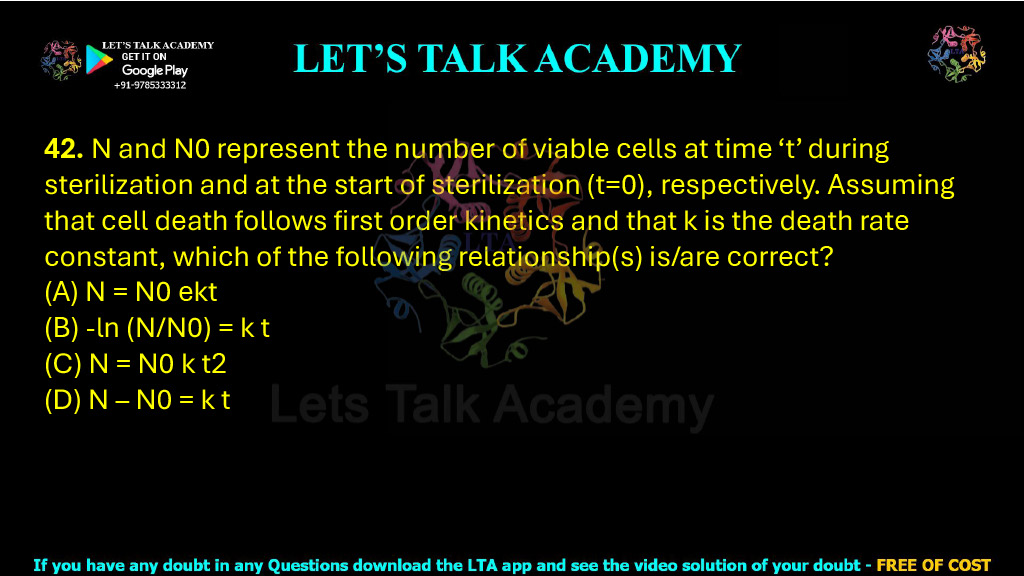
42. N and N0 represent the number of viable cells at time ‘t’ during sterilization and at the start of sterilization (t=0), respectively. Assuming that cell death follows first order kinetics and that k is the death rate constant, which of the following relationship(s) is/are correct?
(A) N = N0 ekt
(B) -ln (N/N0) = k t
(C) N = N0 k t2
(D) N – N0 = k t
First-Order Cell Death Kinetics During Sterilization: Relationship Between Viable Cell Number and Death Rate Constant
Introduction
Sterilization is one of the most important processes in microbiology, biotechnology, pharmaceutical production, food technology, and healthcare. The primary objective of sterilization is to destroy all viable microorganisms, including vegetative cells, spores, fungi, and viruses, thereby ensuring complete microbial safety. Whether sterilization is achieved through moist heat, dry heat, radiation, filtration, or chemical agents, understanding the mathematical principles governing microbial death is essential for designing effective sterilization protocols.
Unlike microbial growth, which follows exponential multiplication, microbial death during sterilization generally follows first-order kinetics. This means that the rate of cell death at any instant is directly proportional to the number of viable cells remaining. Consequently, a constant fraction of the surviving microbial population is killed per unit time rather than a constant number of cells. This exponential decline in viable cell numbers forms the basis of sterilization kinetics and is widely applied in autoclave validation, food preservation, pharmaceutical manufacturing, and industrial biotechnology.
Correct Answer
Correct Option: (B)
Detailed Explanation
Microbial death during sterilization follows the principles of first-order reaction kinetics. According to first-order kinetics, the rate at which microorganisms die is proportional to the number of living cells remaining at any moment.
The differential equation describing first-order cell death is:
dN/dt = −kN
where:
- N = Number of viable cells at time t
- N0 = Initial number of viable cells
- k = Death rate constant
- t = Sterilization time
Integrating the differential equation gives:
ln(N/N0) = −kt
Rearranging the equation:
−ln(N/N0) = kt
This equation is the standard mathematical expression used to describe exponential microbial death during sterilization.
Another equivalent expression is:
N = N0e−kt
Notice that the exponent contains a negative sign, indicating that the viable cell population decreases with time.
Explanation of Each Option
Option (A): N = N0ekt
This option is incorrect. The equation represents exponential growth because the exponent is positive. During sterilization, microorganisms die rather than multiply, so the correct equation is:
N = N0e−kt
The missing negative sign makes this option mathematically incorrect.
Option (B): −ln(N/N0) = kt
This option is correct. It is the standard integrated first-order kinetic equation obtained from the microbial death rate equation. It accurately describes the exponential decline in viable cell numbers during sterilization.
Option (C): N = N0kt²
This option is incorrect. Cell death does not follow a quadratic relationship with time. Microbial inactivation is exponential, not polynomial.
Option (D): N − N0 = kt
This option is incorrect. This equation suggests a linear decrease in cell number with time. First-order kinetics instead predicts an exponential reduction in viable cells.
Derivation of the First-Order Cell Death Equation
The rate equation is:
dN/dt = −kN
Separating variables:
dN/N = −k dt
Integrating between N0 and N:
∫ dN/N = −k ∫ dt
This gives:
ln N − ln N0 = −kt
Therefore,
ln(N/N0) = −kt
or
−ln(N/N0) = kt
Comparison of All Options
| Option | Relationship | Status |
|---|---|---|
| A | N = N0ekt | Incorrect |
| B | −ln(N/N0) = kt | Correct |
| C | N = N0kt² | Incorrect |
| D | N − N0 = kt | Incorrect |
Important Equations in Sterilization Kinetics
| Equation | Application |
|---|---|
| dN/dt = −kN | First-order microbial death rate |
| N = N0e−kt | Exponential decline in viable cells |
| ln(N/N0) = −kt | Integrated first-order equation |
| −ln(N/N0) = kt | Standard sterilization equation |
Biological Significance
First-order microbial death kinetics forms the scientific basis for designing sterilization processes used in hospitals, pharmaceutical industries, food processing units, and biotechnology laboratories. By understanding the exponential reduction in microbial populations, engineers can determine the required sterilization time, calculate D-values and Z-values, validate autoclave cycles, and ensure complete destruction of pathogenic microorganisms. These mathematical models are critical for maintaining product safety and preventing microbial contamination.
Final Answer
For first-order microbial death kinetics during sterilization:
ln(N/N0) = −kt
or equivalently,
−ln(N/N0) = kt
Therefore, the only correct relationship among the given options is:
Correct Option: (B)


