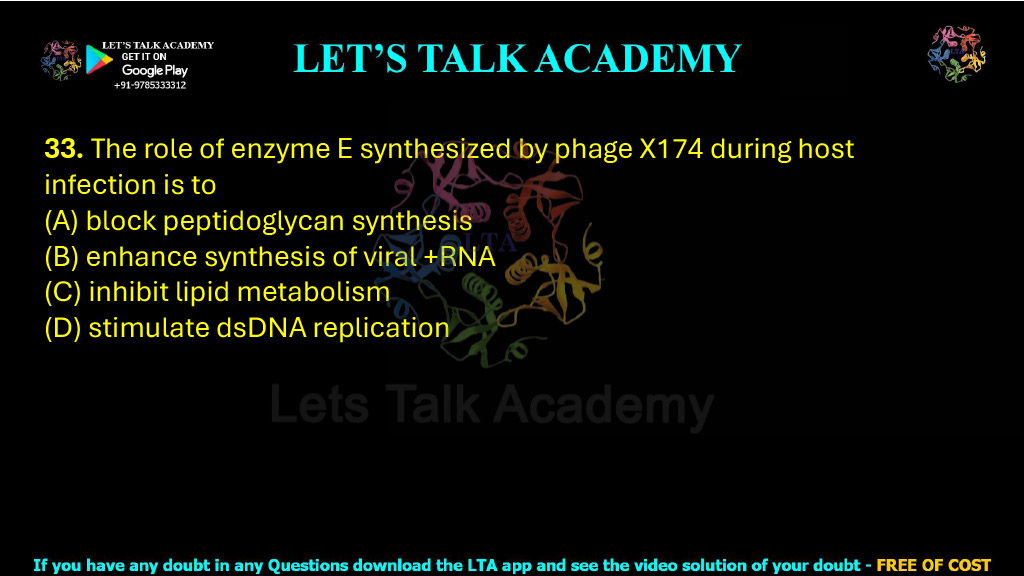
33. The role of enzyme E synthesized by phage X174 during host infection is to
(A) block peptidoglycan synthesis
(B) enhance synthesis of viral +RNA
(C) inhibit lipid metabolism
(D) stimulate dsDNA replication
Role of Enzyme E in Bacteriophage φX174 Infection: Blocking Peptidoglycan Synthesis
Introduction
Bacteriophages are viruses that specifically infect bacteria and utilize the host’s cellular machinery for their replication. After successful infection, bacteriophages must release newly formed viral particles from the bacterial cell. To accomplish this, many bacteriophages produce specialized proteins known as lysis proteins, which weaken or destroy the bacterial cell wall. One of the best-studied examples is enzyme E produced by the bacteriophage φX174 (Phi X174), a small single-stranded DNA bacteriophage that infects Escherichia coli.
Unlike lysozyme-producing bacteriophages that degrade existing peptidoglycan, bacteriophage φX174 follows a unique strategy. Its enzyme E does not directly digest the bacterial cell wall. Instead, it inhibits the synthesis of new peptidoglycan by blocking an essential membrane enzyme involved in cell wall biosynthesis. As bacterial growth continues without proper cell wall formation, the cell eventually ruptures due to osmotic pressure, releasing newly assembled phage particles.
Correct Answer
Correct Option: (A) Block peptidoglycan synthesis
Detailed Explanation
Bacteriophage φX174 is a single-stranded DNA bacteriophage belonging to the family Microviridae. During the final stage of its replication cycle, the phage synthesizes a small membrane-associated protein called enzyme E. This protein functions as a lysis protein by specifically inhibiting bacterial cell wall biosynthesis.
Enzyme E binds to and inhibits the bacterial membrane enzyme MraY (phospho-N-acetylmuramoyl-pentapeptide transferase). MraY catalyzes one of the earliest membrane-associated steps in peptidoglycan biosynthesis by transferring the peptidoglycan precursor onto the lipid carrier undecaprenyl phosphate. When this reaction is blocked, new peptidoglycan cannot be synthesized.
As bacterial growth continues, the weakened cell wall becomes unable to withstand the internal osmotic pressure. Eventually, the bacterial cell undergoes osmotic lysis, releasing hundreds of newly formed bacteriophage particles into the surrounding environment. Therefore, the primary role of enzyme E is to block peptidoglycan synthesis, making option (A) the correct answer.
Explanation of Each Option
Option (A): Block Peptidoglycan Synthesis
This statement is correct. Enzyme E inhibits the bacterial enzyme MraY, preventing peptidoglycan synthesis and ultimately causing bacterial cell lysis.
Option (B): Enhance Synthesis of Viral +RNA
This statement is incorrect. φX174 is a single-stranded DNA virus, not an RNA virus. It does not synthesize positive-sense RNA genomes, and enzyme E has no role in RNA synthesis.
Option (C): Inhibit Lipid Metabolism
This statement is incorrect. Although enzyme E interacts with a membrane-associated enzyme, its target is peptidoglycan biosynthesis rather than lipid metabolism.
Option (D): Stimulate dsDNA Replication
This statement is incorrect. Double-stranded DNA replication occurs during the replication cycle of φX174 through a replicative intermediate, but enzyme E functions only during the lysis stage and does not stimulate DNA replication.
Why Option (A) is Correct
Enzyme E specifically inhibits the bacterial enzyme MraY, preventing the formation of peptidoglycan precursors required for bacterial cell wall synthesis. This eventually causes osmotic lysis of the host cell and release of progeny bacteriophages.
Why the Other Options are Incorrect
Why Option (B) is Incorrect
φX174 is a DNA bacteriophage and does not require synthesis of a positive-sense RNA genome. Enzyme E has no role in RNA replication.
Why Option (C) is Incorrect
The target of enzyme E is a cell wall biosynthetic enzyme rather than enzymes involved in lipid metabolism.
Why Option (D) is Incorrect
DNA replication is carried out by viral and host replication proteins before enzyme E is expressed. Enzyme E functions exclusively during host cell lysis.
Comparison of All Options
| Option | Statement | Status |
|---|---|---|
| A | Blocks peptidoglycan synthesis | Correct |
| B | Enhances viral +RNA synthesis | Incorrect |
| C | Inhibits lipid metabolism | Incorrect |
| D | Stimulates dsDNA replication | Incorrect |
Life Cycle of Bacteriophage φX174
| Stage | Major Event |
|---|---|
| Attachment | Binding to bacterial surface receptors |
| Genome Entry | Injection of single-stranded DNA into the host |
| Replication | Formation of double-stranded replicative form followed by genome replication |
| Assembly | Capsid proteins package newly synthesized genomes |
| Lysis | Enzyme E blocks peptidoglycan synthesis, leading to host cell rupture |
Characteristics of Bacteriophage φX174
| Feature | Description |
|---|---|
| Genome | Single-stranded circular DNA (ssDNA) |
| Virus Family | Microviridae |
| Host | Escherichia coli |
| Lysis Protein | Enzyme E |
| Lysis Mechanism | Inhibition of peptidoglycan synthesis |
Biological Significance
The lysis mechanism of bacteriophage φX174 demonstrates an elegant strategy in which a virus kills its bacterial host without directly degrading the cell wall. Instead, enzyme E blocks bacterial peptidoglycan biosynthesis by inhibiting MraY, eventually leading to osmotic rupture. This mechanism has attracted significant interest in biotechnology and antimicrobial research because MraY represents a promising target for the development of novel antibiotics against multidrug-resistant bacteria.
Final Answer
Correct Option: (A)


