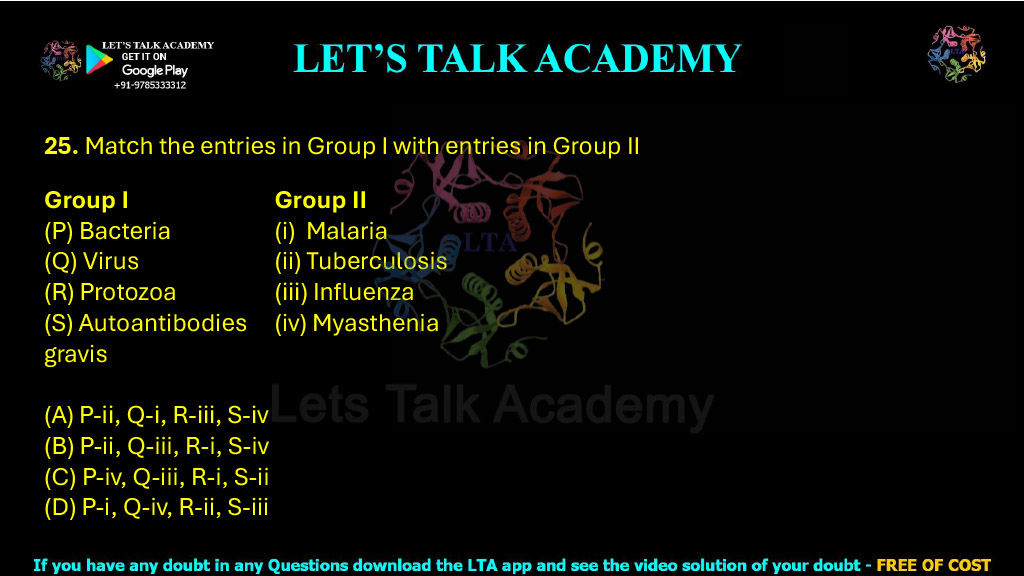
25. Match the entries in Group I with entries in Group II
Group I Group II
(P) Bacteria (i) Malaria
(Q) Virus (ii) Tuberculosis
(R) Protozoa (iii) Influenza
(S) Autoantibodies (iv) Myasthenia gravis
(A) P-ii, Q-i, R-iii, S-iv
(B) P-ii, Q-iii, R-i, S-iv
(C) P-iv, Q-iii, R-i, S-ii
(D) P-i, Q-iv, R-ii, S-iii
Match the Disease-Causing Agents with Their Diseases: Bacteria, Viruses, Protozoa, and Autoantibodies
Introduction
Understanding the relationship between microorganisms and the diseases they cause is one of the fundamental concepts in microbiology and immunology. Human diseases may arise due to infections caused by bacteria, viruses, fungi, protozoa, or parasites. In contrast, some disorders develop because the body’s own immune system mistakenly attacks healthy tissues, resulting in autoimmune diseases. Identifying the causative agent of a disease is essential for selecting appropriate diagnostic methods, preventive measures, and treatment strategies.
Among infectious agents, bacteria are responsible for diseases such as tuberculosis, viruses cause illnesses like influenza, and protozoan parasites are responsible for malaria. Autoimmune disorders differ from infectious diseases because they are not caused by microorganisms but by the production of autoantibodies that target self-antigens. Myasthenia gravis is a classic example of an antibody-mediated autoimmune disease.
Correct Answer
Correct Option: (B)
P – ii, Q – iii, R – i, S – iv
Detailed Explanation
The correct association between disease-causing agents and diseases is based on the biological origin of each disease. Tuberculosis is caused by the bacterium Mycobacterium tuberculosis, making it a bacterial disease. Influenza is caused by influenza viruses belonging to the family Orthomyxoviridae. Malaria is caused by protozoan parasites of the genus Plasmodium, which are transmitted by female Anopheles mosquitoes. Myasthenia gravis is an autoimmune disorder caused by autoantibodies directed against acetylcholine receptors at the neuromuscular junction.
Therefore, the correct matching is:
- Bacteria → Tuberculosis
- Virus → Influenza
- Protozoa → Malaria
- Autoantibodies → Myasthenia gravis
This corresponds to Option (B).
Explanation of Each Match
P. Bacteria → Tuberculosis
This match is correct. Tuberculosis is caused by Mycobacterium tuberculosis, an acid-fast bacterium that primarily infects the lungs but can also affect other organs.
Q. Virus → Influenza
This match is correct. Influenza is caused by Influenza A, B, or C viruses. These enveloped RNA viruses infect the respiratory tract and are responsible for seasonal flu outbreaks.
R. Protozoa → Malaria
This match is correct. Malaria is caused by protozoan parasites of the genus Plasmodium, including P. falciparum, P. vivax, P. malariae, and P. ovale.
S. Autoantibodies → Myasthenia Gravis
This match is correct. In myasthenia gravis, autoantibodies bind to acetylcholine receptors at the neuromuscular junction, impairing nerve impulse transmission and causing muscle weakness.
Why Option (B) is Correct
Option (B) correctly associates each biological agent with the disease it causes:
- Bacteria → Tuberculosis
- Virus → Influenza
- Protozoa → Malaria
- Autoantibodies → Myasthenia gravis
Why the Other Options are Incorrect
Option (A)
This option incorrectly matches viruses with malaria and protozoa with influenza. Malaria is caused by protozoa, whereas influenza is caused by viruses.
Option (C)
This option incorrectly identifies bacteria as the cause of myasthenia gravis and autoantibodies as the cause of tuberculosis.
Option (D)
This option incorrectly associates bacteria with malaria, viruses with myasthenia gravis, protozoa with tuberculosis, and autoantibodies with influenza.
Comparison of All Options
| Option | Matching | Status |
|---|---|---|
| A | P-ii, Q-i, R-iii, S-iv | Incorrect |
| B | P-ii, Q-iii, R-i, S-iv | Correct |
| C | P-iv, Q-iii, R-i, S-ii | Incorrect |
| D | P-i, Q-iv, R-ii, S-iii | Incorrect |
Summary of Disease-Causing Agents
| Disease | Causative Agent | Category |
|---|---|---|
| Tuberculosis | Mycobacterium tuberculosis | Bacterium |
| Influenza | Influenza virus | Virus |
| Malaria | Plasmodium species | Protozoan |
| Myasthenia gravis | Autoantibodies against acetylcholine receptors | Autoimmune Disorder |
Classification of Disease-Causing Agents
| Agent | Genetic Material | Cellular Organization |
|---|---|---|
| Bacteria | DNA | Prokaryotic cell |
| Virus | DNA or RNA | Acellular |
| Protozoa | DNA | Unicellular eukaryote |
| Autoantibodies | Protein molecules | Produced by immune system |
Biological Significance
Correct identification of disease-causing agents forms the basis of modern diagnosis, treatment, and disease prevention. Infectious diseases require antimicrobial drugs directed against the responsible microorganism, whereas autoimmune disorders require therapies that suppress or modulate the immune response. Understanding the differences between bacterial, viral, protozoan, and autoimmune diseases is therefore essential in microbiology, immunology, medicine, and biotechnology.
Final Answer
Correct Option: (B)
P – ii, Q – iii, R – i, S – iv
The correct matching is:
- Bacteria → Tuberculosis
- Virus → Influenza
- Protozoa → Malaria
- Autoantibodies → Myasthenia gravis


