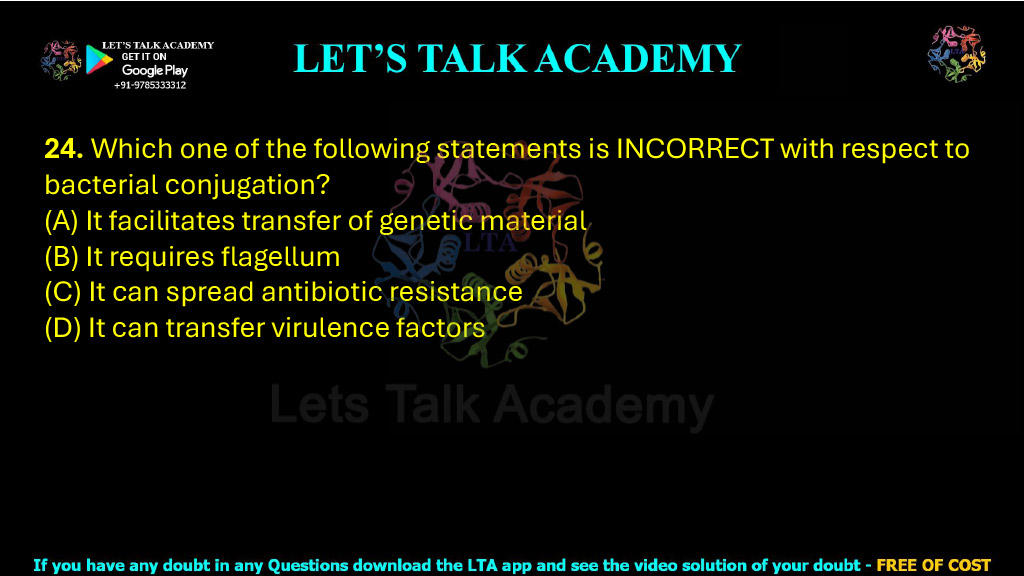
24. Which one of the following statements is INCORRECT with respect to bacterial conjugation?
(A) It facilitates transfer of genetic material
(B) It requires flagellum
(C) It can spread antibiotic resistance
(D) It can transfer virulence factors
Bacterial Conjugation Explained: Mechanism, Genetic Transfer, Antibiotic Resistance & Virulence Factors
Introduction
Bacterial conjugation is one of the three major mechanisms of horizontal gene transfer (HGT) in bacteria, the other two being transformation and transduction. Unlike vertical gene transfer, where genetic material passes from parent to daughter cells during cell division, horizontal gene transfer enables bacteria to exchange DNA directly with unrelated bacterial cells. This process plays a crucial role in bacterial evolution by allowing rapid acquisition of new genetic traits such as antibiotic resistance, toxin production, metabolic capabilities, and virulence factors.
The process of conjugation was first discovered by Joshua Lederberg and Edward Tatum in Escherichia coli, demonstrating that bacteria are capable of genetic recombination. During conjugation, DNA is transferred through direct cell-to-cell contact using a specialized structure called the sex pilus or conjugative pilus. This mechanism has enormous medical significance because it is responsible for the rapid spread of multidrug-resistant bacteria in hospitals and the dissemination of virulence genes among pathogenic microorganisms.
Correct Answer
Correct Option: (B) It requires flagellum
Detailed Explanation
Bacterial conjugation is a direct DNA transfer process that requires physical contact between a donor and a recipient bacterial cell. The donor cell usually carries a conjugative plasmid, such as the F (fertility) plasmid, which encodes proteins required for DNA transfer. One of these proteins forms the sex pilus, a hollow filamentous appendage that establishes contact with the recipient cell and brings both cells together.
Once stable contact is established, a single strand of plasmid DNA is transferred from the donor to the recipient through a conjugation channel. Both cells then synthesize the complementary DNA strand, resulting in complete plasmids in each bacterium. As a result, the recipient may acquire entirely new characteristics encoded by the transferred DNA.
A common misconception is that bacterial conjugation requires a flagellum. In reality, the flagellum is a locomotory organelle responsible for bacterial motility, whereas conjugation depends on the sex pilus. Therefore, flagella have no direct role in DNA transfer during conjugation.
Conjugative plasmids often carry genes encoding resistance to antibiotics, heavy metals, or toxic compounds. Some plasmids also contain genes responsible for toxin production, adhesins, invasins, and other virulence determinants. Consequently, conjugation contributes significantly to the emergence of multidrug-resistant and highly pathogenic bacterial strains.
Explanation of Each Option
Option (A): It Facilitates Transfer of Genetic Material
This statement is correct. The primary purpose of bacterial conjugation is the transfer of DNA, including plasmids and, in some cases, chromosomal DNA, from a donor to a recipient cell.
Option (B): It Requires Flagellum
This statement is incorrect. Conjugation requires a sex pilus, not a flagellum. Flagella are involved in bacterial movement, whereas pili mediate cell-to-cell attachment and DNA transfer.
Option (C): It Can Spread Antibiotic Resistance
This statement is correct. Resistance (R) plasmids carrying antibiotic resistance genes are commonly transferred through conjugation, making this process one of the major causes of multidrug-resistant bacterial infections.
Option (D): It Can Transfer Virulence Factors
This statement is correct. Virulence plasmids encoding toxins, adhesion molecules, secretion systems, and invasion proteins can also be transferred by conjugation, increasing bacterial pathogenicity.
Why Option (B) is Correct
The incorrect statement is that conjugation requires a flagellum. DNA transfer during conjugation occurs through a sex pilus, which is structurally and functionally different from the flagellum. Therefore, bacterial flagella are not involved in the conjugation process.
Why the Other Options are Correct
Why Option (A) is Correct
Conjugation is specifically designed to transfer genetic material between bacterial cells, making this statement completely accurate.
Why Option (C) is Correct
Many conjugative plasmids carry antibiotic resistance genes that can rapidly spread among bacterial populations, contributing to antimicrobial resistance.
Why Option (D) is Correct
Virulence genes located on conjugative plasmids can be transferred to non-pathogenic bacteria, transforming them into pathogenic organisms.
Comparison of All Options
| Option | Statement | Status |
|---|---|---|
| A | Facilitates transfer of genetic material | Correct |
| B | Requires flagellum | Incorrect |
| C | Can spread antibiotic resistance | Correct |
| D | Can transfer virulence factors | Correct |
Steps of Bacterial Conjugation
| Step | Process |
|---|---|
| 1 | Donor cell carrying F plasmid forms a sex pilus |
| 2 | Sex pilus attaches to recipient cell |
| 3 | Cells are pulled together to form a conjugation bridge |
| 4 | One DNA strand of the plasmid is transferred |
| 5 | Complementary DNA strands are synthesized in both cells |
| 6 | Recipient acquires new genetic traits |
Comparison of Horizontal Gene Transfer Mechanisms
| Mechanism | DNA Source | Requires Cell Contact? |
|---|---|---|
| Transformation | Free DNA from environment | No |
| Transduction | Bacteriophage | No |
| Conjugation | Donor bacterium | Yes |
Importance of Conjugative Plasmids
| Plasmid Type | Function |
|---|---|
| F Plasmid | Conjugation and fertility |
| R Plasmid | Antibiotic resistance |
| Virulence Plasmid | Toxin production and pathogenicity |
| Metabolic Plasmid | Utilization of unusual nutrients |
Biological Significance
Bacterial conjugation is one of the most important mechanisms driving microbial evolution. It enables bacteria to rapidly acquire advantageous genes without waiting for spontaneous mutations. This process contributes to the global spread of antimicrobial resistance, increased bacterial virulence, enhanced metabolic diversity, and adaptation to changing environmental conditions. Conjugation also plays an essential role in genetic engineering, recombinant DNA technology, and molecular cloning, where modified plasmids are transferred into bacterial cells for research and industrial applications.
Final Answer
Correct Option: (B)
Bacterial conjugation does not require a flagellum. Instead, it depends on the sex pilus (conjugative pilus), which establishes direct contact between donor and recipient cells to facilitate DNA transfer. Conjugation plays a major role in spreading antibiotic resistance genes and virulence factors among bacterial populations.


