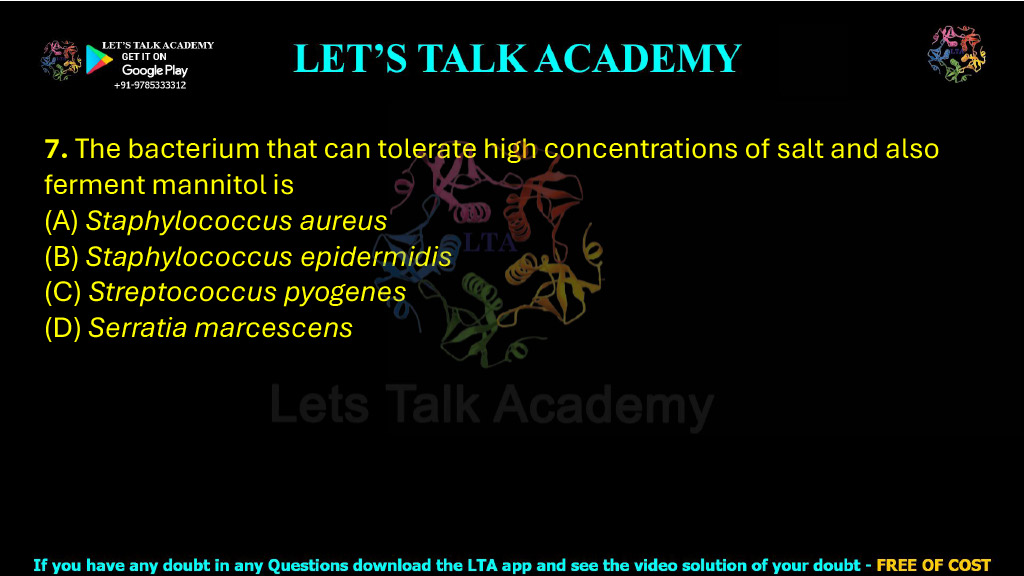
7. The bacterium that can tolerate high concentrations of salt and also ferment mannitol is
(A) Staphylococcus aureus
(B) Staphylococcus epidermidis
(C) Streptococcus pyogenes
(D) Serratia marcescens
Staphylococcus aureus Explained: Salt Tolerance and Mannitol Fermentation
Introduction
One of the most widely used laboratory techniques for identifying medically important bacteria is the use of selective and differential culture media. These media allow microbiologists to distinguish bacterial species based on their ability to tolerate specific environmental conditions and metabolize particular substrates. A classic example is Mannitol Salt Agar (MSA), which is specifically designed to isolate and differentiate members of the genus Staphylococcus.
Mannitol Salt Agar contains approximately 7.5% sodium chloride (NaCl), making it highly selective for salt-tolerant bacteria. It also contains the carbohydrate mannitol and the pH indicator phenol red, allowing differentiation between bacteria that ferment mannitol and those that do not. Among the common human pathogens, Staphylococcus aureus is unique because it not only tolerates high salt concentrations but also ferments mannitol, producing acid that changes the medium from red to yellow.
Correct Answer
Correct Option: (A) Staphylococcus aureus
Detailed Explanation
Staphylococcus aureus is a Gram-positive, catalase-positive, coagulase-positive coccus that commonly colonizes the skin and nasal passages of healthy individuals. One of its distinguishing laboratory characteristics is its ability to grow in media containing 7.5% sodium chloride, demonstrating its halotolerant nature. In addition to salt tolerance, S. aureus ferments mannitol, producing acidic metabolic products that lower the pH of the medium.
On Mannitol Salt Agar (MSA), acid production from mannitol fermentation changes the color of the pH indicator phenol red from red or pink to yellow. Therefore, colonies of Staphylococcus aureus are typically surrounded by a yellow zone, making them easy to distinguish from non-mannitol-fermenting staphylococci.
This ability to tolerate high salt concentrations while fermenting mannitol is an important diagnostic feature used in microbiology laboratories for the preliminary identification of Staphylococcus aureus. It also helps differentiate this pathogen from Staphylococcus epidermidis, which grows on MSA but does not ferment mannitol.
Explanation of Each Option
Option (A): Staphylococcus aureus
This option is correct. Staphylococcus aureus grows well in 7.5% NaCl and ferments mannitol, producing acid that turns Mannitol Salt Agar yellow.
Option (B): Staphylococcus epidermidis
This option is incorrect. Although Staphylococcus epidermidis is also salt tolerant and grows on Mannitol Salt Agar, it generally does not ferment mannitol. Therefore, the medium remains red or pink.
Option (C): Streptococcus pyogenes
This option is incorrect. Streptococcus pyogenes is not salt tolerant and does not grow on Mannitol Salt Agar. It is commonly cultured on blood agar, where it produces beta-hemolysis.
Option (D): Serratia marcescens
This option is incorrect. Serratia marcescens is a Gram-negative rod belonging to the Enterobacteriaceae. It is not characterized by high salt tolerance and is not identified using Mannitol Salt Agar.
Why Option (A) is Correct
Staphylococcus aureus possesses two important characteristics: it is halotolerant, allowing growth in high salt concentrations, and it ferments mannitol, producing acid that changes the color of Mannitol Salt Agar from red to yellow.
Why the Other Options are Incorrect
Why Option (B) is Incorrect
Staphylococcus epidermidis grows on Mannitol Salt Agar because it tolerates salt, but it usually does not ferment mannitol and therefore does not produce a yellow color change.
Why Option (C) is Incorrect
Streptococcus pyogenes lacks significant salt tolerance and is not differentiated using Mannitol Salt Agar.
Why Option (D) is Incorrect
Serratia marcescens is a Gram-negative bacterium that is neither highly salt tolerant nor routinely identified by mannitol fermentation on MSA.
Comparison of All Options
| Option | Organism | Salt Tolerance | Mannitol Fermentation | Correct or Incorrect |
|---|---|---|---|---|
| A | Staphylococcus aureus | Yes | Yes | Correct |
| B | Staphylococcus epidermidis | Yes | No | Incorrect |
| C | Streptococcus pyogenes | No | No | Incorrect |
| D | Serratia marcescens | No | Not characteristic | Incorrect |
Mannitol Salt Agar (MSA): Composition and Function
| Component | Function |
|---|---|
| 7.5% Sodium Chloride | Selects for salt-tolerant bacteria |
| Mannitol | Fermentable carbohydrate |
| Phenol Red | pH indicator that turns yellow after acid production |
| Peptone | Provides nutrients for bacterial growth |
Comparison Between Staphylococcus aureus and Staphylococcus epidermidis
| Feature | Staphylococcus aureus | Staphylococcus epidermidis |
|---|---|---|
| Gram Stain | Gram-positive cocci | Gram-positive cocci |
| Catalase Test | Positive | Positive |
| Coagulase Test | Positive | Negative |
| Mannitol Fermentation | Positive | Negative |
| MSA Color | Yellow | Red or Pink |
| Clinical Importance | Major human pathogen | Opportunistic pathogen |
Clinical Importance of Staphylococcus aureus
| Disease | Description |
|---|---|
| Skin Infections | Boils, abscesses, cellulitis |
| Pneumonia | Lung infection |
| Food Poisoning | Enterotoxin-mediated illness |
| Septicemia | Bloodstream infection |
| Toxic Shock Syndrome | Toxin-mediated systemic disease |
| Endocarditis | Infection of heart valves |
Biological Significance
The ability of Staphylococcus aureus to tolerate high salt concentrations enables it to survive on human skin, where salt concentrations can be relatively high due to perspiration. Mannitol fermentation reflects its metabolic versatility and provides a rapid laboratory method for distinguishing it from less pathogenic staphylococcal species. The use of Mannitol Salt Agar has become a standard diagnostic approach in clinical microbiology because it combines selective and differential properties in a single culture medium.
Final Answer
Correct Option: (A) Staphylococcus aureus
Staphylococcus aureus is a halotolerant bacterium capable of growing in media containing 7.5% sodium chloride. It also ferments mannitol, producing acid that changes the color of Mannitol Salt Agar from red to yellow, making it an important diagnostic characteristic in clinical microbiology.


