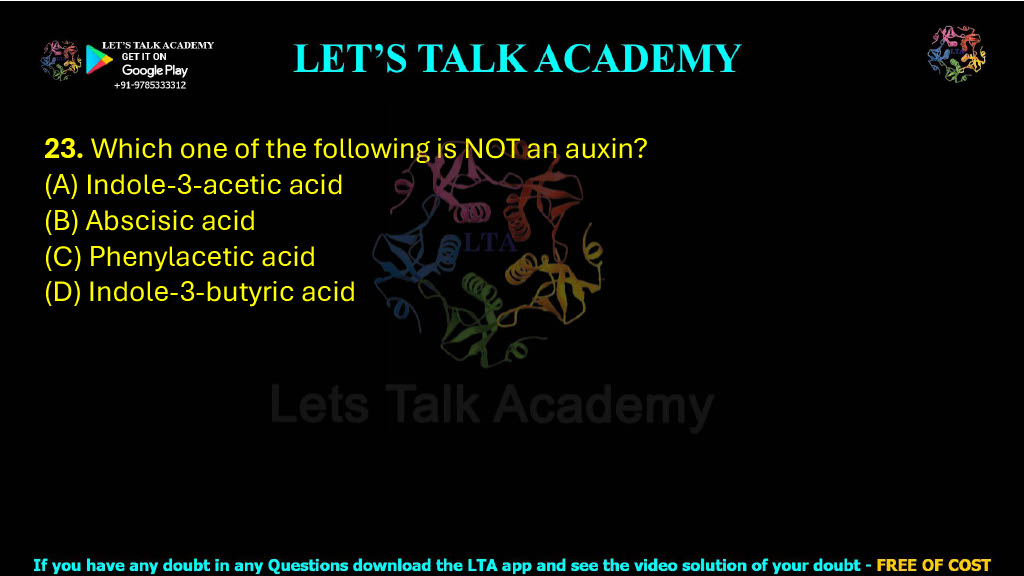
23. Which one of the following is NOT an auxin?
(A) Indole-3-acetic acid
(B) Abscisic acid
(C) Phenylacetic acid
(D) Indole-3-butyric acid
Which Compound is NOT an Auxin? Abscisic Acid Explained
Introduction
Plant growth and development are controlled by a group of naturally occurring signaling molecules known as plant growth regulators (PGRs) or phytohormones. Among these hormones, auxins were the first to be discovered and are considered the primary regulators of cell elongation, apical dominance, vascular differentiation, adventitious root formation, tropic responses, and fruit development. Auxins coordinate growth by regulating gene expression, cell wall loosening, and differential cell elongation in response to environmental stimuli such as gravity and light.
Not all plant hormones, however, promote growth. Abscisic acid (ABA) is a completely different class of plant hormone that mainly functions as a growth inhibitor and stress hormone. It regulates seed dormancy, stomatal closure during water stress, and plant responses to adverse environmental conditions. Because auxins and ABA perform contrasting physiological roles, distinguishing them is an important concept in Plant Physiology.
Correct Answer
Correct Option: (B) Abscisic acid
Detailed Explanation
Auxins are plant growth-promoting hormones that regulate numerous developmental processes including cell elongation, apical dominance, root initiation, vascular differentiation, fruit development, and tropic movements. The principal natural auxin is Indole-3-acetic acid (IAA), while several other naturally occurring and synthetic compounds also exhibit auxin activity.
Phenylacetic acid (PAA) is another naturally occurring auxin, although it is less abundant and generally less active than IAA. Similarly, Indole-3-butyric acid (IBA) possesses strong auxin activity and is widely used in horticulture and plant tissue culture to stimulate adventitious root formation.
Abscisic acid (ABA), however, belongs to an entirely different class of plant hormones. Rather than promoting growth, ABA functions primarily as a stress hormone. It induces stomatal closure during drought, promotes seed dormancy, inhibits premature seed germination, and helps plants tolerate environmental stresses such as dehydration, salinity, and cold. Therefore, ABA is not an auxin.
Explanation of Each Option
Option (A): Indole-3-acetic Acid (IAA)
This option is incorrect because IAA is the principal natural auxin found in higher plants. It regulates cell elongation, gravitropism, phototropism, apical dominance, vascular differentiation, and fruit development.
Option (B): Abscisic Acid (ABA)
This option is correct. Abscisic acid is not an auxin. It functions mainly as a plant stress hormone that regulates seed dormancy, stomatal closure, and responses to environmental stress.
Option (C): Phenylacetic Acid (PAA)
This option is incorrect because Phenylacetic acid is a naturally occurring auxin that exhibits auxin-like physiological activity, although it is generally less potent than IAA.
Option (D): Indole-3-butyric Acid (IBA)
This option is incorrect. Indole-3-butyric acid is an auxin widely used to induce rooting in stem cuttings and plant tissue culture due to its strong root-promoting activity.
Why Option (B) is Correct
Abscisic acid belongs to a different class of plant hormones and primarily regulates stress adaptation rather than growth promotion. Unlike auxins, ABA inhibits growth, induces seed dormancy, and promotes stomatal closure during drought conditions.
Why the Other Options are Incorrect
Why Option (A) is Incorrect
IAA is the most important naturally occurring auxin and serves as the reference molecule for auxin activity.
Why Option (C) is Incorrect
Phenylacetic acid possesses auxin activity and is therefore classified as a naturally occurring auxin.
Why Option (D) is Incorrect
IBA is an auxin extensively used in horticulture for inducing adventitious root formation and vegetative propagation.
Comparison of All Options
| Option | Plant Hormone | Classification | Correct or Incorrect |
|---|---|---|---|
| A | Indole-3-acetic acid (IAA) | Natural Auxin | Incorrect |
| B | Abscisic acid (ABA) | Stress Hormone | Correct |
| C | Phenylacetic acid (PAA) | Natural Auxin | Incorrect |
| D | Indole-3-butyric acid (IBA) | Natural Auxin | Incorrect |
Major Functions of Auxins
| Function | Role |
|---|---|
| Cell Elongation | Promotes elongation of shoot cells |
| Apical Dominance | Suppresses lateral bud growth |
| Gravitropism | Controls directional growth in response to gravity |
| Phototropism | Causes bending toward light |
| Root Formation | Stimulates adventitious roots |
| Fruit Development | Promotes fruit growth and parthenocarpy |
Major Functions of Abscisic Acid (ABA)
| Function | Importance |
|---|---|
| Stomatal Closure | Reduces water loss during drought |
| Seed Dormancy | Prevents premature germination |
| Stress Tolerance | Improves drought, salinity, and cold resistance |
| Growth Inhibition | Suppresses cell growth under stress |
Comparison Between Auxin and Abscisic Acid
| Feature | Auxin | Abscisic Acid |
|---|---|---|
| Main Role | Growth Promotion | Stress Response |
| Cell Elongation | Stimulates | Generally Inhibits |
| Root Formation | Promotes | No Major Role |
| Seed Dormancy | No Primary Role | Promotes Dormancy |
| Stomatal Closure | No | Yes |
Examples of Important Plant Hormones
| Hormone | Primary Function |
|---|---|
| Auxin (IAA) | Cell elongation and tropic responses |
| Cytokinin | Cell division and shoot formation |
| Gibberellin | Stem elongation and seed germination |
| Ethylene | Fruit ripening and senescence |
| Abscisic Acid (ABA) | Stress response and dormancy |
Biological Significance
The balance between growth-promoting hormones such as auxins and growth-inhibiting hormones such as abscisic acid enables plants to coordinate development according to environmental conditions. Auxins stimulate growth during favorable conditions, whereas ABA conserves water, induces dormancy, and enhances stress tolerance during unfavorable conditions. Together, these hormones ensure optimal survival, reproduction, and adaptation throughout the plant life cycle.
Final Answer
Correct Option: (B) Abscisic acid
Abscisic acid (ABA) is not an auxin. It functions primarily as a plant stress hormone involved in seed dormancy, stomatal closure, growth inhibition, and adaptation to environmental stress, whereas IAA, Phenylacetic acid, and IBA are all auxins that promote plant growth and development.


