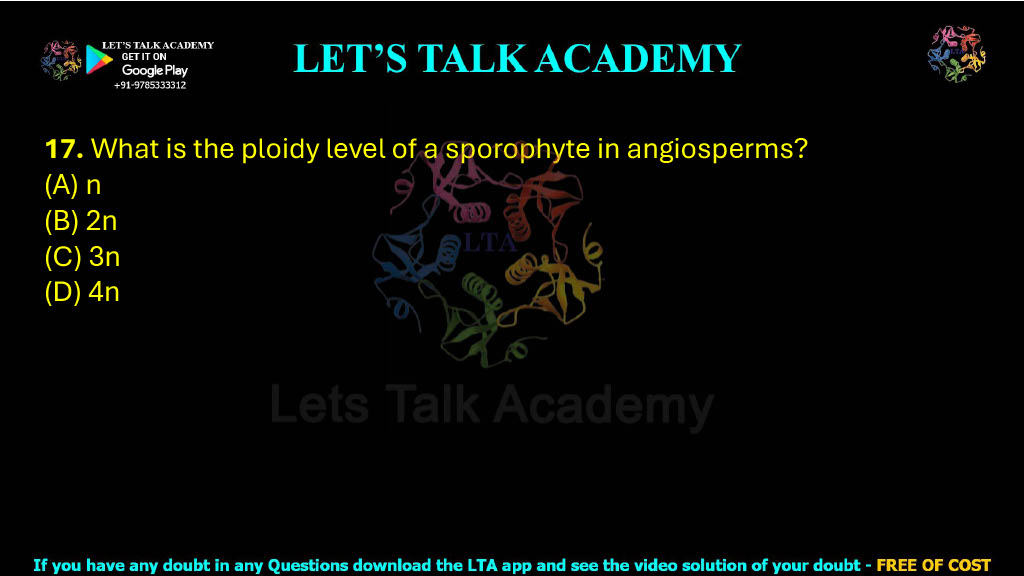
17. What is the ploidy level of a sporophyte in angiosperms?
(A) n
(B) 2n
(C) 3n
(D) 4n
Ploidy Level of Sporophyte in Angiosperms Explained
Introduction
The life cycle of flowering plants, or angiosperms, follows the phenomenon known as alternation of generations, in which two multicellular generations alternate during the reproductive cycle. These two generations differ not only in structure and function but also in chromosome number. The sporophyte represents the diploid generation, while the gametophyte represents the haploid generation. Understanding the relationship between these generations is fundamental to plant reproduction and is one of the most frequently tested topics in Plant Biology.
In angiosperms, the dominant and conspicuous plant body that we commonly recognize as a flowering plant is the sporophyte. This diploid plant produces spores through meiosis, giving rise to highly reduced male and female gametophytes. Following fertilization, the diploid zygote develops into a new sporophyte, thereby completing the life cycle.
Correct Answer
Correct Option: (B) 2n
Detailed Explanation
The sporophyte is the diploid (2n) generation of the plant life cycle. It develops from the diploid zygote formed after the fusion of the haploid male and female gametes during fertilization. Since the zygote contains two complete sets of chromosomes—one inherited from each parent—the resulting sporophyte remains diploid throughout its life.
In flowering plants, the sporophyte constitutes the entire visible plant body, including roots, stems, leaves, flowers, fruits, and seeds. Specialized reproductive organs within flowers contain sporangia, where diploid sporogenous cells undergo meiosis to produce haploid spores (n). These spores subsequently develop into male and female gametophytes, which produce gametes by mitosis.
After fertilization, the fusion of the egg cell (n) and sperm cell (n) restores the diploid chromosome number (2n), producing the zygote that grows into the next sporophyte generation. Therefore, the sporophyte in angiosperms is always diploid.
Explanation of Each Option
Option (A): n
This option is incorrect. The chromosome number n represents the haploid condition, which is characteristic of spores, pollen grains, embryo sacs, sperm cells, and egg cells. It does not represent the sporophyte.
Option (B): 2n
This option is correct. The sporophyte develops from the diploid zygote and therefore possesses two complete sets of chromosomes throughout its life cycle.
Option (C): 3n
This option is incorrect. The triploid (3n) chromosome number is characteristic of the endosperm in angiosperms, which forms after double fertilization when one sperm nucleus fuses with the two polar nuclei.
Option (D): 4n
This option is incorrect. Tetraploid (4n) plants may occur naturally or be artificially induced through chromosome doubling, but this is not the normal ploidy level of the sporophyte in angiosperms.
Why Option (B) is Correct
The sporophyte originates from the diploid zygote following fertilization. Since it inherits one chromosome set from each parent, every vegetative and reproductive tissue of the sporophyte remains diploid until meiosis occurs during spore formation.
Why the Other Options are Incorrect
Why Option (A) is Incorrect
The haploid chromosome number is found in the gametophyte generation and gametes, not in the sporophyte.
Why Option (C) is Incorrect
The triploid condition is unique to the endosperm produced by double fertilization in flowering plants.
Why Option (D) is Incorrect
Tetraploidy is an abnormal or induced polyploid condition and is not the standard chromosome number of the angiosperm sporophyte.
Comparison of All Options
| Option | Ploidy Level | Occurs In | Correct or Incorrect |
|---|---|---|---|
| A | n | Gametophytes and gametes | Incorrect |
| B | 2n | Sporophyte | Correct |
| C | 3n | Endosperm | Incorrect |
| D | 4n | Polyploid plants | Incorrect |
Ploidy Levels in the Angiosperm Life Cycle
| Structure | Ploidy |
|---|---|
| Sporophyte | 2n |
| Microspore | n |
| Megaspore | n |
| Pollen Grain | n |
| Embryo Sac | n |
| Egg Cell | n |
| Sperm Cell | n |
| Zygote | 2n |
| Embryo | 2n |
| Endosperm | 3n |
Alternation of Generations in Angiosperms
| Generation | Ploidy | Main Function |
|---|---|---|
| Sporophyte | 2n | Produces spores by meiosis |
| Gametophyte | n | Produces gametes by mitosis |
Important Events in the Life Cycle
| Process | Chromosome Change |
|---|---|
| Meiosis | 2n → n |
| Mitosis in Gametophyte | n → n |
| Fertilization | n + n → 2n |
| Double Fertilization (Endosperm) | n + n + n → 3n |
Biological Significance
The diploid sporophyte ensures genetic stability while allowing recombination through meiosis during spore formation. The alternation between diploid sporophyte and haploid gametophyte increases genetic diversity, enhances adaptation to changing environments, and contributes to the remarkable evolutionary success of flowering plants. The dominance of the sporophyte generation is one of the defining characteristics of angiosperms.
Final Answer
Correct Option: (B) 2n
The sporophyte in angiosperms is diploid (2n) because it develops from the diploid zygote formed after fertilization. It represents the dominant generation of the flowering plant life cycle and produces haploid spores through meiosis.


