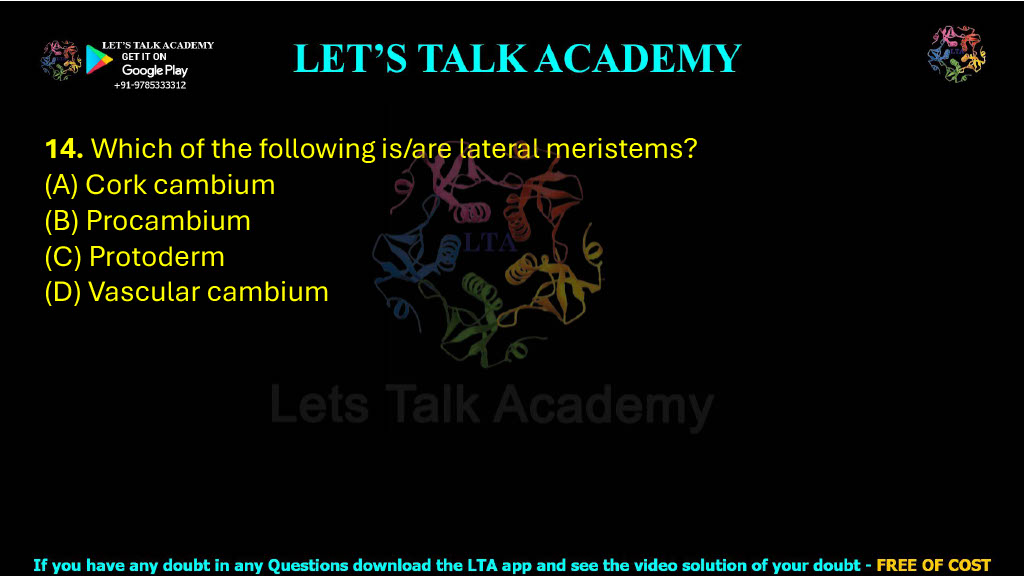
14. Which of the following is/are lateral meristems?
(A) Cork cambium
(B) Procambium
(C) Protoderm
(D) Vascular cambium
Lateral Meristems in Plants Explained | Cork Cambium and Vascular Cambium
Introduction
Meristems are specialized regions of actively dividing cells that are responsible for the continuous growth and development of plants. Unlike animal cells, many plant cells retain the ability to divide throughout the life of the organism. These dividing tissues enable plants to increase in length, diameter, and complexity while continuously producing new organs such as roots, stems, leaves, flowers, and vascular tissues.
Based on their position within the plant body, meristems are classified into apical meristems, intercalary meristems, and lateral meristems. Apical and intercalary meristems contribute to primary growth, which increases the length of roots and shoots. In contrast, lateral meristems are responsible for secondary growth, increasing the thickness or girth of stems and roots. The two principal lateral meristems are the vascular cambium and the cork cambium (phellogen).
Correct Answer
Correct Option: (A) Cork cambium and (D) Vascular cambium
Detailed Explanation
Lateral meristems are cylindrical layers of actively dividing cells located parallel to the long axis of stems and roots. Their primary function is to produce secondary tissues, thereby increasing the diameter of plant organs. Secondary growth is characteristic of most dicotyledonous plants and gymnosperms and is responsible for the formation of wood and bark.
The vascular cambium is a lateral meristem that produces secondary xylem toward the inside and secondary phloem toward the outside. The continuous activity of vascular cambium leads to the annual increase in stem and root thickness and is responsible for the formation of wood.
The cork cambium, also called phellogen, is another lateral meristem. It develops in the outer cortex and produces cork (phellem) externally and phelloderm internally. Together, these tissues form the periderm, which replaces the epidermis during secondary growth and protects the plant against water loss, pathogens, and mechanical injury.
In contrast, procambium and protoderm are primary meristems that originate from the apical meristem. Procambium gives rise to the primary vascular tissues (primary xylem and primary phloem), while protoderm develops into the epidermis. Since they participate in primary growth rather than secondary growth, they are not lateral meristems.
Explanation of Each Option
Option (A): Cork Cambium
This option is correct. Cork cambium is a lateral meristem responsible for producing cork and phelloderm during secondary growth. It forms the protective periderm that replaces the epidermis in woody stems and roots.
Option (B): Procambium
This option is incorrect. Procambium is a primary meristem derived from the apical meristem. It gives rise to the primary xylem and primary phloem during primary growth.
Option (C): Protoderm
This option is incorrect. Protoderm is also a primary meristem that differentiates into the epidermis, the outer protective layer of young plant organs.
Option (D): Vascular Cambium
This option is correct. Vascular cambium is the principal lateral meristem responsible for producing secondary xylem and secondary phloem, leading to an increase in stem and root girth.
Why Options (A) and (D) are Correct
Both cork cambium and vascular cambium remain actively dividing throughout secondary growth. They increase the thickness of stems and roots by producing secondary tissues, making them true lateral meristems.
Why the Other Options are Incorrect
Why Option (B) is Incorrect
Procambium participates only in primary growth and develops into primary vascular tissues rather than secondary tissues.
Why Option (C) is Incorrect
Protoderm forms the epidermis during primary growth and is therefore classified as a primary meristem.
Comparison of All Options
| Option | Meristem | Major Function | Classification |
|---|---|---|---|
| A | Cork Cambium | Produces cork and phelloderm | Lateral Meristem |
| B | Procambium | Produces primary xylem and primary phloem | Primary Meristem |
| C | Protoderm | Produces epidermis | Primary Meristem |
| D | Vascular Cambium | Produces secondary xylem and secondary phloem | Lateral Meristem |
Classification of Plant Meristems
| Meristem | Location | Main Function |
|---|---|---|
| Apical Meristem | Root and shoot tips | Primary growth and increase in length |
| Intercalary Meristem | Nodes and leaf bases | Rapid elongation of internodes |
| Lateral Meristem | Sides of stems and roots | Secondary growth and increase in girth |
Primary Meristems and Their Derivatives
| Primary Meristem | Derivative Tissue |
|---|---|
| Protoderm | Epidermis |
| Procambium | Primary xylem and primary phloem |
| Ground Meristem | Cortex, pith and ground tissues |
Functions of Lateral Meristems
| Lateral Meristem | Function |
|---|---|
| Vascular Cambium | Produces secondary xylem and secondary phloem |
| Cork Cambium | Forms periderm and protective bark |
| Secondary Growth | Increases stem and root diameter |
| Wood Formation | Produces secondary xylem |
Difference Between Primary and Secondary Growth
| Feature | Primary Growth | Secondary Growth |
|---|---|---|
| Responsible Meristem | Apical Meristem | Lateral Meristem |
| Main Effect | Increase in length | Increase in thickness |
| Occurs In | All vascular plants | Mainly dicots and gymnosperms |
| Major Products | Primary tissues | Secondary tissues |
Biological Significance
Lateral meristems enable perennial plants to survive for many years by continuously producing new vascular tissues and protective layers. The vascular cambium generates secondary xylem that strengthens stems and improves water transport, while the cork cambium forms bark that protects plants from desiccation, pathogens, insects, and physical injury. Secondary growth also allows trees to attain massive trunk diameters, supporting large canopies and increasing longevity.
Final Answer
Correct Answer: (A) Cork cambium and (D) Vascular cambium
Cork cambium and vascular cambium are the two major lateral meristems in plants. They are responsible for secondary growth by producing protective tissues, secondary xylem, and secondary phloem, thereby increasing the girth of stems and roots.


