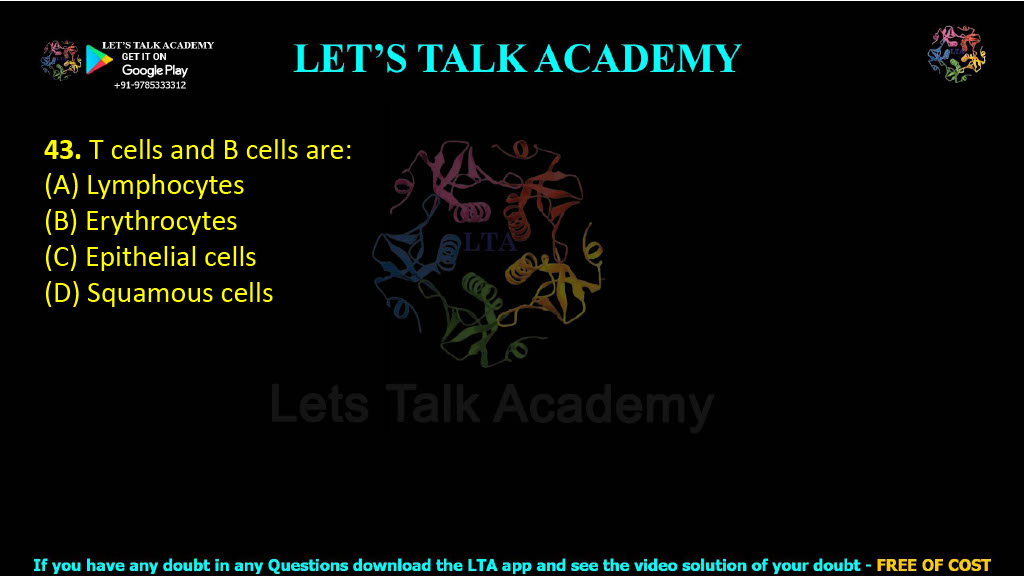
43. T cells and B cells are:
(A) Lymphocytes
(B) Erythrocytes
(C) Epithelial cells
(D) Squamous cells
T Cells and B Cells
Introduction
The immune system protects the human body against viruses, bacteria, fungi, parasites, and cancer cells through an organized network of immune cells and signaling molecules. Among these immune cells, T lymphocytes (T cells) and B lymphocytes (B cells) are the most important components of the adaptive immune system. These cells recognize specific antigens, develop immunological memory, and provide long-lasting protection against pathogens.
T cells and B cells both originate from hematopoietic stem cells present in the bone marrow. However, they undergo maturation in different organs. B cells mature within the bone marrow, whereas T cells migrate to the thymus, where they undergo maturation and selection before entering circulation. Because both belong to the lymphoid lineage of white blood cells, they are collectively classified as lymphocytes. Their coordinated action enables the body to generate highly specific immune responses and long-term immunological memory.
Correct Answer
Correct Option: (A) Lymphocytes
Detailed Explanation
T cells and B cells are specialized lymphocytes, a major class of white blood cells (leukocytes) responsible for adaptive immunity. They arise from common lymphoid progenitor cells in the bone marrow and possess antigen-specific receptors that enable them to recognize foreign molecules with remarkable specificity.
B lymphocytes mature in the bone marrow and are responsible for humoral immunity. Upon encountering an antigen and receiving assistance from helper T cells, they differentiate into plasma cells that secrete antibodies. These antibodies neutralize pathogens, activate the complement system, promote opsonization, and prevent microbial infection. Some activated B cells also become memory B cells, allowing a faster and stronger immune response upon subsequent exposure to the same antigen.
T lymphocytes mature in the thymus and mediate cell-mediated immunity. Different subsets of T cells perform distinct functions. Helper T cells (CD4+) coordinate immune responses by secreting cytokines that activate B cells, macrophages, and cytotoxic T cells. Cytotoxic T cells (CD8+) recognize and destroy virus-infected cells and tumor cells by inducing apoptosis. Regulatory T cells maintain immune tolerance and prevent autoimmune diseases, while memory T cells provide long-term immune protection.
Since both T cells and B cells belong to the lymphocyte family of leukocytes, they are correctly classified as lymphocytes.
Explanation of Each Option
Option (A): Lymphocytes
This statement is correct. Both T cells and B cells are lymphocytes that constitute the adaptive immune system and provide antigen-specific immunity.
Option (B): Erythrocytes
This statement is incorrect. Erythrocytes are red blood cells responsible for transporting oxygen and carbon dioxide. They do not participate in immune responses.
Option (C): Epithelial Cells
This statement is incorrect. Epithelial cells form protective coverings and linings of organs and body surfaces but are not immune cells.
Option (D): Squamous Cells
This statement is incorrect. Squamous cells are a specialized type of epithelial cell found in tissues such as the skin and blood vessels. They are unrelated to lymphocytes.
Why Option (A) is Correct
T cells and B cells originate from lymphoid stem cells and function as antigen-specific immune cells. Their roles in antibody production, cellular immunity, immune regulation, and immunological memory define them as lymphocytes of the adaptive immune system.
Why the Other Options are Incorrect
Why Option (B) is Incorrect
Erythrocytes transport respiratory gases and lack nuclei in mature humans. They are not involved in adaptive immunity.
Why Option (C) is Incorrect
Epithelial cells provide structural barriers and perform absorption or secretion but do not function as lymphocytes.
Why Option (D) is Incorrect
Squamous cells are flattened epithelial cells and are unrelated to the immune system.
Comparison of All Options
| Option | Cell Type | Main Function | Correct or Incorrect |
|---|---|---|---|
| A | Lymphocytes | Adaptive immune response | Correct |
| B | Erythrocytes | Transport oxygen and carbon dioxide | Incorrect |
| C | Epithelial Cells | Protection and lining of organs | Incorrect |
| D | Squamous Cells | Flat epithelial cells for protection | Incorrect |
Differences Between T Cells and B Cells
| Feature | T Cells | B Cells |
|---|---|---|
| Site of Maturation | Thymus | Bone Marrow |
| Type of Immunity | Cell-Mediated Immunity | Humoral Immunity |
| Main Function | Destroy infected cells and regulate immunity | Produce antibodies |
| Surface Receptor | T Cell Receptor (TCR) | B Cell Receptor (BCR) |
| Major Effector Cell | Cytotoxic T Cell | Plasma Cell |
Major Types of Lymphocytes
| Lymphocyte | Primary Function |
|---|---|
| B Cells | Antibody production |
| Helper T Cells (CD4+) | Coordinate immune responses |
| Cytotoxic T Cells (CD8+) | Kill infected and cancer cells |
| Regulatory T Cells | Maintain immune tolerance |
| Memory T and B Cells | Provide long-term immunity |
| Natural Killer (NK) Cells | Destroy infected and tumor cells (Innate Immunity) |
Origin of Blood Cells
| Stem Cell Lineage | Cells Produced |
|---|---|
| Common Lymphoid Progenitor | T Cells, B Cells, NK Cells |
| Common Myeloid Progenitor | Erythrocytes, Platelets, Neutrophils, Monocytes, Eosinophils, Basophils |
Biological Significance of Lymphocytes
Lymphocytes are essential for highly specific immune protection. B cells eliminate extracellular pathogens through antibody production, whereas T cells destroy infected cells and regulate immune responses. Together they establish immunological memory, which forms the basis of successful vaccination and long-lasting immunity. Defects in lymphocyte development or function can result in immunodeficiency, autoimmune diseases, or increased susceptibility to infections.
Final Answer
Correct Option: (A) Lymphocytes
T cells and B cells are lymphocytes, a specialized group of white blood cells responsible for adaptive immunity. B cells produce antibodies, while T cells regulate immune responses and destroy infected cells, making them the principal cellular components of the adaptive immune system.


