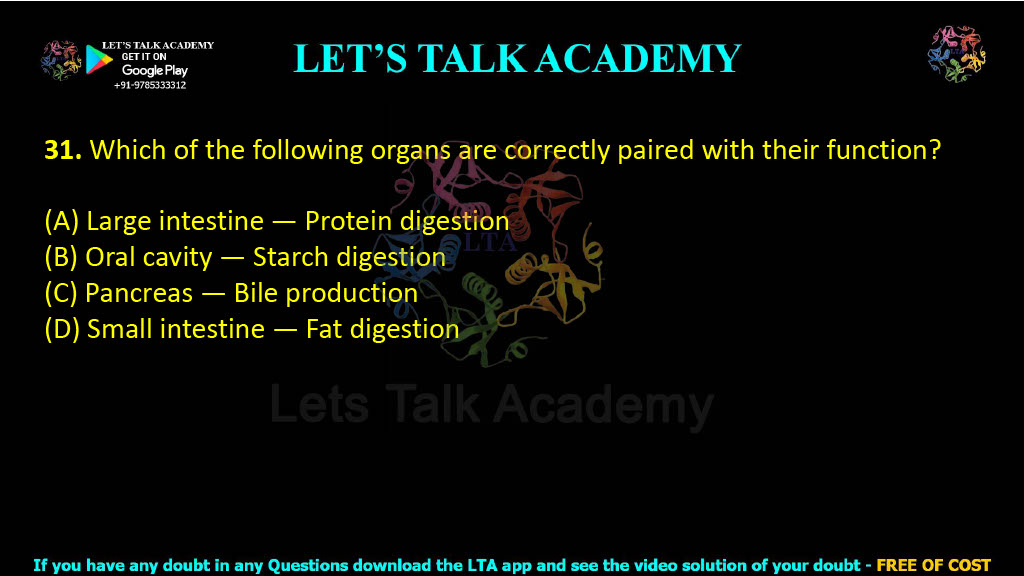
31. Which of the following organs are correctly paired with their function?
(A) Large intestine — Protein digestion
(B) Oral cavity — Starch digestion
(C) Pancreas — Bile production
(D) Small intestine — Fat digestion
Digestive Organs and Their Functions
Introduction
The human digestive system is a highly organized organ system that converts complex food molecules into simpler nutrients that can be absorbed and utilized by the body. Digestion involves both mechanical and chemical processes and occurs sequentially in different organs of the gastrointestinal tract. Each digestive organ performs specialized functions with the help of digestive enzymes, acids, hormones, and accessory secretions. Understanding the specific role of each organ is essential for comprehending human nutrition and metabolism.
The oral cavity initiates carbohydrate digestion, the stomach begins protein digestion, the small intestine is the principal site for digestion and absorption of carbohydrates, proteins, and fats, while the large intestine mainly absorbs water and electrolytes. The pancreas secretes digestive enzymes, whereas the liver produces bile required for fat emulsification.
Correct Answer
Correct Options: (B) and (D)
Detailed Explanation
Each organ of the digestive system has a highly specialized function. Digestion begins in the oral cavity, where food is mechanically broken down by chewing and mixed with saliva. Saliva contains the enzyme salivary amylase (ptyalin), which hydrolyzes starch into maltose and shorter polysaccharides. Therefore, the oral cavity is the first site of carbohydrate digestion.
The small intestine is the major site for digestion and absorption of nutrients. Fat digestion occurs primarily here with the help of bile salts, produced by the liver and stored in the gallbladder, which emulsify fats. Pancreatic lipase then hydrolyzes triglycerides into fatty acids and monoglycerides, which are subsequently absorbed by intestinal epithelial cells.
The large intestine is not involved in protein digestion. Instead, it primarily absorbs water, electrolytes, certain vitamins synthesized by intestinal bacteria, and forms feces.
The pancreas secretes pancreatic juice containing digestive enzymes such as trypsin, chymotrypsin, amylase, lipase, and nucleases. However, it does not produce bile. Bile is synthesized by the liver and stored in the gallbladder before being released into the small intestine.
Therefore, only Options (B) and (D) correctly match the organ with its physiological function.
Explanation of Each Option
Option (A): Large Intestine — Protein Digestion
This statement is incorrect. Protein digestion occurs mainly in the stomach and small intestine through the action of pepsin, trypsin, chymotrypsin, carboxypeptidases, and intestinal peptidases. The large intestine primarily absorbs water and salts rather than digesting proteins.
Option (B): Oral Cavity — Starch Digestion
This statement is correct. Salivary glands secrete salivary amylase, which initiates the digestion of starch into maltose and dextrins. Thus, starch digestion begins in the oral cavity.
Option (C): Pancreas — Bile Production
This statement is incorrect. The pancreas produces digestive enzymes and bicarbonate-rich pancreatic juice but does not synthesize bile. Bile is produced exclusively by hepatocytes in the liver.
Option (D): Small Intestine — Fat Digestion
This statement is correct. Most fat digestion occurs in the duodenum and jejunum after emulsification by bile salts and hydrolysis by pancreatic lipase.
Why Options (B) and (D) are Correct
The oral cavity initiates carbohydrate digestion through salivary amylase, while the small intestine serves as the principal site of fat digestion through the coordinated action of bile salts and pancreatic lipase. These functions are well established in digestive physiology.
Why the Other Options are Incorrect
Why Option (A) is Incorrect
The large intestine specializes in water absorption and feces formation rather than enzymatic digestion of proteins.
Why Option (C) is Incorrect
The pancreas produces digestive enzymes, whereas bile is synthesized by the liver and stored in the gallbladder.
Comparison of All Options
| Option | Organ | Function | Correct or Incorrect |
|---|---|---|---|
| A | Large Intestine | Protein digestion | Incorrect |
| B | Oral Cavity | Starch digestion | Correct |
| C | Pancreas | Bile production | Incorrect |
| D | Small Intestine | Fat digestion | Correct |
Major Digestive Organs and Their Functions
| Organ | Main Function |
|---|---|
| Oral Cavity | Mechanical digestion and initiation of starch digestion |
| Stomach | Protein digestion by pepsin |
| Small Intestine | Digestion and absorption of carbohydrates, proteins, and fats |
| Large Intestine | Water and electrolyte absorption, feces formation |
| Pancreas | Secretion of digestive enzymes and bicarbonate |
| Liver | Bile production |
| Gallbladder | Storage and concentration of bile |
Major Digestive Enzymes
| Enzyme | Source | Substrate | Product |
|---|---|---|---|
| Salivary Amylase | Salivary Glands | Starch | Maltose and dextrins |
| Pepsin | Stomach | Proteins | Peptides |
| Pancreatic Lipase | Pancreas | Triglycerides | Fatty acids and monoglycerides |
| Trypsin | Pancreas | Proteins | Peptides |
Site of Digestion of Major Nutrients
| Nutrient | Site of Digestion | Main Enzyme |
|---|---|---|
| Carbohydrates | Oral cavity and small intestine | Amylase |
| Proteins | Stomach and small intestine | Pepsin, Trypsin |
| Fats | Small intestine | Pancreatic Lipase |
Biological Significance of Organ-Specific Digestion
Each digestive organ performs specialized functions that ensure efficient nutrient utilization. Beginning carbohydrate digestion in the oral cavity reduces the digestive load on the intestine, gastric digestion initiates protein breakdown, and the small intestine completes digestion while absorbing nearly all nutrients. Accessory organs such as the liver and pancreas provide essential secretions that greatly enhance digestive efficiency. The coordinated activity of these organs ensures optimal energy production, growth, tissue repair, and maintenance of homeostasis.
Final Answer
Correct Options: (B) Oral cavity — Starch digestion and (D) Small intestine — Fat digestion
The oral cavity initiates carbohydrate digestion through the action of salivary amylase, while the small intestine is the principal site of fat digestion through the combined action of bile salts and pancreatic lipase. Therefore, the correct answers are Options (B) and (D).


