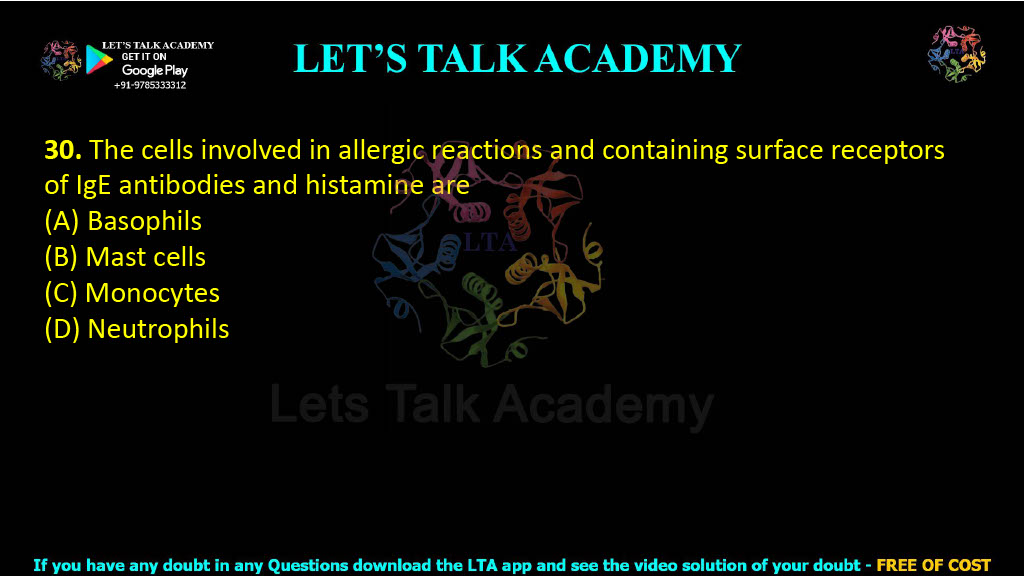
30. The cells involved in allergic reactions and containing surface receptors of IgE antibodies and histamine are
(A) Basophils
(B) Mast cells
(C) Monocytes
(D) Neutrophils
Cells Involved in Allergic Reactions Containing IgE Receptors and Histamine
Introduction
Allergic reactions are exaggerated immune responses that occur when the immune system reacts to harmless environmental substances known as allergens. Common allergens include pollen, dust mites, animal dander, insect venom, certain foods, and medications. These reactions are classified as Type I hypersensitivity reactions according to the Gell and Coombs classification. They are mediated primarily by Immunoglobulin E (IgE) antibodies and specialized immune cells that rapidly release inflammatory mediators.
The principal effector cells responsible for immediate allergic reactions are mast cells. These tissue-resident immune cells express high-affinity FcεRI receptors that bind IgE antibodies on their surface. When an allergen binds and cross-links adjacent IgE molecules, mast cells become activated and rapidly release histamine and numerous other inflammatory mediators. This process produces the characteristic symptoms of allergy, including vasodilation, increased vascular permeability, bronchoconstriction, itching, mucus secretion, and tissue swelling.
Correct Answer
Correct Option: (B) Mast Cells
Detailed Explanation
Mast cells are connective tissue-resident immune cells that play the central role in immediate allergic reactions. Their plasma membrane contains numerous high-affinity FcεRI receptors, which specifically bind the Fc region of IgE antibodies. During the first exposure to an allergen, plasma cells produce allergen-specific IgE antibodies that attach to these receptors on mast cells, a process known as sensitization.
Upon subsequent exposure to the same allergen, the allergen binds simultaneously to two or more IgE molecules on the mast cell surface. This cross-linking activates intracellular signaling pathways that trigger rapid degranulation. During degranulation, mast cells release preformed mediators such as histamine, heparin, and proteases, followed by newly synthesized mediators including leukotrienes, prostaglandins, and cytokines.
Histamine is the major mediator responsible for the early phase of allergic reactions. It increases vascular permeability, dilates blood vessels, stimulates mucus secretion, causes smooth muscle contraction in the bronchi, and activates sensory nerve endings that produce itching. Because mast cells both express surface-bound IgE receptors and contain abundant histamine granules, they are regarded as the primary effector cells in allergic diseases.
Explanation of Each Option
Option (A): Basophils
This statement is incorrect for this question. Basophils also possess FcεRI receptors and contain histamine-containing granules. However, they circulate in the bloodstream and are much less abundant than mast cells. Mast cells are the principal tissue-resident cells responsible for initiating immediate allergic reactions and are therefore the expected answer in competitive examinations.
Option (B): Mast Cells
This statement is correct. Mast cells express high-affinity IgE receptors, store large amounts of histamine in cytoplasmic granules, and serve as the primary effector cells in Type I hypersensitivity reactions.
Option (C): Monocytes
This statement is incorrect. Monocytes are phagocytic cells that differentiate into macrophages and dendritic cells. They participate in innate immunity, antigen presentation, and inflammation but do not mediate IgE-dependent allergic reactions.
Option (D): Neutrophils
This statement is incorrect. Neutrophils are the most abundant circulating leukocytes and function primarily in bacterial defense through phagocytosis. They are not the principal cells responsible for IgE-mediated allergic responses.
Why Option (B) is Correct
Mast cells are strategically located in connective tissues beneath epithelial surfaces where allergens first enter the body. Their surface FcεRI receptors bind IgE antibodies with very high affinity, and their granules contain large amounts of histamine. Upon allergen exposure, rapid degranulation produces the characteristic manifestations of allergy. Therefore, mast cells are the principal cells responsible for immediate hypersensitivity reactions.
Why the Other Options are Incorrect
Why Option (A) is Incorrect
Although basophils also express FcεRI receptors and contain histamine, they are circulating granulocytes and contribute less prominently than mast cells to immediate allergic reactions. Standard immunology questions identify mast cells as the primary effector cells.
Why Option (C) is Incorrect
Monocytes function mainly in phagocytosis, inflammation, and antigen presentation rather than IgE-mediated hypersensitivity.
Why Option (D) is Incorrect
Neutrophils specialize in eliminating bacteria and fungi through phagocytosis and do not possess the characteristic IgE-mediated degranulation mechanism of mast cells.
Comparison of All Options
| Option | Cell Type | Major Function | Correct or Incorrect |
|---|---|---|---|
| A | Basophils | Circulating granulocytes involved in allergic inflammation | Incorrect |
| B | Mast Cells | Primary effector cells of Type I hypersensitivity | Correct |
| C | Monocytes | Phagocytosis and antigen presentation | Incorrect |
| D | Neutrophils | Defense against bacterial infection | Incorrect |
Major Cells Involved in Allergic Reactions
| Cell Type | Role in Allergy |
|---|---|
| Mast Cells | Immediate degranulation and histamine release |
| Basophils | Circulating cells that release histamine during allergic inflammation |
| Eosinophils | Late-phase allergic inflammation and parasite defense |
| B Lymphocytes | Produce allergen-specific IgE antibodies |
| Helper T Cells (Th2) | Stimulate IgE production through IL-4 and IL-13 |
Sequence of an IgE-Mediated Allergic Reaction
| Step | Event |
|---|---|
| 1 | Allergen enters the body |
| 2 | Activation of Th2 cells |
| 3 | B cells produce allergen-specific IgE |
| 4 | IgE binds FcεRI receptors on mast cells |
| 5 | Re-exposure causes IgE cross-linking |
| 6 | Mast cell degranulation |
| 7 | Release of histamine and other inflammatory mediators |
| 8 | Clinical symptoms of allergy develop |
Mediators Released by Mast Cells
| Mediator | Physiological Effect |
|---|---|
| Histamine | Vasodilation, increased vascular permeability, itching, bronchoconstriction |
| Heparin | Anticoagulant activity |
| Leukotrienes | Bronchoconstriction and prolonged inflammation |
| Prostaglandins | Inflammation and vasodilation |
| Cytokines | Recruitment of inflammatory cells |
Biological Significance of Mast Cells
Mast cells provide rapid protection against parasites and venoms by initiating immediate inflammatory responses. However, excessive activation by harmless environmental allergens results in allergic disorders such as allergic rhinitis, urticaria, asthma, eczema, food allergies, and anaphylaxis. Because mast cells are central to these diseases, many anti-allergic therapies—including antihistamines, mast cell stabilizers, corticosteroids, and anti-IgE monoclonal antibodies—are designed to inhibit mast cell activation or block the actions of histamine.
Final Answer
Correct Option: (B) Mast Cells
Mast cells are the primary cells involved in allergic reactions because they possess high-affinity surface receptors (FcεRI) for IgE antibodies and contain abundant histamine-rich granules. Cross-linking of IgE by an allergen triggers mast cell degranulation, leading to the rapid release of histamine and the characteristic symptoms of Type I hypersensitivity reactions.


