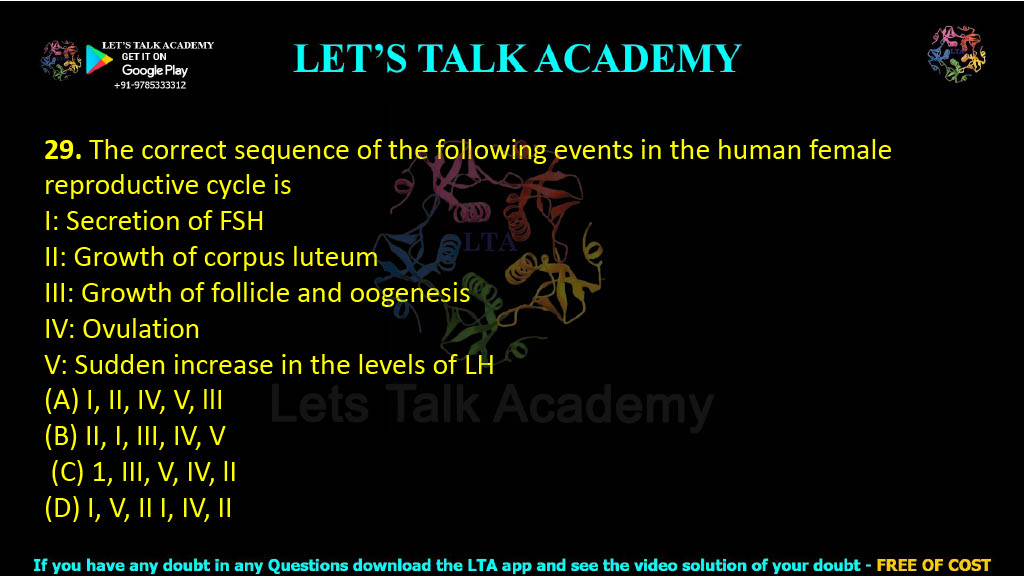
29. The correct sequence of the following events in the human female reproductive cycle is
I: Secretion of FSH
II: Growth of corpus luteum
III: Growth of follicle and oogenesis
IV: Ovulation
V: Sudden increase in the levels of LH
(A) I, II, IV, V, llI
(B) II, I, III, IV, V
(C) 1, III, V, IV, lI
(D) I, V, II I, IV, II
Correct Sequence of Events in the Human Female Reproductive Cycle Explained
Introduction
The human female reproductive cycle is a precisely coordinated physiological process regulated by the hypothalamus, pituitary gland, and ovaries. Hormonal interactions ensure the maturation of ovarian follicles, release of a mature ovum, preparation of the uterus for implantation, and maintenance of pregnancy if fertilization occurs. This cyclic process generally lasts about 28 days and consists of the follicular phase, ovulation, and the luteal phase.
The hormones Follicle Stimulating Hormone (FSH), Luteinizing Hormone (LH), estrogen, and progesterone regulate these sequential events. FSH initiates follicular growth, estrogen produced by developing follicles induces the LH surge, the LH surge triggers ovulation, and the ruptured follicle transforms into the corpus luteum, which secretes progesterone.
Correct Answer
Correct Option: (C) I → III → V → IV → II
Detailed Explanation
The ovarian cycle begins with the secretion of Follicle Stimulating Hormone (FSH) from the anterior pituitary gland. FSH stimulates the growth and maturation of ovarian follicles. During this stage, the primary oocyte resumes development, and granulosa cells proliferate while estrogen secretion gradually increases.
As the dominant follicle grows, increasing estrogen levels exert a positive feedback effect on the anterior pituitary. This positive feedback results in a sudden and dramatic increase in Luteinizing Hormone (LH), commonly known as the LH surge. The LH surge is the key hormonal event responsible for triggering ovulation.
Approximately 24–36 hours after the LH surge, ovulation occurs. During ovulation, the mature Graafian follicle ruptures and releases the secondary oocyte into the fallopian tube, where fertilization may occur if sperm are present.
Following ovulation, the remnants of the ruptured follicle differentiate into the corpus luteum. The corpus luteum secretes progesterone and small amounts of estrogen, preparing the endometrium for implantation and supporting early pregnancy if fertilization occurs.
Therefore, the correct sequence of events is:
FSH secretion → Follicle growth and oogenesis → LH surge → Ovulation → Growth of corpus luteum
This corresponds to Option (C).
Explanation of Each Event
Event I: Secretion of FSH
This is the first event. Follicle Stimulating Hormone initiates follicular development and stimulates granulosa cells within the ovary.
Event III: Growth of Follicle and Oogenesis
This is the second event. Under the influence of FSH, ovarian follicles enlarge, estrogen production increases, and oocyte maturation progresses.
Event V: Sudden Increase in LH Levels
This is the third event. Rising estrogen concentrations from the mature follicle induce the LH surge, which triggers ovulation.
Event IV: Ovulation
This is the fourth event. The mature Graafian follicle ruptures, releasing the secondary oocyte into the oviduct.
Event II: Growth of Corpus Luteum
This is the final event. After ovulation, the ruptured follicle transforms into the corpus luteum, which secretes progesterone to maintain the uterine lining.
Why Option (C) is Correct
Each event follows the normal hormonal regulation of the ovarian cycle. FSH stimulates follicular growth, estrogen induces the LH surge, LH causes ovulation, and the ruptured follicle subsequently develops into the corpus luteum. Therefore, I → III → V → IV → II is the only biologically correct sequence.
Why the Other Options are Incorrect
Why Option (A) is Incorrect
The corpus luteum develops only after ovulation, not immediately after FSH secretion. Therefore, this sequence is physiologically incorrect.
Why Option (B) is Incorrect
The corpus luteum cannot develop before follicular growth or ovulation. This sequence reverses the normal ovarian cycle.
Why Option (D) is Incorrect
The LH surge occurs only after sufficient follicular growth and estrogen production. Therefore, LH cannot precede follicular maturation.
Comparison of All Options
| Option | Sequence | Correct or Incorrect |
|---|---|---|
| A | I → II → IV → V → III | Incorrect |
| B | II → I → III → IV → V | Incorrect |
| C | I → III → V → IV → II | Correct |
| D | I → V → III → IV → II | Incorrect |
Hormonal Regulation of the Ovarian Cycle
| Hormone | Source | Primary Function |
|---|---|---|
| GnRH | Hypothalamus | Stimulates release of FSH and LH |
| FSH | Anterior Pituitary | Follicular growth and estrogen synthesis |
| LH | Anterior Pituitary | Triggers ovulation and corpus luteum formation |
| Estrogen | Growing Follicle | Endometrial proliferation and LH surge |
| Progesterone | Corpus Luteum | Maintains endometrium for implantation |
Sequence of Events During the Ovarian Cycle
| Step | Major Event |
|---|---|
| 1 | FSH secretion |
| 2 | Follicular growth and oocyte maturation |
| 3 | Rise in estrogen concentration |
| 4 | LH surge |
| 5 | Ovulation |
| 6 | Corpus luteum formation |
| 7 | Progesterone secretion |
Follicular Phase versus Luteal Phase
| Feature | Follicular Phase | Luteal Phase |
|---|---|---|
| Dominant Hormone | FSH and Estrogen | Progesterone |
| Main Structure | Growing Follicle | Corpus Luteum |
| Major Event | Follicle maturation | Preparation of uterus for implantation |
| Ends With | Ovulation | Menstruation or Pregnancy |
Biological Significance of This Sequence
The orderly progression of hormonal events ensures successful reproduction. FSH promotes follicular development, estrogen prepares the reproductive tract and induces the LH surge, LH releases the mature oocyte through ovulation, and the corpus luteum secretes progesterone to create a receptive uterine environment for implantation. Any disruption in this sequence can lead to infertility, irregular menstrual cycles, or endocrine disorders.
Final Answer
Correct Option: (C) I → III → V → IV → II
The normal sequence of events in the human female reproductive cycle begins with FSH secretion, followed by follicular growth and oogenesis. Rising estrogen levels induce the LH surge, which triggers ovulation. After ovulation, the ruptured follicle differentiates into the corpus luteum, which secretes progesterone to prepare the uterus for possible implantation.


