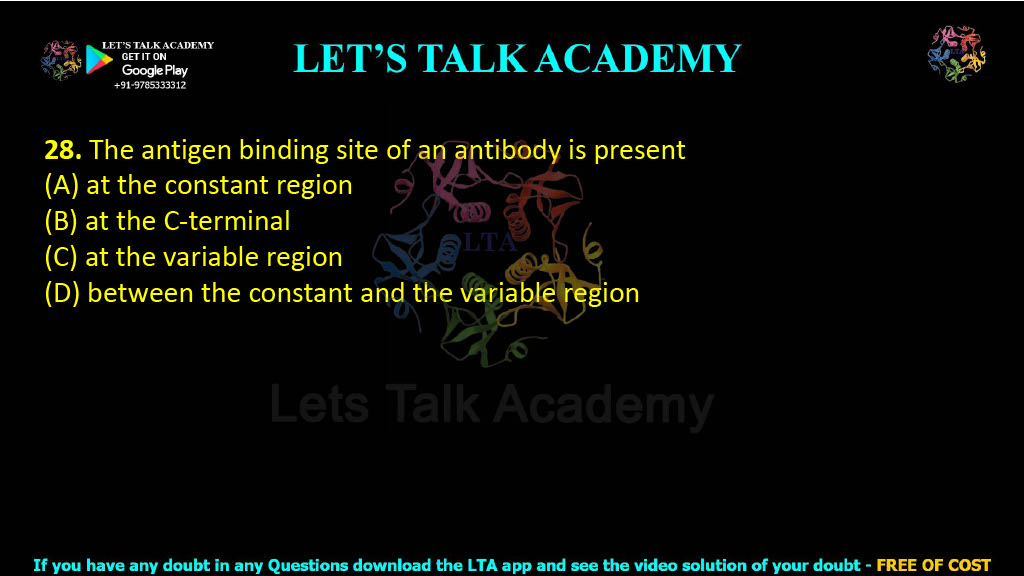
28. The antigen binding site of an antibody is present
(A) at the constant region
(B) at the C-terminal
(C) at the variable region
(D) between the constant and the variable region
Antigen Binding Site of an Antibody
Introduction
Antibodies, also known as immunoglobulins (Ig), are specialized glycoproteins produced by plasma cells in response to foreign antigens. They play a central role in adaptive immunity by recognizing and binding specifically to pathogens such as bacteria, viruses, fungi, parasites, and toxins. This highly specific antigen recognition enables antibodies to neutralize pathogens directly, activate the complement system, promote phagocytosis, and facilitate immune clearance.
The remarkable specificity of antibodies arises from their unique three-dimensional structure. Each antibody consists of two identical heavy chains and two identical light chains linked together by disulfide bonds. These chains contain variable (V) regions and constant (C) regions. The antigen-binding site is formed by the variable domains of one heavy chain and one light chain, particularly within the hypervariable regions called Complementarity Determining Regions (CDRs). These regions provide enormous diversity, allowing the immune system to recognize millions of different antigens.
Correct Answer
Correct Option: (C) At the Variable Region
Detailed Explanation
The antigen-binding site of an antibody is located at the variable region of both the heavy and light chains. The variable domains are situated at the amino (N)-terminal ends of the antibody molecule and together form the antigen-binding pocket, also known as the paratope. This paratope specifically recognizes a complementary region on the antigen called the epitope.
Within the variable region are three highly variable loops known as Complementarity Determining Regions (CDR1, CDR2, and CDR3). These hypervariable regions make direct contact with the antigen through multiple non-covalent interactions, including hydrogen bonds, ionic interactions, van der Waals forces, and hydrophobic interactions. Because of variation in amino acid sequence within the CDRs, antibodies can recognize an enormous variety of antigens.
The constant region, in contrast, does not bind antigen directly. Instead, it determines the biological functions of the antibody, including complement activation, placental transfer, and interaction with Fc receptors on immune cells.
Therefore, the antigen-binding site is present exclusively in the variable region of the antibody.
Explanation of Each Option
Option (A): At the Constant Region
This statement is incorrect. The constant region does not participate in antigen recognition. Instead, it mediates effector functions such as complement activation, binding to Fc receptors, and regulation of immune responses.
Option (B): At the C-Terminal
This statement is incorrect. The C-terminal portion belongs primarily to the Fc region of the heavy chain, which is responsible for immune effector functions rather than antigen binding. Antigen recognition occurs at the N-terminal variable domains.
Option (C): At the Variable Region
This statement is correct. The antigen-binding site is formed by the variable regions of one heavy chain and one light chain. The hypervariable CDR loops within these domains directly recognize the antigen.
Option (D): Between the Constant and the Variable Region
This statement is incorrect. There is no specialized antigen-binding site located between the constant and variable regions. Antigen recognition occurs entirely within the variable domains.
Why Option (C) is Correct
The variable regions contain unique amino acid sequences that form the antigen-binding pocket. These sequences differ among antibodies, allowing each antibody to recognize a specific antigen. The constant regions remain relatively conserved and perform biological functions after antigen binding.
Why the Other Options are Incorrect
Why Option (A) is Incorrect
The constant region determines antibody class (IgG, IgA, IgM, IgE, IgD) and mediates immune effector functions but does not recognize antigens.
Why Option (B) is Incorrect
The C-terminal region forms the Fc portion of the antibody and is involved in complement activation and Fc receptor binding rather than antigen recognition.
Why Option (D) is Incorrect
Antigen binding is restricted to the variable domains and does not occur at the junction between variable and constant regions.
Comparison of All Options
| Option | Location | Role | Correct or Incorrect |
|---|---|---|---|
| A | Constant Region | Effector functions | Incorrect |
| B | C-Terminal Region | Fc-mediated immune functions | Incorrect |
| C | Variable Region | Antigen recognition and binding | Correct |
| D | Between Variable and Constant Regions | No antigen-binding function | Incorrect |
Structure of an Antibody
| Component | Function |
|---|---|
| Variable Region (VH and VL) | Recognizes and binds antigen |
| Constant Region | Determines antibody class and effector function |
| Fab Fragment | Contains antigen-binding sites |
| Fc Fragment | Binds Fc receptors and activates complement |
| Hinge Region | Provides flexibility for antigen binding |
Variable Region versus Constant Region
| Feature | Variable Region | Constant Region |
|---|---|---|
| Sequence | Highly variable | Highly conserved |
| Main Function | Antigen recognition | Immune effector functions |
| Contains CDRs | Yes | No |
| Determines Specificity | Yes | No |
| Activates Complement | No | Yes (mainly IgG and IgM) |
Important Components of Antigen Recognition
| Term | Definition |
|---|---|
| Epitope | Specific region of an antigen recognized by an antibody |
| Paratope | Antigen-binding site of the antibody |
| CDRs | Hypervariable loops responsible for antigen recognition |
| Fab Region | Fragment responsible for antigen binding |
| Fc Region | Fragment responsible for immune effector functions |
Biological Significance of the Variable Region
The variable region enables the immune system to recognize an almost unlimited variety of pathogens. Small differences in amino acid sequences within the CDRs generate enormous antibody diversity, allowing effective protection against new infections. Following antigen recognition, the constant region recruits other immune components such as complement proteins, macrophages, and natural killer cells to eliminate the invading pathogen. Thus, both regions work together to produce an effective immune response.
Final Answer
Correct Option: (C) At the Variable Region
The antigen-binding site of an antibody is present in the variable region, where the variable domains of one heavy chain and one light chain combine to form the paratope. The hypervariable Complementarity Determining Regions (CDRs) within these domains provide the specificity required for precise antigen recognition.


