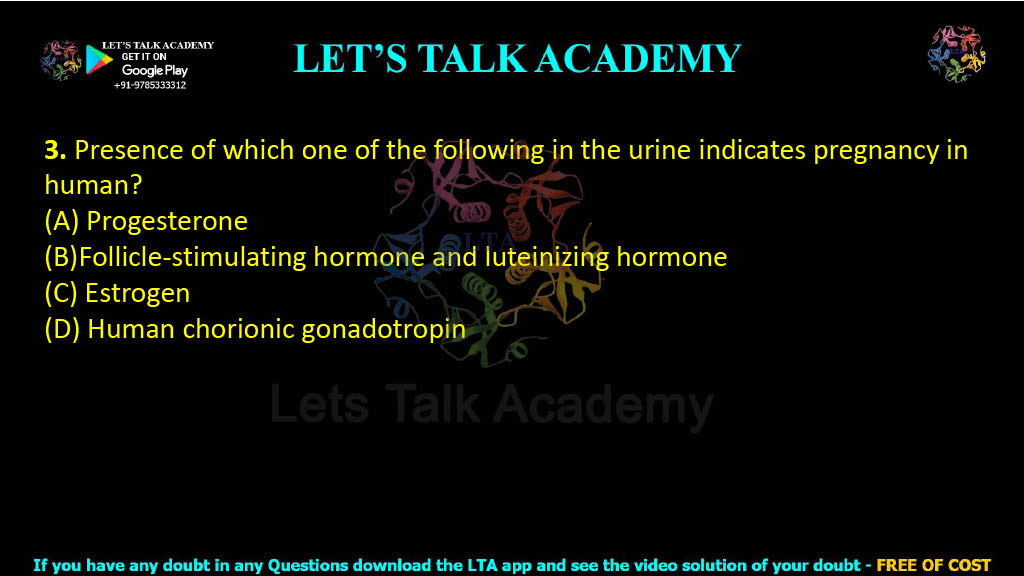
3. Presence of which one of the following in the urine indicates pregnancy in human?
(A) Progesterone
(B)Follicle-stimulating hormone and luteinizing hormone
(C) Estrogen
(D) Human chorionic gonadotropin
Human Chorionic Gonadotropin (hCG) in Urine Indicates Pregnancy
Introduction
Pregnancy is accompanied by remarkable hormonal changes that ensure successful implantation, fetal development, and maintenance of the uterine environment. Shortly after fertilization and implantation, specialized embryonic cells begin producing specific hormones that can be detected in maternal blood and urine. These hormones are widely used in clinical diagnosis because they provide one of the earliest and most reliable indicators of pregnancy.
The hormone most commonly used for pregnancy diagnosis is Human Chorionic Gonadotropin (hCG). This glycoprotein hormone is secreted by the trophoblast cells of the developing embryo and later by the placenta. Because hCG enters the maternal bloodstream and is filtered into urine, it serves as the basis of almost all home pregnancy tests.
Correct Answer
Correct Option: (D) Human Chorionic Gonadotropin (hCG)
Detailed Explanation
Human Chorionic Gonadotropin (hCG) is the earliest specific hormonal marker of pregnancy. Following fertilization, the embryo develops into a blastocyst that implants into the uterine wall approximately six to seven days after fertilization. The outer trophoblast cells of the implanted embryo begin secreting hCG, which rapidly enters the maternal circulation and is subsequently excreted in urine.
The primary function of hCG is to maintain the corpus luteum during the early weeks of pregnancy. The corpus luteum continues secreting progesterone under the influence of hCG, preventing degeneration of the endometrium and supporting implantation until the placenta becomes capable of producing sufficient progesterone independently.
Modern urine pregnancy tests detect hCG using highly specific antibodies. Because hCG appears in urine within approximately 10–14 days after fertilization, it provides a sensitive and reliable method for early pregnancy detection.
Explanation of Each Option
Option (A): Progesterone
This statement is incorrect. Progesterone is essential for maintaining pregnancy by preparing and sustaining the uterine lining, reducing uterine contractions, and supporting fetal development. However, progesterone is present in women during the normal menstrual cycle as well as during pregnancy. Therefore, its presence in urine is not a specific indicator of pregnancy.
Option (B): Follicle-Stimulating Hormone (FSH) and Luteinizing Hormone (LH)
This statement is incorrect. FSH and LH are pituitary hormones that regulate ovarian follicle development and ovulation. During pregnancy, their secretion is markedly suppressed because elevated estrogen, progesterone, and hCG inhibit pituitary gonadotropin release. These hormones are not used for pregnancy diagnosis.
Option (C): Estrogen
This statement is incorrect. Estrogen levels increase during pregnancy, but estrogen is also produced throughout the normal menstrual cycle. Since estrogen is present under both pregnant and non-pregnant conditions, it is not a reliable or specific marker for pregnancy detection.
Option (D): Human Chorionic Gonadotropin (hCG)
This statement is correct. Human Chorionic Gonadotropin is produced specifically after implantation by trophoblast cells and later by the placenta. Its appearance in maternal urine forms the basis of clinical and home pregnancy tests because it is highly specific for pregnancy.
Why Option (D) is Correct
Human Chorionic Gonadotropin is produced only after successful implantation of the embryo. Its concentration rises rapidly during early pregnancy and can be detected in maternal urine using immunological assays. Since hCG is highly specific to pregnancy, it serves as the standard biochemical marker for pregnancy diagnosis worldwide.
Why the Other Options are Incorrect
Why Option (A) is Incorrect
Progesterone is produced during both the menstrual cycle and pregnancy, making it unsuitable as a specific pregnancy marker.
Why Option (B) is Incorrect
FSH and LH regulate ovulation and are suppressed during pregnancy rather than elevated.
Why Option (C) is Incorrect
Estrogen is normally present in cycling females and therefore cannot specifically indicate pregnancy.
Comparison of All Options
| Option | Hormone | Indicates Pregnancy? | Reason |
|---|---|---|---|
| A | Progesterone | No | Present during both menstrual cycle and pregnancy. |
| B | FSH and LH | No | Control ovulation and decrease during pregnancy. |
| C | Estrogen | No | Produced throughout the reproductive cycle. |
| D | Human Chorionic Gonadotropin (hCG) | Yes | Specific hormone produced after embryo implantation. |
Major Reproductive Hormones and Their Functions
| Hormone | Source | Main Function |
|---|---|---|
| Human Chorionic Gonadotropin (hCG) | Trophoblast and placenta | Maintains corpus luteum and early pregnancy |
| Progesterone | Corpus luteum and placenta | Maintains endometrium and pregnancy |
| Estrogen | Ovaries and placenta | Female reproductive development and uterine growth |
| Follicle-Stimulating Hormone (FSH) | Anterior pituitary | Stimulates ovarian follicle development |
| Luteinizing Hormone (LH) | Anterior pituitary | Triggers ovulation and corpus luteum formation |
Characteristics of Human Chorionic Gonadotropin (hCG)
| Feature | Description |
|---|---|
| Hormone Type | Glycoprotein hormone |
| Produced By | Trophoblast cells and placenta |
| Appears After | Embryo implantation |
| Main Function | Maintains corpus luteum and progesterone secretion |
| Clinical Use | Urine and blood pregnancy tests |
Biological Significance of hCG
Human Chorionic Gonadotropin is essential during early pregnancy because it prevents degeneration of the corpus luteum, ensuring continued secretion of progesterone until the placenta becomes fully functional. This hormonal support maintains the uterine lining, promotes embryo survival, and enables successful continuation of pregnancy. Measurement of hCG is also clinically valuable for monitoring early pregnancy, diagnosing ectopic pregnancy, detecting trophoblastic diseases, and evaluating certain germ-cell tumors.
Final Answer
Correct Option: (D) Human Chorionic Gonadotropin (hCG)
Human Chorionic Gonadotropin (hCG) is the specific hormone detected in maternal urine during pregnancy. It is secreted by trophoblast cells after implantation and maintains the corpus luteum, ensuring continued progesterone production during early pregnancy. Because of its specificity and early appearance, hCG is the hormone used in almost all urine pregnancy tests.


