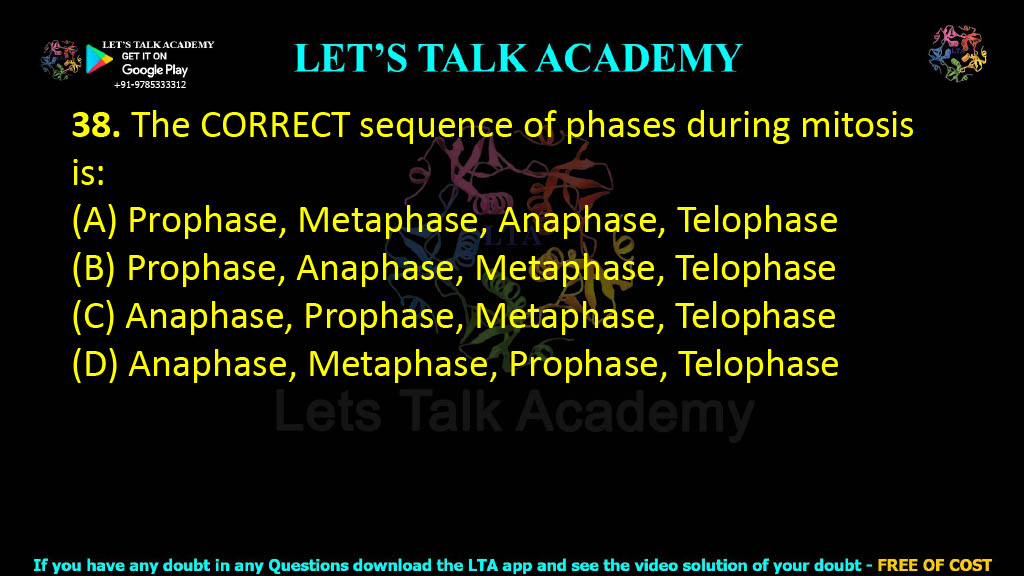
38. The CORRECT sequence of phases during mitosis is:
(A) Prophase, Metaphase, Anaphase, Telophase
(B) Prophase, Anaphase, Metaphase, Telophase
(C) Anaphase, Prophase, Metaphase, Telophase
(D) Anaphase, Metaphase, Prophase, Telophase
Correct Sequence of Mitosis Phases
Introduction
Mitosis is the process of nuclear division in eukaryotic cells that ensures the equal distribution of duplicated chromosomes into two genetically identical daughter cells. It plays a crucial role in growth, tissue repair, regeneration, embryonic development, and maintenance of chromosome number across successive generations of somatic cells. Since chromosome segregation must occur with remarkable precision, mitosis follows a highly organized sequence of events controlled by cyclins, cyclin-dependent kinases (CDKs), spindle checkpoint proteins, and various regulatory molecules.
The four principal stages of mitosis are Prophase, Metaphase, Anaphase, and Telophase. Each stage is characterized by specific structural changes in chromosomes, the nuclear envelope, spindle microtubules, and centrosomes.
Correct Answer
Correct Option: (A) Prophase → Metaphase → Anaphase → Telophase
Detailed Explanation
Mitosis proceeds in a fixed chronological sequence beginning with Prophase, followed by Metaphase, Anaphase, and finally Telophase. Each phase prepares the cell for the next, ensuring accurate chromosome segregation.
During Prophase, chromatin condenses into visible chromosomes, the nucleolus disappears, centrosomes migrate toward opposite poles, and the mitotic spindle begins to assemble. In late prophase (prometaphase), the nuclear envelope breaks down, allowing spindle microtubules to interact with chromosome kinetochores.
In Metaphase, chromosomes become maximally condensed and align precisely along the metaphase plate. Each sister chromatid is attached to spindle fibers originating from opposite poles. The spindle assembly checkpoint verifies that every chromosome is correctly attached before chromosome separation begins.
During Anaphase, cohesin proteins holding sister chromatids together are cleaved by separase. Sister chromatids separate and move toward opposite poles through shortening of kinetochore microtubules and elongation of polar microtubules.
Finally, in Telophase, chromosomes reach the spindle poles and begin to decondense. Nuclear envelopes re-form around each chromosome set, nucleoli reappear, and cytokinesis begins or is completed, producing two genetically identical daughter cells.
Explanation of Each Option
Option (A): Prophase → Metaphase → Anaphase → Telophase
This statement is correct. This is the universally accepted sequence of mitotic stages. Chromosomes condense during prophase, align during metaphase, separate during anaphase, and become enclosed within newly formed nuclei during telophase.
Option (B): Prophase → Anaphase → Metaphase → Telophase
This statement is incorrect. Chromosome alignment at the metaphase plate must occur before sister chromatids can separate. Therefore, anaphase cannot precede metaphase.
Option (C): Anaphase → Prophase → Metaphase → Telophase
This statement is incorrect. Anaphase is one of the later stages of mitosis and cannot occur before chromosome condensation and spindle formation in prophase.
Option (D): Anaphase → Metaphase → Prophase → Telophase
This statement is incorrect. The sequence is completely reversed and does not represent the biological progression of mitosis.
Why Option (A) is Correct
The sequence Prophase → Metaphase → Anaphase → Telophase accurately reflects the orderly progression of chromosome condensation, chromosome alignment, sister chromatid separation, and nuclear reformation. Each phase depends upon successful completion of the previous phase, ensuring faithful chromosome inheritance.
Why the Other Options are Incorrect
Why Option (B) is Incorrect
Chromosome separation cannot begin until chromosomes have aligned at the metaphase plate.
Why Option (C) is Incorrect
Anaphase requires spindle formation and chromosome alignment, which occur earlier during prophase and metaphase.
Why Option (D) is Incorrect
The stages are arranged in an incorrect biological order and do not correspond to normal mitosis.
Comparison of All Options
| Option | Sequence | Correct or Incorrect | Reason |
|---|---|---|---|
| A | Prophase → Metaphase → Anaphase → Telophase | Correct | Represents the normal order of mitosis. |
| B | Prophase → Anaphase → Metaphase → Telophase | Incorrect | Anaphase cannot occur before metaphase. |
| C | Anaphase → Prophase → Metaphase → Telophase | Incorrect | Anaphase is a late mitotic stage. |
| D | Anaphase → Metaphase → Prophase → Telophase | Incorrect | Completely incorrect sequence. |
Events During Each Phase of Mitosis
| Mitotic Phase | Major Events |
|---|---|
| Prophase | Chromosome condensation, spindle formation, disappearance of nucleolus |
| Metaphase | Chromosomes align at the metaphase plate |
| Anaphase | Sister chromatids separate and migrate to opposite poles |
| Telophase | Nuclear envelope re-forms, chromosomes decondense, cytokinesis begins |
Summary of Mitotic Changes
| Cellular Structure | Prophase | Metaphase | Anaphase | Telophase |
|---|---|---|---|---|
| Chromosomes | Condense | Align | Separate | Decondense |
| Nuclear Envelope | Breaks down | Absent | Absent | Re-forms |
| Mitotic Spindle | Forms | Fully developed | Pulls chromatids apart | Disassembles |
| Nucleolus | Disappears | Absent | Absent | Reappears |
Biological Significance of Mitosis
Mitosis maintains chromosome number and genetic stability in somatic cells by producing two genetically identical daughter cells. It supports growth, embryonic development, tissue regeneration, wound healing, and replacement of aged or damaged cells. Accurate chromosome segregation during mitosis prevents aneuploidy and genomic instability, both of which are associated with developmental abnormalities and cancer.
Final Answer
Correct Option: (A) Prophase → Metaphase → Anaphase → Telophase
The correct sequence of mitotic phases is Prophase, Metaphase, Anaphase, and Telophase. During these stages, chromosomes condense, align at the metaphase plate, separate into daughter chromosomes, and are finally enclosed within newly formed nuclei, ensuring accurate chromosome segregation and formation of two genetically identical daughter cells.


