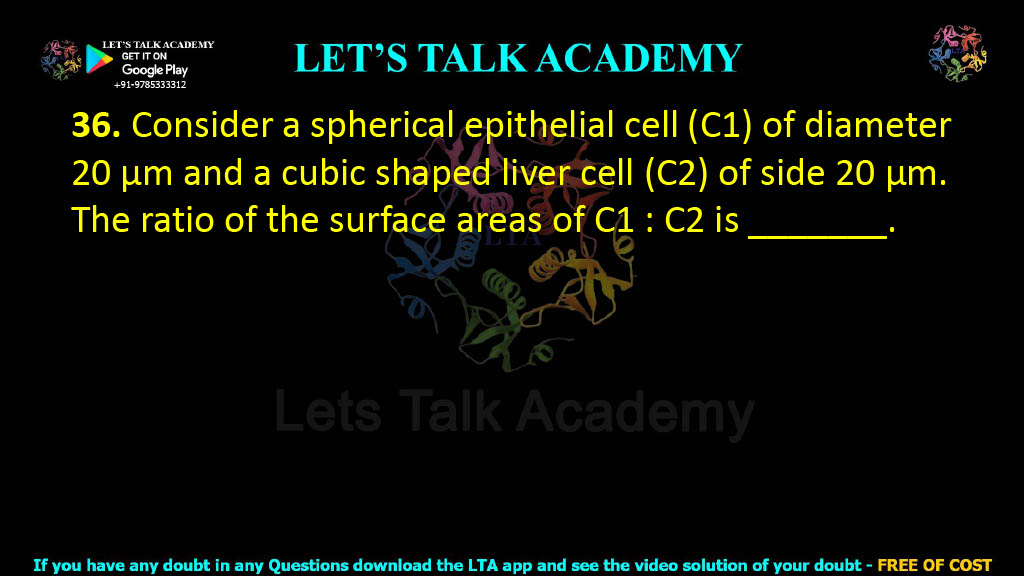
36. Consider a spherical epithelial cell (C1) of diameter 20 μm and a cubic shaped liver cell (C2) of side 20 μm. The ratio of the surface areas of C1 : C2 is _______.
Surface Area Ratio of a Spherical Cell and a Cubic Cell
Introduction
Geometry plays an important role in Cell Biology because the shape of a cell directly influences its surface area, volume, nutrient uptake, waste removal, and rate of exchange with the surrounding environment. Different cell types possess characteristic shapes that are closely related to their biological functions. Spherical cells minimize surface area relative to volume, whereas cuboidal cells provide a larger surface area for transport, secretion, and absorption.
Correct Answer
Correct Answer: 1 : 2
Step-by-Step Solution
Step 1: Surface Area of the Spherical Cell (C1)
The diameter of the sphere is 20 μm.
Therefore, the radius is:
r = 20 ÷ 2 = 10 μm
The surface area of a sphere is:
Surface Area = 4πr2
Substituting the value of the radius:
= 4π × (10)2
= 4π × 100
= 400π μm2
Surface Area of C1 = 400π μm2
Step 2: Surface Area of the Cubic Cell (C2)
The side of the cube is:
a = 20 μm
The surface area of a cube is:
Surface Area = 6a2
Substituting the value:
= 6 × (20)2
= 6 × 400
= 2400 μm2
Surface Area of C2 = 2400 μm2
Step 3: Calculate the Ratio
C1 : C2 = 400π : 2400
Divide both terms by 400:
= π : 6
Using the standard approximation:
π ≈ 3
= 3 : 6
= 1 : 2
Therefore, the ratio of the surface areas is 1 : 2.
Detailed Explanation
The spherical epithelial cell and the cubic liver cell have the same linear dimension of 20 μm, but their geometries are different. A sphere has the minimum possible surface area for a given volume, making it highly efficient for protecting internal contents. In contrast, a cube possesses six flat faces, resulting in a comparatively larger surface area.
Although the exact mathematical ratio is π : 6, competitive examinations generally use π ≈ 3 unless instructed otherwise. This simplifies the ratio to 1 : 2, which is the expected answer.
Mathematical Formula Used
| Shape | Surface Area Formula |
|---|---|
| Sphere | 4πr2 |
| Cube | 6a2 |
Complete Calculation Table
| Cell | Dimension | Formula | Surface Area |
|---|---|---|---|
| Spherical Cell (C1) | Radius = 10 μm | 4πr2 | 400π μm2 |
| Cubic Cell (C2) | Side = 20 μm | 6a2 | 2400 μm2 |
Ratio Calculation
| Expression | Calculation |
|---|---|
| Surface Area Ratio | 400π : 2400 |
| After Simplification | π : 6 |
| Using π ≈ 3 | 3 : 6 |
| Final Ratio | 1 : 2 |
Comparison Between Spherical and Cubic Cells
| Feature | Spherical Cell | Cubic Cell |
|---|---|---|
| Shape | Sphere | Cube |
| Surface Area Formula | 4πr2 | 6a2 |
| Surface Area | 400π μm2 | 2400 μm2 |
| Relative Surface Area | Smaller | Larger |
Biological Significance of Cell Surface Area
The surface area of a cell determines the efficiency with which nutrients enter and waste products leave the cell. Cells with a larger surface area generally possess greater capacity for absorption, secretion, and transport. This is why absorptive epithelial cells develop microvilli that dramatically increase surface area. Liver cells, intestinal epithelial cells, and kidney tubule cells possess structural adaptations that maximize membrane area to support their specialized physiological functions.
Spherical cells, on the other hand, minimize surface area relative to volume and are therefore structurally efficient for cells whose primary function is protection or storage rather than extensive exchange with the environment.
Final Answer
Correct Answer: 1 : 2
The spherical epithelial cell has a surface area of 400π μm2, while the cubic liver cell has a surface area of 2400 μm2. Therefore, the ratio of their surface areas is 400π : 2400 = π : 6, which simplifies to 1 : 2 using the standard approximation π ≈ 3.


