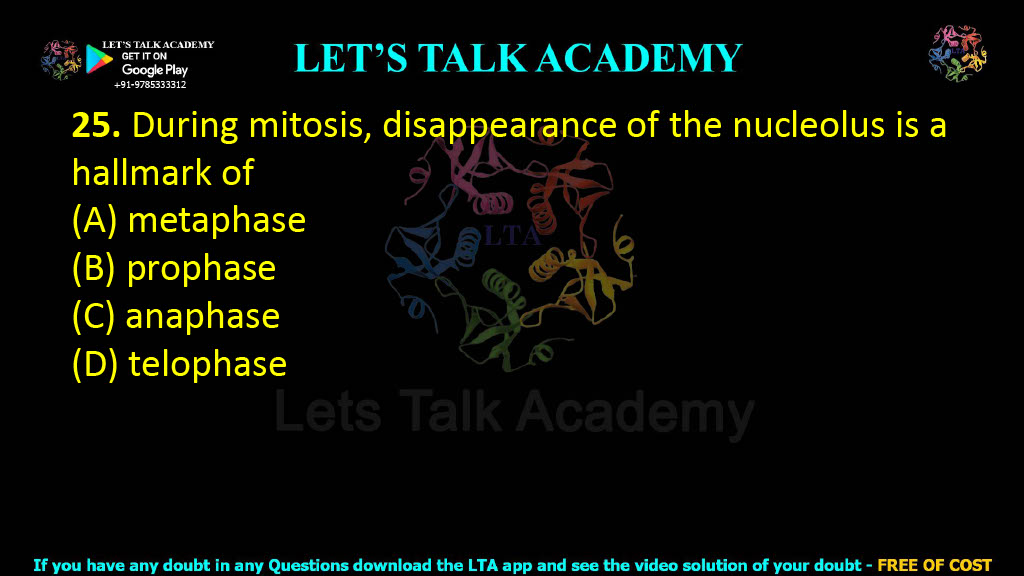
25. During mitosis, disappearance of the nucleolus is a hallmark of
(A) metaphase
(B) prophase
(C) anaphase
(D) telophase
Disappearance of the Nucleolus During Mitosis: Prophase
Introduction
Mitosis is a highly coordinated process of nuclear division that ensures equal distribution of chromosomes into two genetically identical daughter cells. It is a fundamental event in growth, tissue repair, regeneration, and asexual reproduction in eukaryotic organisms. Throughout mitosis, the nucleus undergoes several characteristic structural changes, including chromosome condensation, disappearance of the nucleolus, breakdown of the nuclear envelope, spindle formation, chromosome segregation, and reformation of the nucleus.
One of the earliest visible events during mitosis is the disappearance of the nucleolus. Since the nucleolus is the site of ribosomal RNA synthesis and ribosome assembly, its disassembly reflects the temporary shutdown of ribosome production as the cell prepares for chromosome segregation.
Correct Answer
Correct Option: (B) Prophase
Detailed Explanation
The prophase is the first stage of mitosis during which the cell prepares its chromosomes for accurate segregation. As prophase begins, chromatin fibers condense into distinct chromosomes composed of two sister chromatids joined at the centromere. Simultaneously, the nucleolus gradually disappears because ribosomal RNA transcription stops and nucleolar proteins disperse throughout the nucleus. Shortly afterward, the nuclear envelope begins to disassemble, allowing spindle microtubules to interact with chromosomes during prometaphase.
The disappearance of the nucleolus is therefore considered one of the earliest and most characteristic morphological events of prophase. Once mitosis is completed, the nucleolus reforms during telophase when ribosomal RNA synthesis resumes in the newly formed daughter nuclei.
Explanation of Each Option
Option (A): Metaphase
This statement is incorrect. During metaphase, chromosomes are fully condensed and aligned at the metaphase plate. By this stage, the nucleolus has already disappeared during prophase, and the nuclear envelope has completely broken down. Therefore, nucleolar disappearance is not a defining feature of metaphase.
Option (B): Prophase
This statement is correct. Prophase is characterized by chromosome condensation, disappearance of the nucleolus, initiation of mitotic spindle formation, and the beginning of nuclear envelope disassembly. These structural changes prepare the cell for chromosome alignment and segregation. Hence, disappearance of the nucleolus is one of the classical hallmarks of prophase.
Option (C): Anaphase
This statement is incorrect. During anaphase, sister chromatids separate at the centromeres and move toward opposite spindle poles. Since the nucleolus disappeared much earlier during prophase, it is not associated with anaphase.
Option (D): Telophase
This statement is incorrect. Telophase is essentially the reverse of prophase. Chromosomes decondense into chromatin, the nuclear envelope reassembles around each chromosome set, and the nucleolus reappears as ribosomal RNA synthesis resumes. Therefore, telophase is characterized by nucleolar reformation rather than disappearance.
Why Option (B) is Correct
The disappearance of the nucleolus is an early event of mitosis that occurs during prophase. It reflects the cessation of ribosomal RNA synthesis and ribosome assembly while the cell redirects its resources toward chromosome segregation. Because this event consistently marks the beginning of mitosis, prophase is the correct answer.
Why the Other Options are Incorrect
Why Option (A) is Incorrect
Metaphase occurs after chromosome condensation and nucleolar disappearance have already been completed. It is characterized primarily by chromosome alignment at the equatorial plate.
Why Option (C) is Incorrect
Anaphase involves separation of sister chromatids and their migration to opposite poles. The nucleolus is absent throughout this stage.
Why Option (D) is Incorrect
During telophase, the nucleolus reforms as transcription of ribosomal RNA resumes in the daughter nuclei.
Comparison of All Options
| Option | Mitotic Phase | Nucleolus Status | Correct or Incorrect |
|---|---|---|---|
| A | Metaphase | Already absent | Incorrect |
| B | Prophase | Disappears | Correct |
| C | Anaphase | Absent | Incorrect |
| D | Telophase | Reappears | Incorrect |
Major Events of Each Mitotic Phase
| Mitotic Phase | Major Events |
|---|---|
| Prophase | Chromosome condensation, disappearance of nucleolus, spindle formation begins, nuclear envelope starts disassembling |
| Prometaphase | Complete breakdown of nuclear envelope and attachment of spindle fibers to kinetochores |
| Metaphase | Chromosomes align at the metaphase plate |
| Anaphase | Sister chromatids separate and migrate toward opposite poles |
| Telophase | Chromosomes decondense, nuclear envelope reforms, nucleolus reappears |
Disappearance and Reappearance of the Nucleolus
| Cell Cycle Stage | Nucleolus Status |
|---|---|
| Interphase | Clearly visible and actively synthesizing rRNA |
| Prophase | Disappears |
| Metaphase | Absent |
| Anaphase | Absent |
| Telophase | Reappears |
Biological Significance of Nucleolar Disassembly
The nucleolus functions as the site of ribosomal RNA synthesis and ribosome assembly during interphase. As the cell enters mitosis, transcription of ribosomal RNA temporarily ceases, causing nucleolar components to disperse. This allows the cell to concentrate its energy on chromosome condensation and spindle assembly. After chromosome segregation is complete, the nucleolus reforms in each daughter nucleus, and ribosome production resumes to support protein synthesis in the newly formed cells.
Final Answer
Correct Option: (B) Prophase
During prophase, the nucleolus disappears as ribosomal RNA synthesis temporarily stops and chromosomes begin to condense. This event marks the initiation of mitosis and prepares the cell for accurate chromosome segregation. The nucleolus remains absent throughout metaphase and anaphase and reforms only during telophase.


