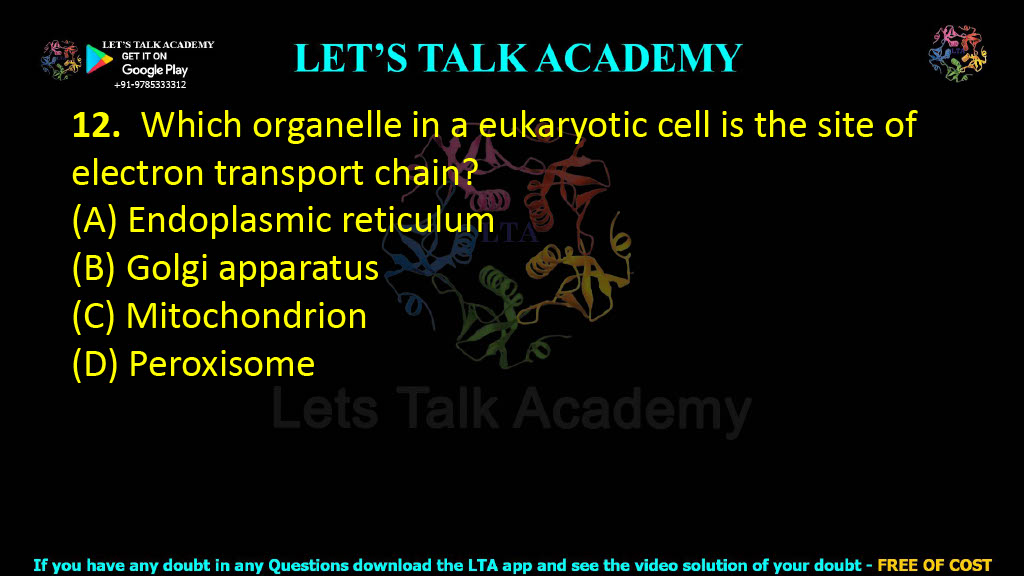
12. Which organelle in a eukaryotic cell is the site of electron transport chain?
(A) Endoplasmic reticulum
(B) Golgi apparatus
(C) Mitochondrion
(D) Peroxisome
Electron Transport Chain in Eukaryotic Cells: Mitochondrion as the Site of Oxidative Phosphorylation
Introduction
The electron transport chain (ETC) is the final and most energy-efficient stage of aerobic cellular respiration. It is responsible for producing the majority of ATP required by eukaryotic cells to perform essential biological functions such as active transport, muscle contraction, protein synthesis, nerve impulse transmission, and cell division. During this process, electrons released from NADH and FADH2 are transferred through a series of protein complexes embedded within the inner mitochondrial membrane. The energy released during electron transfer is used to pump protons across the membrane, creating an electrochemical gradient that ultimately drives ATP synthesis.
Correct Answer
Correct Option: (C) Mitochondrion
Detailed Explanation
The electron transport chain is located on the inner mitochondrial membrane of eukaryotic cells. This membrane contains a series of protein complexes known as Complex I, Complex II, Complex III, Complex IV, and ATP synthase (Complex V). Electrons donated by NADH and FADH2, generated during glycolysis, pyruvate oxidation, and the citric acid cycle, pass through these complexes in a highly organized sequence. As electrons move from one complex to another, energy is released and used to pump hydrogen ions (H+) from the mitochondrial matrix into the intermembrane space.
The accumulation of protons creates an electrochemical gradient known as the proton motive force. ATP synthase utilizes this gradient to synthesize ATP from ADP and inorganic phosphate through the process of oxidative phosphorylation. Oxygen serves as the terminal electron acceptor, combining with electrons and protons to form water. Because the complete electron transport chain and ATP synthase are localized in the inner mitochondrial membrane, the mitochondrion is the correct answer.
Explanation of Each Option
Option (A): Endoplasmic Reticulum
This statement is incorrect. The endoplasmic reticulum (ER) functions primarily in protein synthesis, protein folding, lipid biosynthesis, detoxification, and intracellular calcium storage. Rough endoplasmic reticulum contains ribosomes for protein synthesis, while smooth endoplasmic reticulum participates in lipid metabolism and detoxification. Although the ER performs numerous essential metabolic functions, it does not contain the respiratory chain complexes required for oxidative phosphorylation or ATP production through the electron transport chain.
Option (B): Golgi Apparatus
This statement is incorrect. The Golgi apparatus modifies, sorts, packages, and transports proteins and lipids synthesized by the endoplasmic reticulum. It is responsible for glycosylation, protein maturation, lysosome formation, and vesicular trafficking. The Golgi apparatus does not participate in electron transport, proton pumping, or oxidative phosphorylation and therefore cannot serve as the site of the electron transport chain.
Option (C): Mitochondrion
This statement is correct. The mitochondrion is the principal site of aerobic respiration in eukaryotic cells. The inner mitochondrial membrane contains the complete electron transport chain consisting of Complex I (NADH dehydrogenase), Complex II (succinate dehydrogenase), Complex III (cytochrome bc1 complex), Complex IV (cytochrome c oxidase), and ATP synthase (Complex V). These protein complexes work together to generate ATP through oxidative phosphorylation. Because the electron transport chain is localized exclusively within the mitochondrion, this option is correct.
Option (D): Peroxisome
This statement is incorrect. Peroxisomes are single-membrane organelles involved in fatty acid β-oxidation, detoxification of hydrogen peroxide through catalase, and metabolism of reactive oxygen species. Although peroxisomes participate in oxidative reactions, they do not contain the electron transport chain or ATP synthase. Their primary role is cellular detoxification rather than ATP production.
Why Option (C) is Correct
The mitochondrion contains all components necessary for oxidative phosphorylation. The inner mitochondrial membrane houses the respiratory chain complexes responsible for electron transfer, proton pumping, and ATP generation. Electrons derived from NADH and FADH2 move through the electron transport chain to molecular oxygen, while ATP synthase utilizes the proton gradient to synthesize ATP. Since no other eukaryotic organelle possesses this complete system, the mitochondrion is the only correct answer.
Why the Other Options are Incorrect
Why Option (A) is Incorrect
The endoplasmic reticulum performs protein synthesis, lipid metabolism, and detoxification but lacks the respiratory chain complexes necessary for oxidative phosphorylation.
Why Option (B) is Incorrect
The Golgi apparatus modifies and packages proteins for secretion and intracellular transport. It is not involved in ATP synthesis or electron transport.
Why Option (D) is Incorrect
Peroxisomes perform oxidation reactions associated with lipid metabolism and hydrogen peroxide degradation. They do not contain ATP synthase or electron transport chain complexes.
Comparison of All Options
| Option | Organelle | Site of Electron Transport Chain? | Main Function |
|---|---|---|---|
| A | Endoplasmic Reticulum | No | Protein synthesis, lipid synthesis, detoxification |
| B | Golgi Apparatus | No | Protein modification, sorting, packaging, secretion |
| C | Mitochondrion | Yes | Electron transport chain and ATP synthesis |
| D | Peroxisome | No | Fatty acid oxidation and hydrogen peroxide detoxification |
Major Components of the Electron Transport Chain
| Complex | Name | Main Function |
|---|---|---|
| Complex I | NADH Dehydrogenase | Transfers electrons from NADH to ubiquinone |
| Complex II | Succinate Dehydrogenase | Transfers electrons from FADH2 to ubiquinone |
| Complex III | Cytochrome bc1 Complex | Transfers electrons to cytochrome c |
| Complex IV | Cytochrome c Oxidase | Transfers electrons to oxygen forming water |
| Complex V | ATP Synthase | Synthesizes ATP using the proton gradient |
Functions of the Mitochondrion
The mitochondrion performs several essential cellular functions beyond ATP production. It is the site of the citric acid cycle, oxidative phosphorylation, fatty acid oxidation, calcium storage, apoptosis regulation, reactive oxygen species production, and synthesis of certain metabolic intermediates. Its double-membrane organization enables efficient coupling of electron transport with ATP synthesis, making it the primary energy-producing organelle of eukaryotic cells.
Biological Significance of the Electron Transport Chain
The electron transport chain generates approximately 26–28 molecules of ATP from a single molecule of glucose, making it the most productive stage of aerobic respiration. Without this process, cells would rely only on glycolysis, producing far less ATP. Efficient oxidative phosphorylation is therefore essential for sustaining energy-demanding tissues such as the brain, heart, skeletal muscles, liver, and kidneys.
Final Answer
Correct Option: (C) Mitochondrion
The electron transport chain is located on the inner mitochondrial membrane, where electrons from NADH and FADH2 pass through a series of respiratory complexes to generate a proton gradient. ATP synthase utilizes this gradient to synthesize ATP through oxidative phosphorylation, making the mitochondrion the primary site of ATP production in eukaryotic cells.


