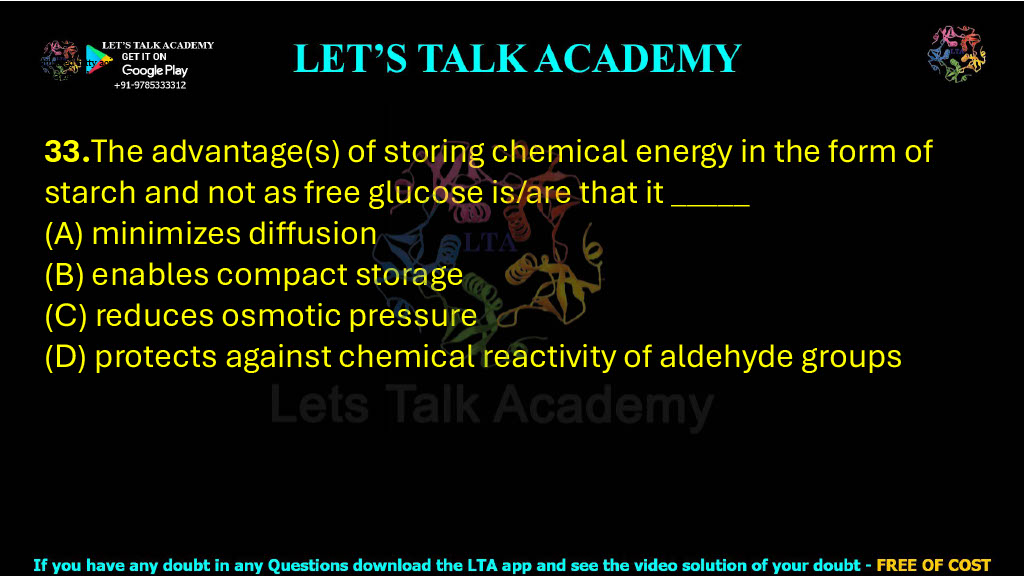
33.The advantage(s) of storing chemical energy in the form of starch and not as free glucose is/are that it _____ .
(A) minimizes diffusion
(B) enables compact storage
(C) reduces osmotic pressure
(D) protects against chemical reactivity of aldehyde groups
Why Is Starch Stored Instead of Free Glucose? | Explanation with Biological Advantages of Starch Storage
Correct Answer
(A), (B), (C) and (D)
Introduction
Living organisms require a continuous supply of energy to carry out essential biological processes such as growth, respiration, biosynthesis, and reproduction. Although glucose is the primary energy-producing molecule in most cells, organisms rarely store it as free glucose. Instead, plants convert excess glucose into starch, while animals store it in the form of glycogen. This conversion is not merely a mechanism for energy storage; it is a highly efficient biological strategy that provides several physiological and biochemical advantages.
Starch is a high-molecular-weight polysaccharide composed of thousands of glucose molecules linked through α(1→4) and α(1→6) glycosidic bonds. Polymerization transforms numerous individual glucose molecules into a single, compact macromolecule with unique physical and chemical properties. This adaptation minimizes osmotic problems, prevents unnecessary diffusion, reduces chemical reactivity, and allows enormous quantities of carbohydrate to be stored efficiently.
Understanding the Concept Behind the Question
Free glucose molecules are small, highly soluble, osmotically active, and chemically reactive. If cells accumulated thousands of glucose molecules individually, they would experience severe osmotic stress, increased diffusion out of storage compartments, and greater susceptibility to unwanted chemical reactions.
By polymerizing glucose into starch, plants convert many small molecules into a single giant macromolecule. As a result:
- Osmotic pressure decreases dramatically.
- Diffusion becomes negligible.
- Storage becomes highly compact.
- Most aldehyde groups are no longer free to participate in chemical reactions.
Therefore, all four options represent genuine biological advantages of storing glucose as starch.
Why Option (A) Is Correct
Minimizes Diffusion
Individual glucose molecules are small and highly water-soluble. Because of their small size, they diffuse rapidly within cells and across membranes whenever transport systems permit. Large losses of glucose through diffusion would reduce the efficiency of energy storage.
When thousands of glucose molecules are linked together into a starch granule, the resulting polymer becomes extremely large and essentially immobile. Such macromolecules cannot diffuse freely through membranes or cytoplasm.
This greatly improves storage efficiency by keeping carbohydrate reserves localized within specialized storage organelles such as plastids.
Therefore,
Option (A) is correct.
Why Option (B) Is Correct
Enables Compact Storage
Starch molecules fold into compact structures composed primarily of amylose and amylopectin.
Because one starch molecule contains hundreds or thousands of glucose residues, enormous amounts of carbohydrate can be stored in a relatively small volume. This compact organization allows plant cells to accumulate large energy reserves without occupying excessive intracellular space.
If glucose remained as individual molecules, much larger cellular volumes would be required for storage.
Therefore,
Option (B) is correct.
Why Option (C) Is Correct
Reduces Osmotic Pressure
Osmotic pressure depends on the number of dissolved particles, not their total mass.
For example:
- 10,000 free glucose molecules behave as 10,000 osmotically active particles.
- The same 10,000 glucose units linked together as one starch molecule behave essentially as one osmotically active particle.
Thus, polymerization dramatically lowers osmotic pressure.
This prevents excessive water influx that could otherwise cause swelling, cellular damage, or even cell lysis.
Reducing osmotic pressure is one of the most important biological reasons for storing carbohydrates as starch.
Therefore,
Option (C) is correct.
Why Option (D) Is Correct
Protects Against Chemical Reactivity of Aldehyde Groups
Glucose is a reducing sugar because it possesses a free aldehyde group (through its open-chain form).
Free aldehyde groups readily participate in reactions such as:
- Glycation of proteins
- Maillard reactions
- Oxidation
- Other unwanted chemical modifications
During starch synthesis, almost every glucose molecule becomes involved in glycosidic bond formation. Consequently, the vast majority of aldehyde groups are no longer freely available for chemical reactions.
Only one reducing end remains in an entire starch molecule regardless of its size.
Therefore, polymerization greatly reduces the overall chemical reactivity of stored glucose.
Hence,
Option (D) is correct.
Why Do Plants Store Starch Instead of Glucose?
Starch represents an ideal storage molecule because it combines several advantageous properties simultaneously.
It is:
- Insoluble
- Compact
- Non-diffusible
- Poorly osmotically active
- Chemically stable
- Easily hydrolyzed when energy is required
Whenever the plant needs energy, enzymes such as amylases rapidly degrade starch back into glucose, providing a readily available source of metabolic fuel.
Comparison Between Free Glucose and Starch
| Feature | Free Glucose | Starch |
|---|---|---|
| Osmotic Effect | Very High | Very Low |
| Diffusion | Rapid | Negligible |
| Storage Efficiency | Poor | Excellent |
| Chemical Reactivity | High | Low |
| Molecular Size | Small | Very Large |
| Storage Form | Not Ideal | Ideal |
Biological Importance of Starch Storage
Starch serves as the principal carbohydrate reserve in plants and accumulates in seeds, roots, tubers, and storage organs. During periods of active growth or germination, starch is hydrolyzed into glucose, supplying energy for respiration and biosynthesis.
Its polymeric nature allows plants to store massive quantities of carbohydrate without disturbing cellular osmotic balance. This adaptation has been essential for the survival of plants throughout evolution and ultimately provides the primary dietary carbohydrate for humans and many animals.
High-Yield Points
- Starch is the storage polysaccharide of plants.
- Glycogen is the storage polysaccharide of animals.
- Polymerization decreases osmotic pressure.
- Large polymers diffuse very slowly.
- Starch allows highly compact carbohydrate storage.
- Polymerization reduces aldehyde reactivity.
- Starch contains amylose and amylopectin.
Frequently Asked Questions
Why does starch reduce osmotic pressure?
Because osmotic pressure depends on the number of dissolved particles. Thousands of glucose molecules become one large polymer, dramatically reducing the number of osmotically active particles.
Why doesn’t starch diffuse easily?
Starch is a very large macromolecule. Its enormous molecular size prevents rapid diffusion through cellular compartments or biological membranes.
Does starch still contain a reducing end?
Yes. Every starch molecule has one reducing end, but because thousands of glucose molecules share a single reducing end, overall chemical reactivity is greatly reduced.
Key Takeaways
Storing glucose as starch provides multiple biological advantages over storing it as free glucose. Polymerization converts thousands of individual glucose molecules into one large macromolecule, thereby minimizing diffusion, allowing compact storage, dramatically reducing osmotic pressure, and decreasing the chemical reactivity associated with free aldehyde groups. These properties make starch an exceptionally efficient storage polysaccharide and explain why it has evolved as the principal carbohydrate reserve in plants.
Final Answer
Correct Answers: (A), (B), (C) and (D)
Explanation
Plants store excess glucose as starch because polymerization provides several important biological advantages. Large starch molecules diffuse very slowly, allowing efficient storage within cells. Their compact structure enables the storage of large amounts of carbohydrate in a small volume. Since thousands of glucose molecules become a single polymer, the number of osmotically active particles decreases dramatically, reducing osmotic pressure. In addition, polymerization converts almost all glucose residues into glycosidic linkages, leaving only one reducing end and thereby reducing the chemical reactivity of aldehyde groups. Therefore, all four statements are correct, making Options (A), (B), (C), and (D) the correct answers.


