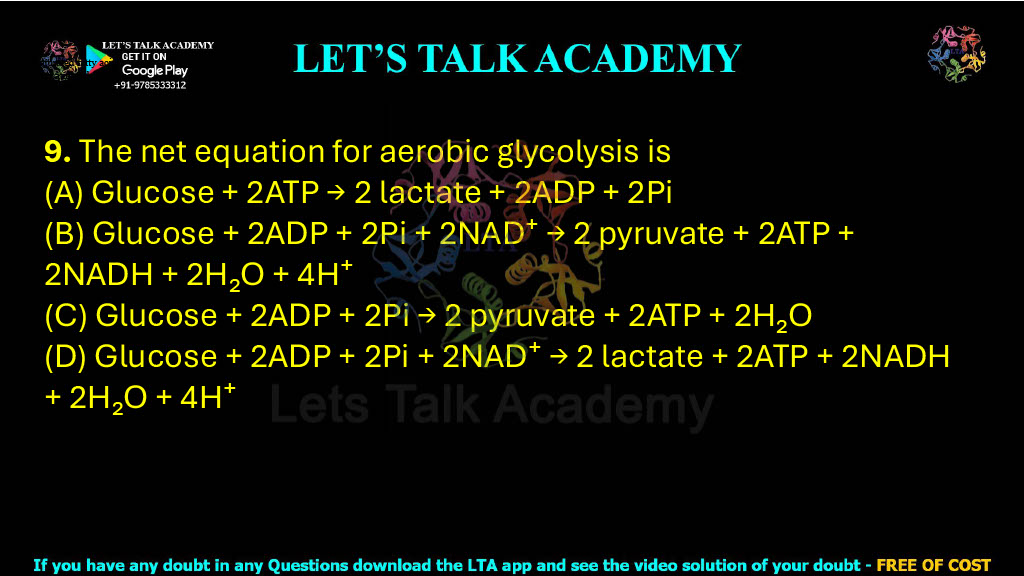
9. The net equation for aerobic glycolysis is
(A) Glucose + 2ATP → 2 lactate + 2ADP + 2Pi
(B) Glucose + 2ADP + 2Pi + 2NAD⁺ → 2 pyruvate + 2ATP + 2NADH + 2H₂O + 4H⁺
(C) Glucose + 2ADP + 2Pi → 2 pyruvate + 2ATP + 2H₂O
(D) Glucose + 2ADP + 2Pi + 2NAD⁺ → 2 lactate + 2ATP + 2NADH + 2H₂O + 4H⁺
Aerobic Glycolysis Net Equation
Correct Answer
Correct Option: (B)
Glucose + 2ADP + 2Pi + 2NAD⁺ → 2 Pyruvate + 2ATP + 2NADH + 2H₂O + 4H⁺
Introduction to the Net Equation of Aerobic Glycolysis
Aerobic glycolysis is the first stage of cellular respiration and one of the most important metabolic pathways studied in biochemistry. It takes place in the cytoplasm of all living cells and converts one molecule of glucose into two molecules of pyruvate through a sequence of ten enzyme-catalyzed reactions. Although glycolysis itself does not require oxygen, it is referred to as aerobic glycolysis when oxygen is available, allowing the pyruvate and NADH produced during the pathway to enter subsequent stages of aerobic respiration. Understanding the net equation of glycolysis is essential because it summarizes the overall energy conversion occurring in the pathway and is frequently tested in competitive examinations such as CSIR NET, GATE, IIT JAM, CUET PG, DBT BET, and university entrance examinations.
Why Option (B) is the Correct Answer
Option (B) correctly represents the overall balanced chemical equation of aerobic glycolysis. During this pathway, one molecule of glucose is broken down into two molecules of pyruvate. While two ATP molecules are consumed in the preparatory phase, four ATP molecules are generated during the payoff phase, resulting in a net gain of two ATP molecules. Simultaneously, two molecules of NAD⁺ accept electrons during the oxidation of glyceraldehyde-3-phosphate and are converted into two molecules of NADH. Water molecules and hydrogen ions are also produced as part of the overall reaction. Therefore, option (B) accurately includes every major reactant and product involved in aerobic glycolysis and represents the accepted biochemical equation found in standard textbooks.
Detailed Explanation of Every Option
Option (A): Glucose + 2ATP → 2 lactate + 2ADP + 2Pi
This option is incorrect because it does not represent the net equation of aerobic glycolysis. The final product shown is lactate, whereas aerobic glycolysis always ends with pyruvate. Lactate is formed only under anaerobic conditions when oxygen is unavailable and pyruvate is reduced to regenerate NAD⁺. Furthermore, this equation ignores the production of ATP and NADH, both of which are essential products of glycolysis. Since it neither represents aerobic glycolysis nor the correct anaerobic reaction, this option is scientifically incorrect.
Option (B): Glucose + 2ADP + 2Pi + 2NAD⁺ → 2 pyruvate + 2ATP + 2NADH + 2H₂O + 4H⁺
This is the correct answer because it includes all of the reactants and products involved in the glycolytic pathway. The equation correctly shows glucose being converted into two molecules of pyruvate while producing a net gain of two ATP molecules and two NADH molecules. The inclusion of NAD⁺ as a reactant and NADH as a product reflects the oxidation-reduction reactions occurring during glycolysis. Water molecules and hydrogen ions are also included, making this the complete and balanced net equation accepted in biochemistry. This reaction is commonly asked in national-level entrance examinations because it integrates concepts of energy metabolism, redox reactions, and ATP synthesis.
Option (C): Glucose + 2ADP + 2Pi → 2 pyruvate + 2ATP + 2H₂O
Although this equation correctly identifies pyruvate as the final product and shows the net production of ATP, it is incomplete because it completely ignores the role of NAD⁺ and NADH. During glycolysis, glyceraldehyde-3-phosphate is oxidized, and this oxidation cannot occur without NAD⁺ serving as an electron acceptor. As a result, two molecules of NADH are always formed during aerobic glycolysis. Since this essential redox component is missing, the equation cannot be considered the correct net reaction.
Option (D): Glucose + 2ADP + 2Pi + 2NAD⁺ → 2 lactate + 2ATP + 2NADH + 2H₂O + 4H⁺
This option incorrectly combines features of aerobic and anaerobic metabolism. Lactate is produced only during anaerobic glycolysis, where NADH is oxidized back to NAD⁺ by the enzyme lactate dehydrogenase. Therefore, if lactate is the final product, NADH should not remain as a net product because it is consumed during lactate formation. This equation incorrectly lists both lactate and NADH as final products, making it chemically inconsistent and biologically incorrect.
The Complete Net Equation of Aerobic Glycolysis
The universally accepted overall reaction for aerobic glycolysis is:
Glucose + 2ADP + 2Pi + 2NAD⁺ → 2 Pyruvate + 2ATP + 2NADH + 2H₂O + 4H⁺
This equation summarizes all ten reactions of the glycolytic pathway after canceling intermediate compounds. It reflects the net production of ATP through substrate-level phosphorylation and the formation of NADH through oxidation of glyceraldehyde-3-phosphate. Under aerobic conditions, the pyruvate produced enters the mitochondrial matrix to participate in the citric acid cycle, while NADH donates electrons to the electron transport chain for additional ATP production.
ATP Yield During Glycolysis
One of the most important concepts in glycolysis is the distinction between gross ATP production and net ATP production. During the first phase of glycolysis, two ATP molecules are consumed to activate glucose and its intermediates. In the second phase, four ATP molecules are synthesized through substrate-level phosphorylation. Since two ATP molecules were initially invested, the pathway provides a net gain of two ATP molecules per glucose molecule. Students often confuse the total ATP produced with the net ATP gained, making this a frequently tested examination concept.
NADH Formation During Glycolysis
In addition to ATP production, glycolysis generates reducing power in the form of NADH. During the oxidation of glyceraldehyde-3-phosphate by glyceraldehyde-3-phosphate dehydrogenase, two molecules of NAD⁺ accept electrons and hydrogen ions, producing two molecules of NADH. Under aerobic conditions, these NADH molecules are transported into the mitochondria through shuttle systems, where they donate electrons to the electron transport chain. The energy released from these electrons contributes to oxidative phosphorylation, significantly increasing the total ATP yield of glucose metabolism.
Difference Between Aerobic and Anaerobic Glycolysis
Although glycolysis itself is an oxygen-independent pathway, its products differ depending on oxygen availability. Under aerobic conditions, pyruvate remains the final product of glycolysis and enters the mitochondria for complete oxidation through the citric acid cycle. NADH generated during glycolysis transfers its electrons to the electron transport chain, allowing efficient ATP production. In contrast, under anaerobic conditions, pyruvate is converted into lactate by lactate dehydrogenase. During this reaction, NADH is oxidized back to NAD⁺, ensuring that glycolysis can continue even in the absence of oxygen. This distinction explains why pyruvate is the correct final product in aerobic glycolysis, whereas lactate is produced only during anaerobic metabolism.
Common Mistakes Students Make
Many students mistakenly believe that glycolysis requires oxygen because the term “aerobic glycolysis” contains the word aerobic. In reality, glycolysis occurs with or without oxygen. Oxygen becomes important only after glycolysis when pyruvate enters the mitochondria for aerobic respiration. Another common mistake is choosing an equation that omits NADH production or incorrectly identifies lactate as the final product. Students should also remember that glycolysis produces four ATP molecules but consumes two ATP molecules, giving a net yield of only two ATP molecules.
Exam Tips for CSIR NET, GATE, IIT JAM, and CUET PG
Questions related to glycolysis often test the overall reaction, ATP yield, NADH production, enzyme functions, irreversible reactions, and differences between aerobic and anaerobic metabolism. Examiners frequently provide options that intentionally omit NADH or replace pyruvate with lactate to confuse candidates. The easiest way to avoid mistakes is to remember that aerobic glycolysis always ends with pyruvate, generates two NADH molecules, and provides a net gain of two ATP molecules. If lactate appears as the final product, the reaction is describing anaerobic metabolism rather than aerobic glycolysis.
Final Answer
The correct net equation for aerobic glycolysis is:
Glucose + 2ADP + 2Pi + 2NAD⁺ → 2 Pyruvate + 2ATP + 2NADH + 2H₂O + 4H⁺
This equation accurately represents the overall biochemical changes that occur during glycolysis under aerobic conditions. It correctly includes the net production of ATP, the formation of NADH through oxidation reactions, and the generation of pyruvate as the final product. Therefore, Option (B) is the correct answer and represents the standard net equation of aerobic glycolysis used in biochemistry textbooks and competitive examinations.


