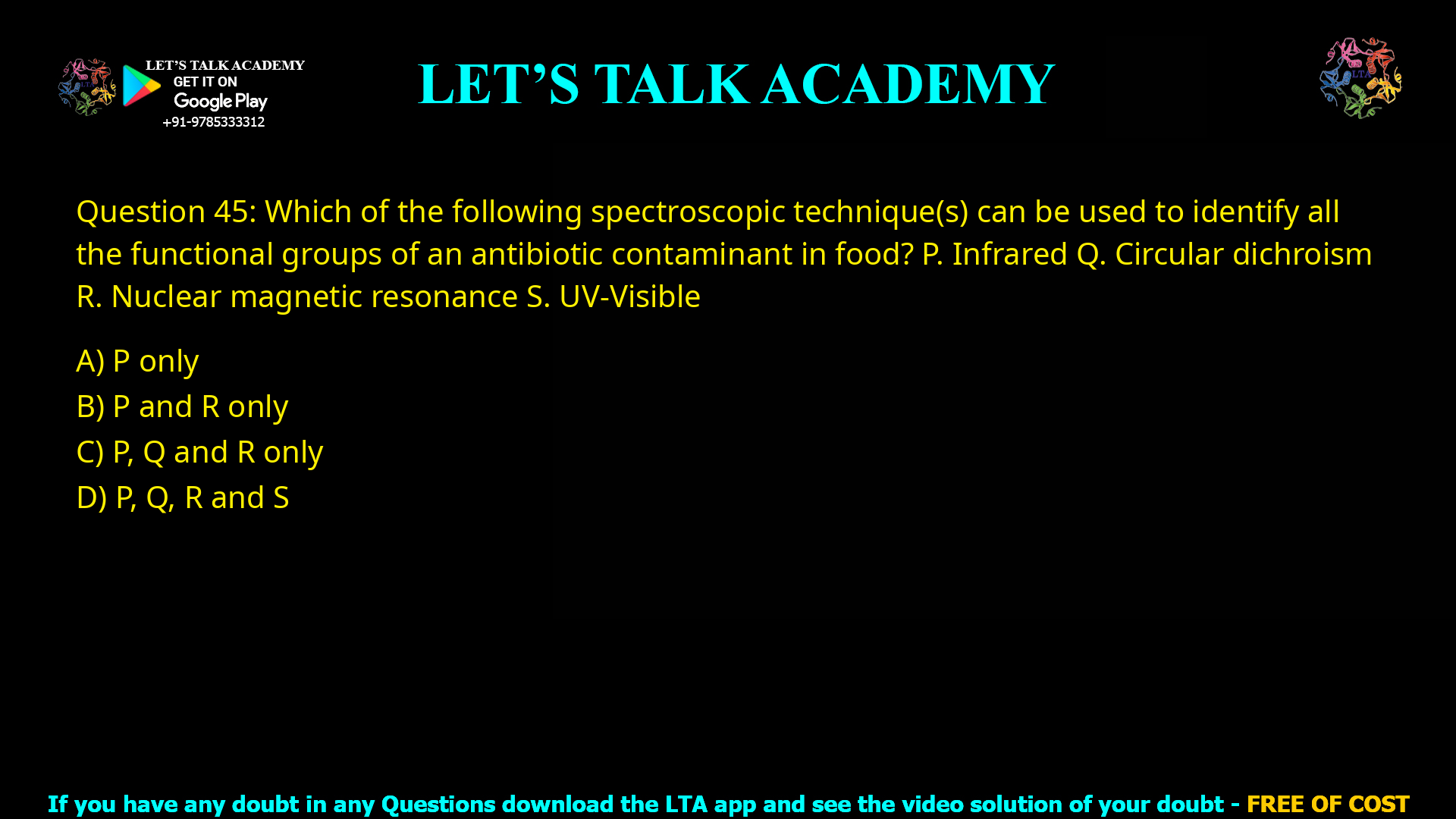
Q.45 Which of the following spectroscopic technique(s) can be used to identify all the
functional groups of an antibiotic contaminant in food?
P. Infrared
Q. Circular dichroism
R. Nuclear magnetic resonance
S. UV-Visible
(A) P only
(B) P and R only
(C) P, Q and R only
(D) P, Q, R and S
Mastering Spectroscopy: Identifying Functional Groups in Antibiotic Contaminants
Infrared (IR) and Nuclear Magnetic Resonance (NMR) spectroscopy stand out as the primary techniques for comprehensively identifying all functional groups in an antibiotic contaminant found in food samples. The correct answer to the multiple-choice question is (B) P and R only, as these methods provide detailed structural insights essential for accurate detection in food safety analysis.
Correct Answer
(B) P and R only
IR spectroscopy excels at detecting functional groups through characteristic vibrational frequencies, while NMR provides atomic-level structural confirmation. Together, they ensure complete identification without gaps common in other methods.
Infrared (P)
Infrared spectroscopy identifies functional groups by measuring molecular vibrations in the 4000–400 cm⁻¹ range, where peaks like 1700 cm⁻¹ signal carbonyls (C=O) and 3300 cm⁻¹ indicate O-H or N-H bonds. This makes it ideal for antibiotics with diverse groups like amides or esters in contaminants such as penicillin derivatives. However, it cannot distinguish stereochemistry or exact proton environments, limiting it to group presence rather than full structure.
Circular Dichroism (Q)
Circular dichroism measures differential absorption of left- and right-circularly polarized light, primarily revealing secondary structures in chiral molecules like proteins or peptides. It proves useful for conformational analysis in some antibiotics but fails to identify all functional groups, as it overlooks non-chiral features like alkyl chains or symmetric carbonyls. Thus, Q cannot standalone for comprehensive detection.
Nuclear Magnetic Resonance (R)
NMR spectroscopy determines the full molecular structure by analyzing nuclear spin interactions, assigning carbons (¹³C NMR) and protons (¹H NMR) to specific functional groups via chemical shifts and coupling patterns. For antibiotic contaminants, it maps out amines, ketones, and heterocycles precisely, even in complex food matrices after extraction. This atomic-resolution capability complements IR perfectly.
UV-Visible (S)
UV-Vis spectroscopy detects conjugated systems or chromophores through electronic transitions, useful for aromatic antibiotics like tetracyclines but blind to saturated groups like alcohols or alkanes. It offers no vibrational or spin data for broad functional group ID, making it supplementary at best for quantification rather than identification.
| Technique | Identifies All Functional Groups? | Key Strength | Limitation |
|---|---|---|---|
| P (IR) | Partial | Vibrational fingerprints | No stereochemistry |
| Q (CD) | No | Chirality/conformation | Ignores non-chiral groups |
| R (NMR) | Yes | Atomic connectivity | Requires pure samples |
| S (UV-Vis) | No | Conjugation | Saturated groups invisible |


