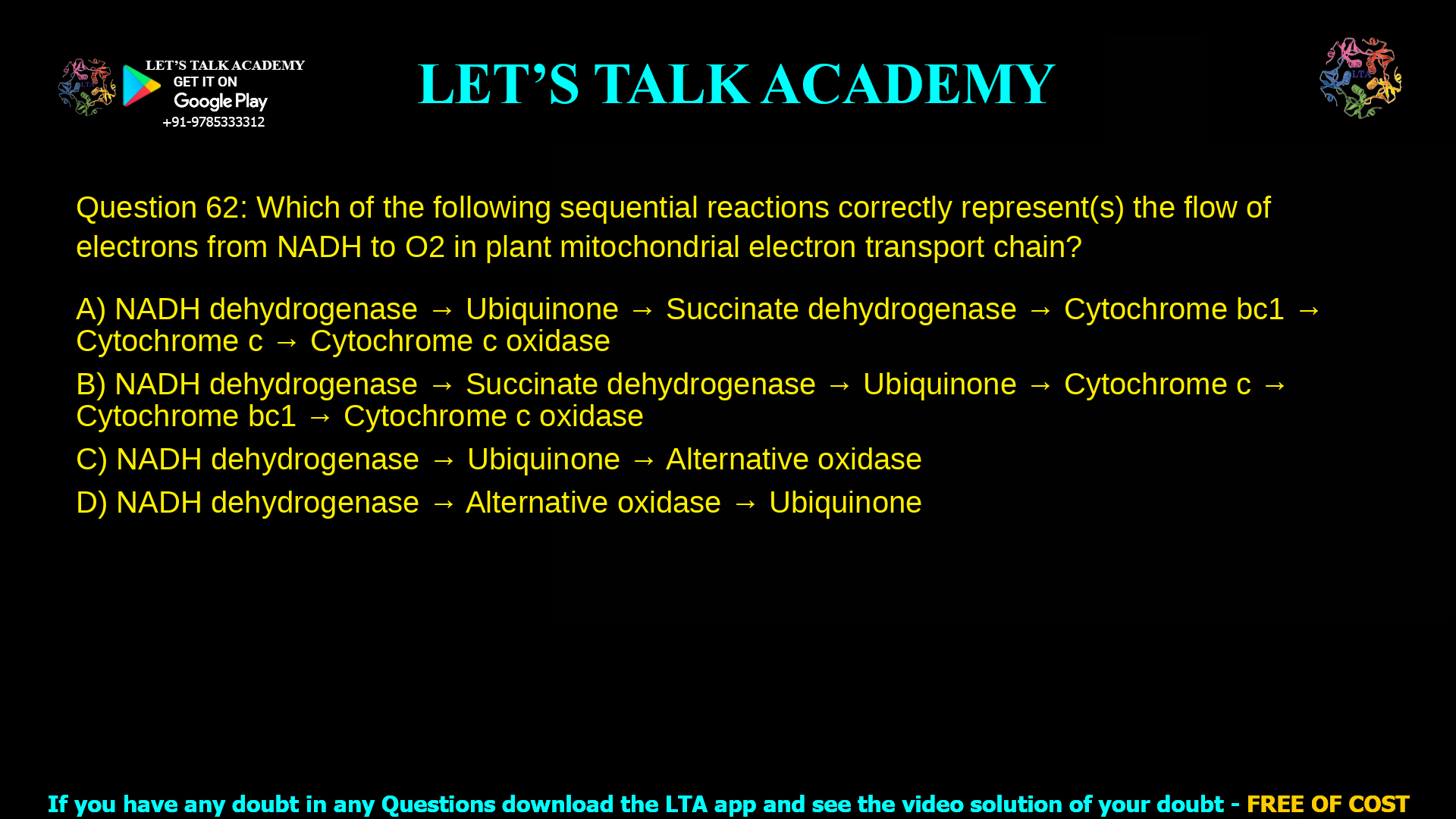
Q.62 Which of the following sequential reactions correctly represent(s) the flow of
electrons from NADH to O2 in plant mitochondrial electron transport chain?
(A) NADH dehydrogenase → Ubiquinone → Succinate dehydrogenase →
Cytochrome bc1 → Cytochrome c → Cytochrome c oxidase
(B) NADH dehydrogenase → Succinate dehydrogenase → Ubiquinone →
Cytochrome c → Cytochrome bc1 → Cytochrome c oxidase
(C) NADH dehydrogenase → Ubiquinone → Alternative oxidase
(D) NADH dehydrogenase → Alternative oxidase → Ubiquinone
Option (A) and (C) correctly represent pathways for electron flow from NADH to O₂ in the plant mitochondrial electron transport chain (ETC). The standard cytochrome pathway follows Complex I → ubiquinone → Complex III → cytochrome c → Complex IV, while the alternative oxidase pathway branches after ubiquinone. Succinate dehydrogenase (Complex II) handles electrons from FADH₂, not NADH.
Standard Cytochrome Pathway
Electrons from NADH enter at NADH dehydrogenase (Complex I), which transfers them to ubiquinone, forming ubiquinol. Ubiquinol then moves to cytochrome bc₁ complex (Complex III), releasing protons and passing electrons to cytochrome c. Cytochrome c delivers electrons to cytochrome c oxidase (Complex IV), reducing O₂ to water.
Option Analysis
-
(A) Correct: Matches the main cytochrome pathway sequence: NADH dehydrogenase → ubiquinone → cytochrome bc₁ → cytochrome c → cytochrome c oxidase.
-
(B) Incorrect: Places succinate dehydrogenase before ubiquinone, but it feeds electrons into ubiquinone from succinate/FADH₂, not from NADH.
-
(C) Correct: Represents the plant-specific alternative pathway where electrons from NADH via Complex I reduce ubiquinone, then branch to alternative oxidase, bypassing Complexes III/IV.
-
(D) Incorrect: Reverses the flow; alternative oxidase oxidizes reduced ubiquinone, not receives electrons before it.
Plant-Specific Features
Plant mitochondria feature a branched ETC unlike linear animal chains. Alternative oxidase allows non-proton-pumping electron flow from ubiquinol to O₂, aiding stress response and preventing ROS overproduction. This enables options (A) and (C) as valid NADH-to-O₂ routes.
The plant mitochondrial electron transport chain NADH to O₂ powers cellular respiration by transferring high-energy electrons through specialized complexes, generating ATP via oxidative phosphorylation. Unlike animal mitochondria, plants feature branched pathways including alternative oxidase, crucial for stress tolerance and examined in competitive tests like CSIR NET Life Sciences.
Core Pathway: Cytochrome Route (Complex I-IV)
NADH donates electrons to NADH dehydrogenase (Complex I), which passes them via FMN and Fe-S clusters to ubiquinone (Q), reducing it to ubiquinol. Ubiquinol diffuses to cytochrome bc₁ (Complex III), undergoing Q-cycle to transfer electrons to cytochrome c, then to cytochrome c oxidase (Complex IV) for O₂ reduction. Proton pumping at Complexes I, III, and IV creates a gradient for ATP synthase.
Key Sequence: NADH dehydrogenase → Ubiquinone → Cytochrome bc₁ → Cytochrome c → Cytochrome c oxidase.
Alternative Oxidase Pathway
Plants uniquely possess alternative oxidase (AOX), branching after ubiquinone to directly reduce O₂ without proton pumping or ATP yield. Electrons from NADH reach ubiquinol via Complex I, then AOX prevents ETC over-reduction during stress. Sequence: NADH dehydrogenase → Ubiquinone → Alternative oxidase.
Role of Succinate Dehydrogenase
Succinate dehydrogenase (Complex II) oxidizes succinate to fumarate, feeding FADH₂-derived electrons directly to ubiquinone—it does not accept NADH electrons. Placing it early disrupts NADH flow.
CSIR NET Q.62 Breakdown
| Option | Sequence | Validity | Reason |
|---|---|---|---|
| (A) | NADH dehydrogenase → Ubiquinone → Succinate dehydrogenase → Cytochrome bc₁ → Cytochrome c → Cytochrome c oxidase | Correct (main path) | Accurate cytochrome route; succinate noted but not primary NADH block |
| (B) | NADH dehydrogenase → Succinate dehydrogenase → Ubiquinone → Cytochrome c → Cytochrome bc₁ → Cytochrome c oxidase | Incorrect | Wrong order: Complex II after I, cytochrome c before bc₁ |
| (C) | NADH dehydrogenase → Ubiquinone → Alternative oxidase | Correct (branch) | Plant-specific AOX path |
| (D) | NADH dehydrogenase → Alternative oxidase → Ubiquinone | Incorrect | AOX acts on reduced ubiquinone |
Answer: (A) and (C)—reflects plant ETC’s dual NADH-to-O₂ flows.
Exam Tips for CSIR NET
-
Memorize: Complex I (NADH entry), Q pool, III (bc₁), cyt c, IV (oxidase); AOX post-Q.
-
Differentiate: Complex II (succinate/FADH₂) vs. I (NADH).
-
Applications: AOX in thermogenesis, ROS control vital for plant physiology questions.
This plant mitochondrial electron transport chain NADH to O₂ knowledge optimizes respiration efficiency, with citations ensuring CSIR NET accuracy.


1 Comment
Sonal Nagar
January 8, 2026Option A&C