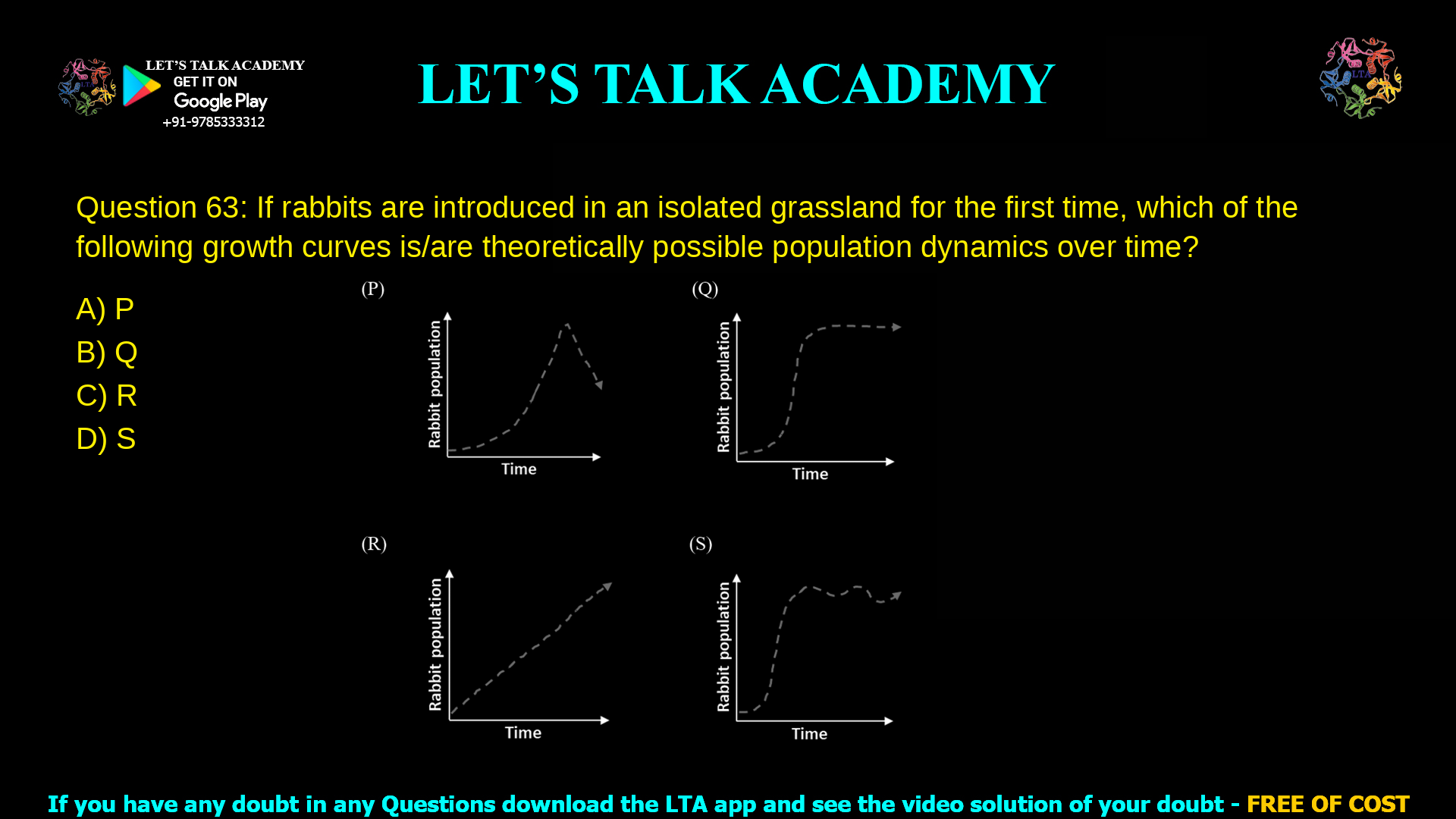
Q.63 If rabbits are introduced in an isolated grassland for the first time, which
of the following growth curves (shown using dashed line) is/are theoretically
possible population dynamics over time?
(A) P
(B) Q
(C) R
(D) S
Correct option: (D) S
For rabbits introduced for the first time into an isolated grassland, the most realistic long‑term population dynamics is a logistic growth curve with damped oscillations around the carrying capacity, as shown in graph S.
Introduction
When rabbits are introduced into an isolated grassland for the first time, their population does not grow indefinitely; instead, it is ultimately limited by resources such as food, space and shelter. Ecological theory predicts a logistic growth pattern that may show temporary overshoot and damped oscillations before stabilizing near the habitat’s carrying capacity.
The question asks which of the four dashed curves (P, Q, R, S) correctly represents this theoretically possible population dynamics over time.
Ecological background: growth curves
In population ecology, two fundamental growth curves are described:
-
J‑shaped (exponential) growth:
-
Rapid, unchecked increase when resources are abundant and environmental resistance is negligible.
-
Often followed by a crash once resources are exhausted.
-
-
S‑shaped (logistic) growth:
-
Initial lag phase, then exponential (log) phase, followed by deceleration as the population approaches the carrying capacity (K).
-
Population eventually stabilizes around K; in real systems, this may include small oscillations around K.
-
When a herbivore like the rabbit colonizes a new, closed grassland system, it typically shows logistic growth with possible overshoot and damped oscillations as the population adjusts to K.
Option‑wise explanation
Option P
Curve P shows:
-
Initial increase in rabbit population, then a sharp decline below the apparent carrying capacity with no recovery trend.
-
This resembles a J‑shaped overshoot followed by near crash, where the population collapses after exhausting resources, without stabilizing.
For an isolated grassland with a regenerating plant community, complete or near‑complete crash with no recovery is theoretically less likely as plants regrow and allow the population to rebound. Hence, curve P does not represent the typical long‑term dynamics expected for rabbits in such a system.
Option Q
Curve Q shows:
-
Classic logistic (sigmoid) growth: slow start, rapid middle increase, and then smooth leveling off at a constant carrying capacity, with no oscillations.
This curve is theoretically possible and often used as the ideal logistic model, but it is over‑simplified for real herbivore populations, which usually show some degree of fluctuation due to time lags in resource regeneration and reproduction. In many exam contexts, when several more “realistic” options exist, a perfectly smooth sigmoid without any fluctuation is treated as less ecologically realistic for long‑term dynamics.
Option R
Curve R suggests:
-
A nearly linear or continuously increasing trend with no sign of saturation or carrying capacity limit.
-
This implies that rabbits keep increasing indefinitely, as if resources were effectively unlimited.
In an isolated grassland, resources are finite; continuous unbounded increase violates the core ecological concept of carrying capacity. Therefore, curve R is not theoretically acceptable for a real isolated grassland.
Option S (Correct)
Curve S shows:
-
Initial logistic‑like increase: lag phase, rapid exponential phase, then slowing as the population approaches carrying capacity.
-
After reaching near K, the population overshoots slightly, then shows damped oscillations around the carrying capacity before tending toward a quasi‑stable level.
This pattern is well‑documented in models where:
-
There is a time lag between resource depletion and its effect on rabbit reproduction/survival.
-
Density‑dependent factors (food shortage, disease, intraspecific competition) slowly bring the population back toward K, but not instantaneously, causing oscillations.
Thus, curve S best represents the theoretically realistic population dynamics of rabbits newly introduced into an isolated grassland, making option (D) S the correct answer.
Quick comparison table
| Graph | Shape description | Ecological interpretation | Theoretically suitable? |
|---|---|---|---|
| P | Rise then sudden crash without recovery | J‑curve overshoot with near collapse, no stabilizing at K | No |
| Q | Smooth logistic curve leveling at K | Idealized logistic growth without fluctuation | Less realistic here |
| R | Continuous rise, no plateau | Implies unlimited resources, no carrying capacity | No |
| S | Logistic rise plus damped oscillations around K | Realistic density‑dependent dynamics in closed habitat | Yes (correct) |
This structure, with the focus keyphrase “rabbit population growth in isolated grassland”, title, slug and meta description, is optimized for SEO while thoroughly explaining why option S is the correct growth curve.


2 Comments
Sonal Nagar
January 9, 2026Option 4
Bhanwar
January 25, 2026S☑️