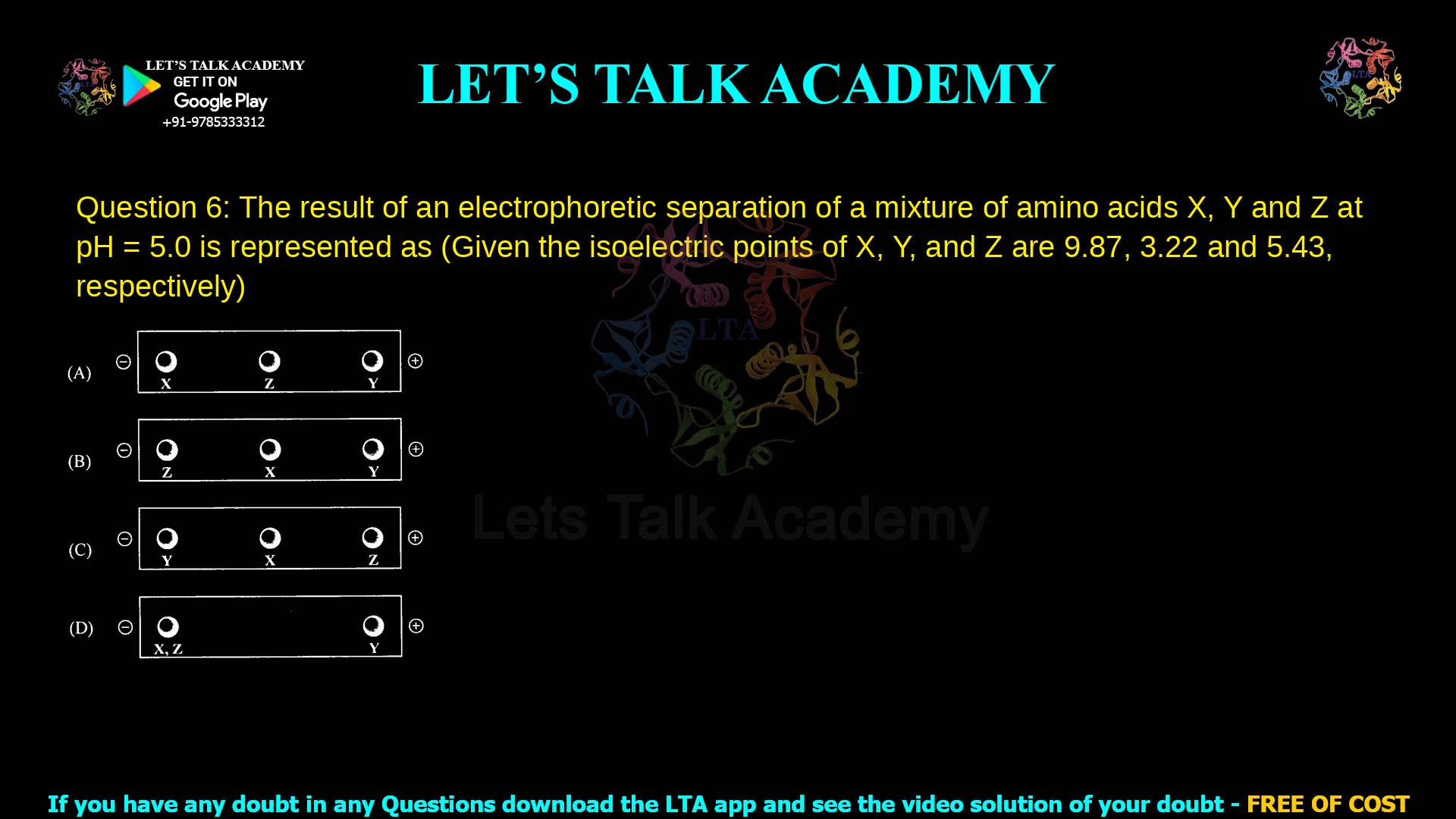
Q.6 The result of an electrophoretic separation of a mixture of amino acids X, Y and Z at pH = 5.0 is represented as (Given the isoelectric points of X, Y and Z are 9.87, 3.22 and 5.43, respectively.)
The correct electrophoretic pattern at pH 5.0 is option (B), where amino acid Z stays at the origin, X moves toward the cathode (negative charge), and Y moves toward the anode (positive charge).
Introduction
In this problem, the electrophoretic separation of a mixture of amino acids X, Y and Z at pH 5.0 is analyzed using their isoelectric points: X = 9.87, Y = 3.22 and Z = 5.43. Understanding how the charge of an amino acid changes relative to its isoelectric point underlies every question on electrophoretic separation in CSIR NET and other life‑science examinations.
Step 1: Charge of each amino acid at pH 5.0
Rule for amino acids in electrophoresis:
-
If pH < pI → amino acid carries net positive charge and migrates toward the cathode (−).
-
If pH > pI → amino acid carries net negative charge and migrates toward the anode (+).
-
If pH ≈ pI → net charge ≈ 0 and the molecule stays near the origin.
Apply this to X, Y and Z at pH 5.0:
-
Amino acid X (pI 9.87)
-
pH 5.0 is much less than 9.87 → X is protonated and positively charged.
-
Therefore X moves toward the cathode.
-
-
Amino acid Y (pI 3.22)
-
pH 5.0 is greater than 3.22 → Y is deprotonated and negatively charged.
-
Therefore Y moves toward the anode.
-
-
Amino acid Z (pI 5.43)
-
pH 5.0 is slightly less than 5.43, very close to its pI → net charge is nearly zero.
-
Z shows minimal movement and stays near the origin.
-
Thus the correct pattern must show:
-
X at the cathodic side,
-
Y at the anodic side,
-
Z around the starting point.
Step 2: Detailed analysis of each option
The figure shows four possible band positions for X, Y and Z on the electrophoretic strip. Interpret each choice in terms of direction of migration and compare with the charges deduced above.
Option (A)
-
Pattern: X in the center, Z toward one end, Y toward the other end.
-
Implication:
-
X is shown at the origin, so X would be neutral.
-
One of Z or Y is on the cathode side and the other on the anode side.
-
-
Why it is incorrect:
-
X cannot be neutral at pH 5.0 because pH is far below its pI (9.87); X must be strongly positive and move toward the cathode.
-
Therefore any pattern keeping X at the origin contradicts the pH–pI rule.
-
Option (B) – Correct pattern
-
Pattern (reading left to right): Z near the center (origin), X displaced toward one side, Y displaced toward the opposite side.
-
Interpretation consistent with theory:
-
Z at the origin → approximately neutral, matching its pI (5.43) being close to pH 5.0.
-
X on the cathode side → positively charged at pH below its pI (9.87).
-
Y on the anode side → negatively charged at pH above its pI (3.22).
-
-
Hence option (B) correctly depicts the electrophoretic separation of a mixture of amino acids X, Y and Z at pH 5.0.
Option (C)
-
Pattern: Y and Z to one side, X to the other side, with none at the origin.
-
Implied charges:
-
If X is isolated on one side, it would have opposite charge to both Y and Z.
-
This would mean Y and Z share the same net charge sign, which is not true from the pI analysis.
-
-
Why it is incorrect:
-
At pH 5.0, Y must be negative, X positive, and Z nearly neutral; Z cannot migrate with Y as a charged species.
-
No amino acid is placed at or near the origin, so the near‑neutral behavior of Z is not represented.
-
Option (D)
-
Pattern: A single band at one side labeled as a combination (X, Z) and another band labeled Y at the opposite side.
-
Implied behavior:
-
X and Z would have identical charge and move together, while Y would be opposite.
-
-
Why it is incorrect:
-
X (pI 9.87) is clearly positive at pH 5.0, whereas Z (pI 5.43) is almost neutral; they cannot migrate together as one band.
-
Z must remain near the origin, not at the same position as strongly charged X.
-
Therefore, only option (B) satisfies the required positions dictated by the relationship between pH and isoelectric point for all three amino acids.


