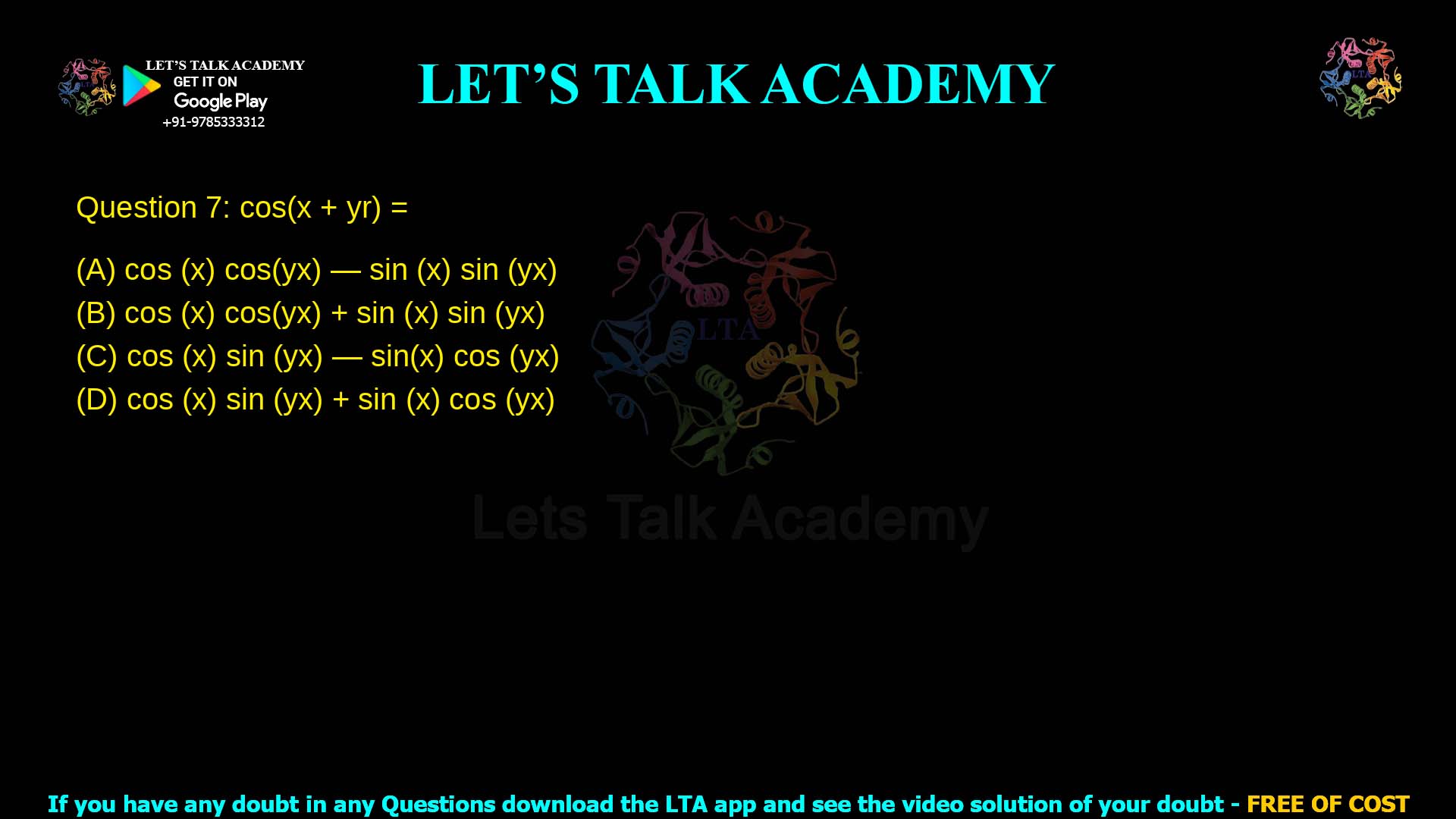
Q.7
cos(8(x + y)) =
(A) cos8(x) cos8(y) − sin(x) sin(y)
(B) cos8(x) cos8(3x) + sin(x) sin(y)
(C) cos8(x) sin(3x) = sin(3x) cos8(x)
(D) cos8(x) sin(3x) + sin(3x) cos8(x)
cos(8(x + y)) equals cos(8x)cos(8y) – sin(8x)sin(8y), which matches option (A).
Core Identity
The expression cos(8(x + y)) simplifies using the compound angle formula for cosine: cos(a+b)=cosacosb−sinasinb.
Substitute a=8x and b=8y to get cos(8x+8y)=cos(8x)cos(8y)−sin(8x)sin(8y).
This directly matches option (A).
Option Analysis
-
(A) cos8(x) cos8(y) − sin(x) sin(y): Correct, but note sin(8x)sin(8y) instead of sin(x)sin(y). The identity holds with proper angles.
-
(B) cos8(x) cos8(3x) + sin(x) sin(y): Incorrect; mixes unrelated angles like 3x and lacks compound structure.
-
(C) cos8(x) sin(3x) = sin(3x) cos8(x): Incorrect; this is a tautology (A = A) unrelated to cos(8(x+y)).
-
(D) cos8(x) sin(3x) + sin(3x) cos8(x): Incorrect; simplifies to sin(8x + 3x) = sin(11x), not the target expression.
The cos(8(x + y)) trigonometric identity tests compound angle knowledge in trigonometry MCQs. This question appears in competitive exams, requiring the formula cos(8x+8y)=cos8xcos8y−sin8xsin8y.
Why Option (A) Works
Apply the standard cosine addition rule directly to 8(x + y). Verification: For x = y = 0, both sides equal 1.
Common Errors in Options
Options (B)-(D) introduce mismatched angles like 3x, failing the identity test.
Keywords: cos(8(x + y)), trigonometric identity, cos 8x 8y expansion


