The correct answer is (3) Peptide bond. Peptide bonds are not typically formed between enzyme and substrate; rather, these covalent bonds connect amino acids in proteins, forming the enzyme’s structure, not […]
The correct answer is (3) Peptide bond. Peptide bonds are not typically formed between enzyme and substrate; rather, these covalent bonds connect amino acids in proteins, forming the enzyme’s structure, not […]
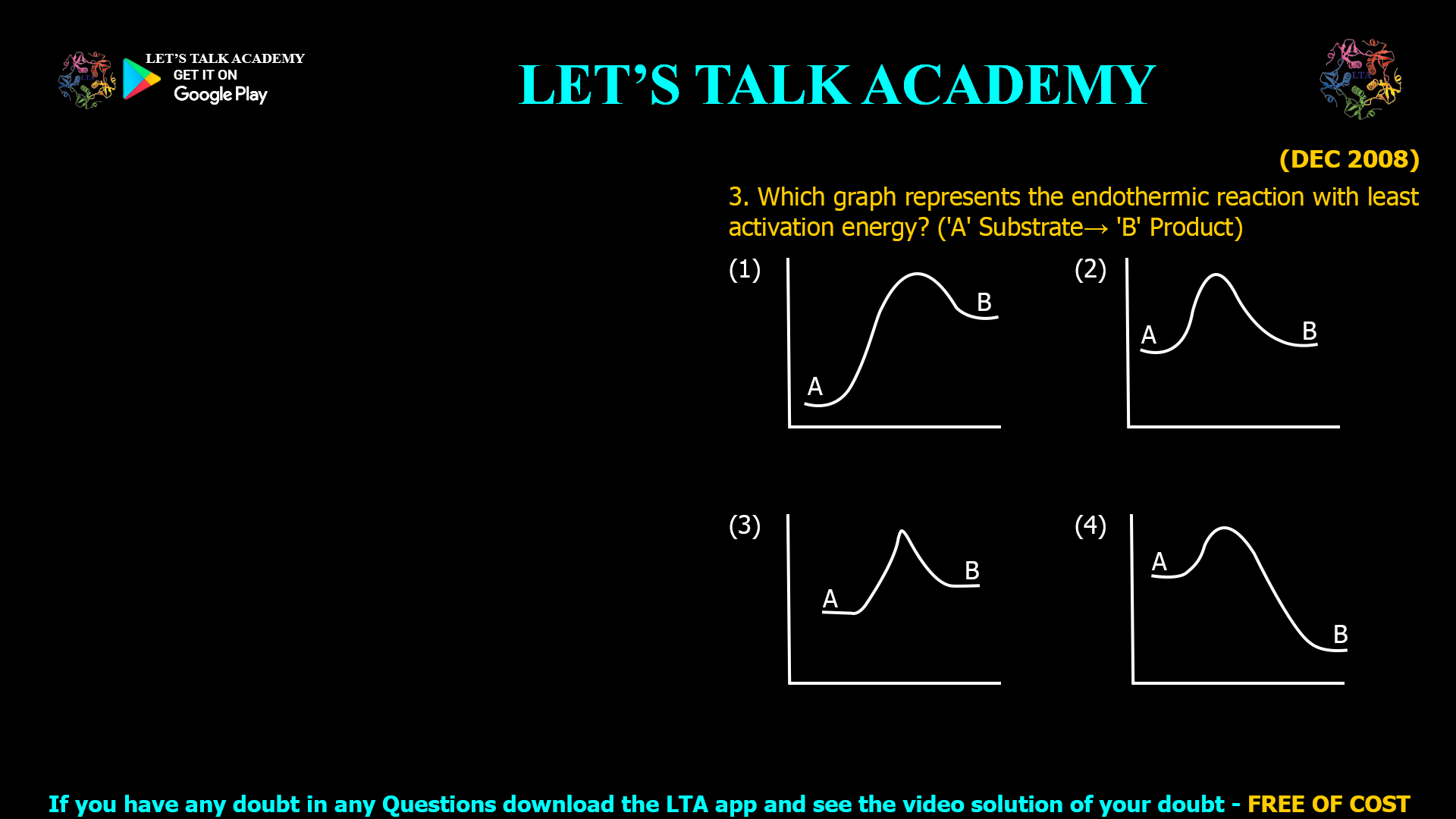
3. Which graph represents the endothermic reaction with least activation energy? (‘A’ Substrate→ ‘B’ Product) The correct answer is Option 3. This graph best represents an endothermic reaction with the least activation energy where ‘A’ (substrate) transitions to ‘B’ (product). Introduction […]
2. Enzymes accelerates rate of reaction by (1) Lowering number of transition states (2) Lowering the activation energy of highest transition state (3) Providing direct energy to substrate (4) Providing […]

Enzymes accelerate a reaction by which one of the following strategies? (1) Decreasing energy required to form the transition state. (2) Increasing kinetic energy of the substrate. (3) Increasing the […]
Which one of the following is NOT a vasoconstrictor? (1) Prostacyclin (2) Thromboxane A2 (3) Angiotensin-ll (4) Endothelin-1 Which One Is NOT a Vasoconstrictor? An In-Depth Explanation Understanding the complex […]
CGMP is produced from GTP by the enzyme guanylate cyclase which exists in soluble and membrane-bound forms. Following statements are made related to signaling molecules that are associated with cGMP […]
The blood volume decreased when a mammal was bled rapidly. However. The cardiovascular changes resulting from hemorrhage could be minimized by the following compensatory mechanisms: A. Increased cerebral blood flow, […]
Loss of a large quantity of blood in an individual due to haemorrhage provokes many physiological changes which are compensatory and decompensatory in nature. The following statements describe few compensatory […]
A person recovered from a moderate degree of haemorrhagic shock. The participating physiological mechanisms in this recovery process are proposed in the following statements. A. The decrease in arterial pressure […]
After hemorrhage, a subject develops hypovolemia and hypotension. Following are some of the statements regarding homeostatic measure taken by the body after hemorrhage. A. Increased release of vasopressin B. Increased […]


