(NOV 2020-1) 13. The following statements were made of suggest the existence of an enzyme-substrate complex. A. at constant concentration of enzyme, the reaction increase with rate increase with increasing […]

(NOV 2020-1) 13. The following statements were made of suggest the existence of an enzyme-substrate complex. A. at constant concentration of enzyme, the reaction increase with rate increase with increasing […]

(DEC 2002) 12. When a mixture of protease, protein, nuclease and nucleic acid are incubated at 37OC, at the end of one hour which will remain intact (1) Nucleic acid […]
(JUNE 2007) 11. The order of reaction catalyzed by enzyme at low substrate concentration is (1) first order (2) Pseudo first order (3) Second order (4) Zero order The correct […]
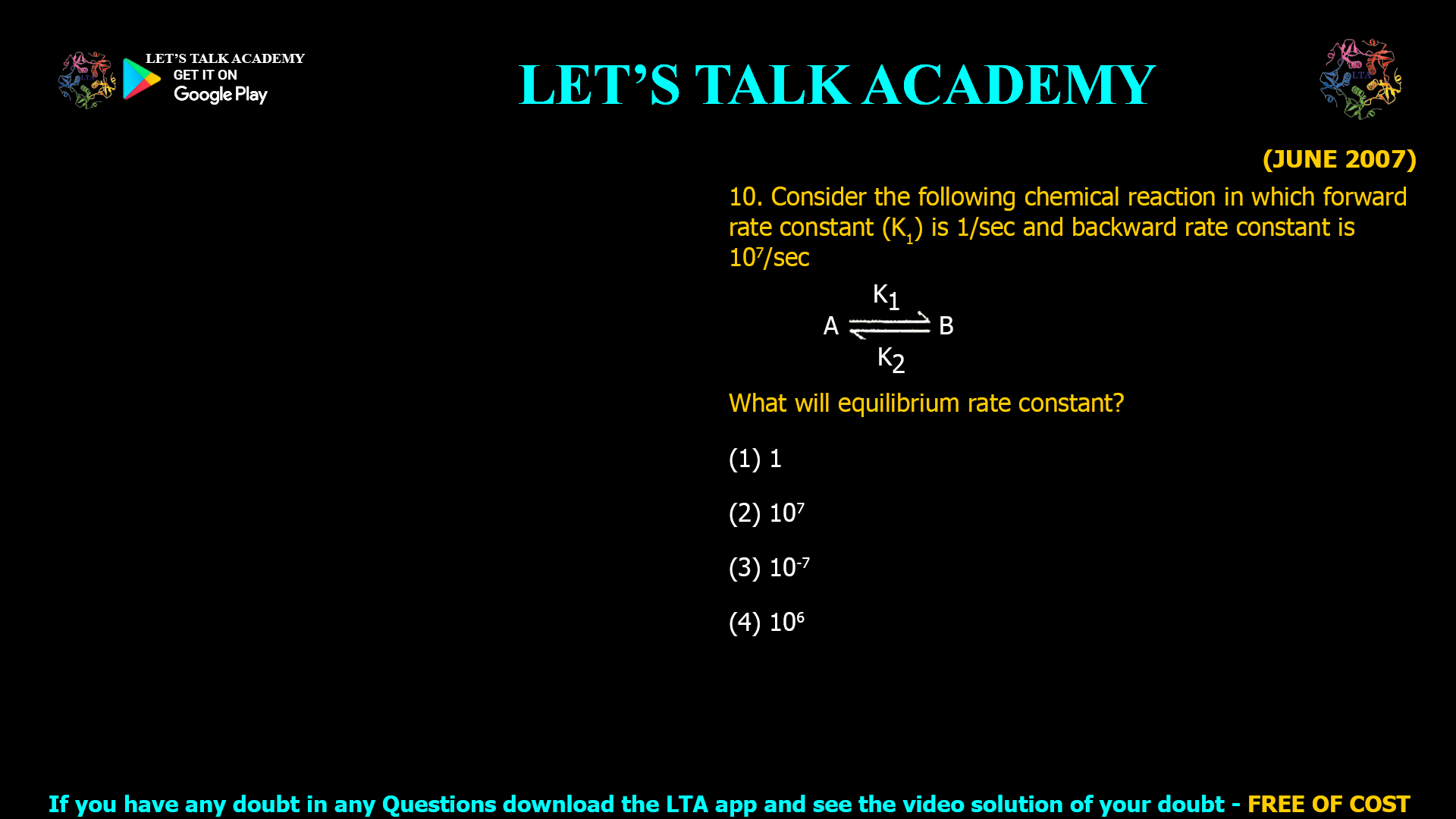
10. Consider the following chemical reaction in which forward rate constant (K1) is 1/sec and backward rate constant is 107/sec What will equilibrium rate constant? (1) 1 (2) 107 (3) […]

(JUNE 2014) 9. A protein is composed of leucine, isoleucine, alanine, glycine, proline, one lysine, one arginine and two cysteines connected by a disulfide bond. Conformational analysis indicates that the […]

(DEC 2013) 8. Enzymes help to lower the activation energies of reactions by (1) covalent interaction with substrates. (2) binding only with the solvent molecules, (3) changing reaction equilibria. (4) […]

7.Which of the following is NOT a property of an enzyme (1) from complex with substrate (2) decrease activation energy (3) decrease Gibb’s free energy (4) Increases rate of reaction […]
6. Which of the following is NOT a property of an enzyme (1) from complex with substrate (2) decrease activation energy (3) decrease Gibb’s free energy (4) Increases rate of […]
6. Enzymes do not interfere with (1) Path of reaction (2) Rate of reaction (3) Activation energy (4) Reaction equilibrium The correct answer is (4) Reaction equilibrium. Enzymes accelerate the rate […]
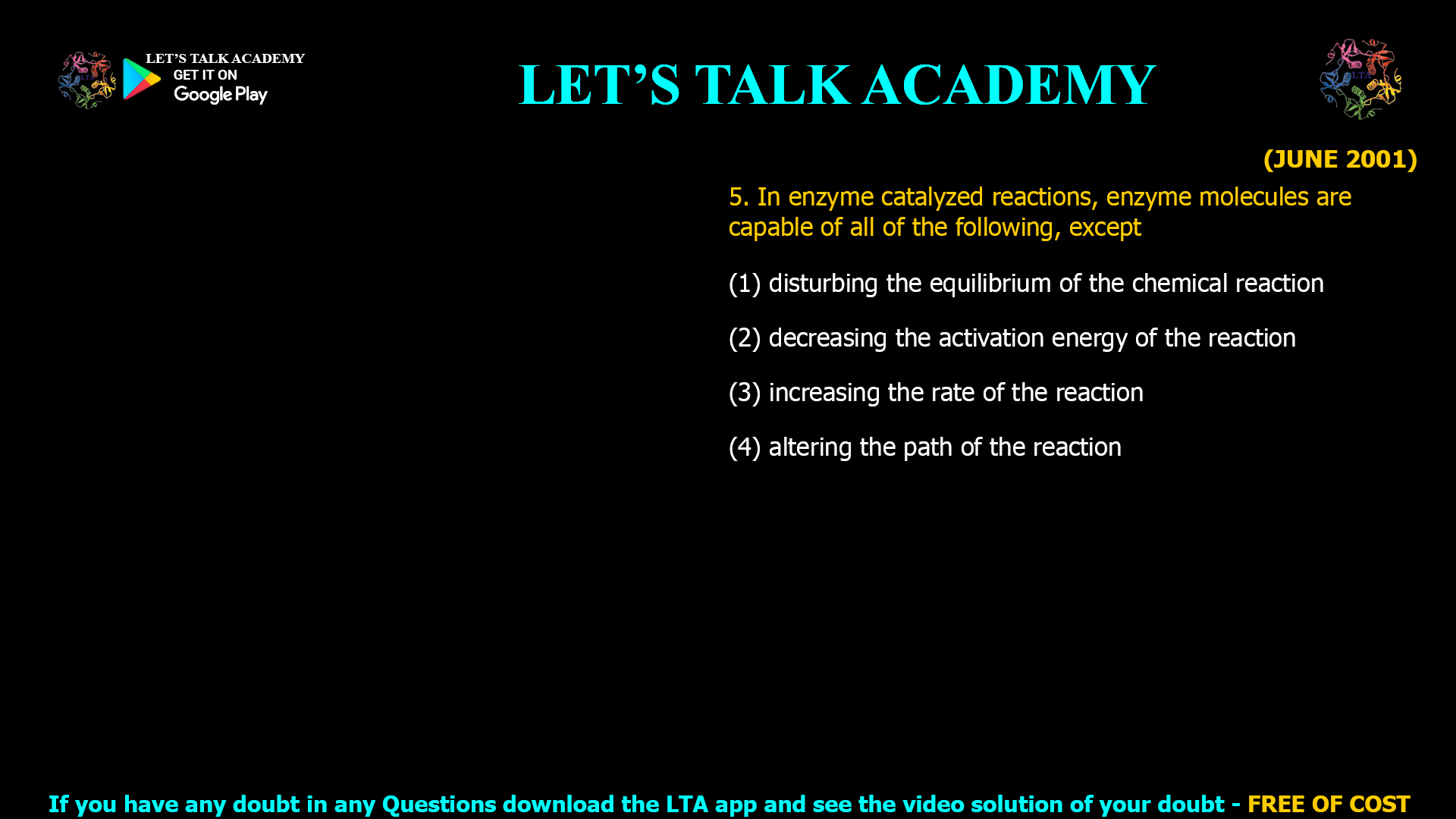
The correct answer is (1) disturbing the equilibrium of the chemical reaction. Enzymes are biological catalysts—they speed up reactions and alter the pathway (lower activation energy), but do not change the reaction’s […]


