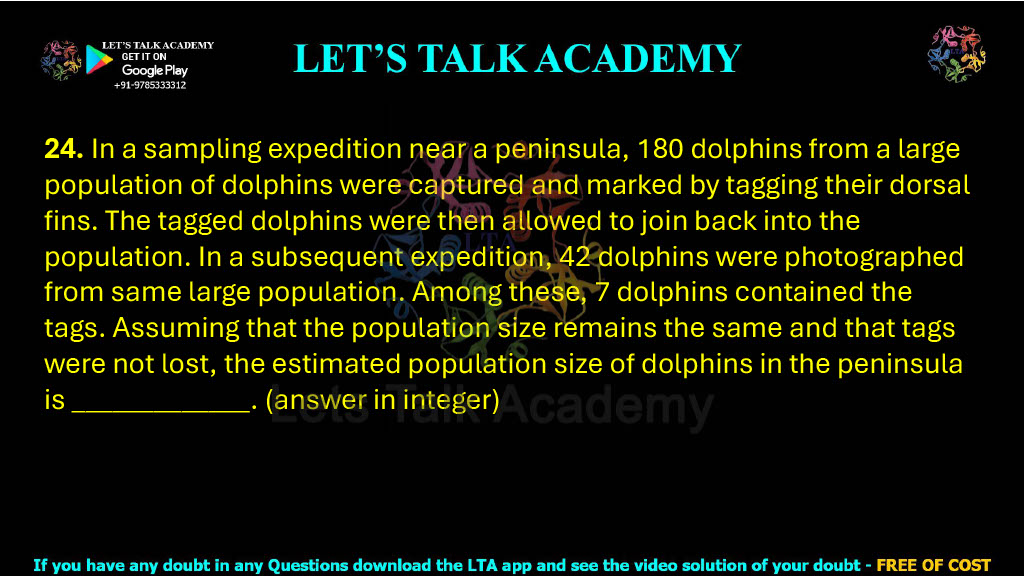
24. In a sampling expedition near a peninsula, 180 dolphins from a large population of dolphins were captured and marked by tagging their dorsal fins. The tagged dolphins were then allowed to join back into the population. In a subsequent expedition, 42 dolphins were photographed from same large population. Among these, 7 dolphins contained the tags. Assuming that the population size remains the same and that tags were not lost, the estimated population size of dolphins in the peninsula is___. (answer in integer)
Dolphin Population Size Estimation Using the Mark-Recapture Method
Explanation of the Correct Answer
The estimated dolphin population size is 1080. This question is solved using the mark-recapture method, an important ecological technique used to estimate the size of mobile animal populations that cannot be counted directly.
During the first sampling expedition, 180 dolphins were captured and marked by placing tags on their dorsal fins. These marked dolphins were then released back into the population and allowed to mix with the unmarked dolphins.
During the second expedition, researchers photographed a sample of 42 dolphins. Among these 42 dolphins, 7 carried the tags applied during the first expedition.
The basic principle of the mark-recapture method is that the proportion of marked animals in the second sample should approximately equal the proportion of marked animals in the entire population. Using this relationship, the total population size can be estimated.
What Is the Mark-Recapture Method?
The mark-recapture method is a population sampling technique used to estimate the number of individuals in a population. It is particularly useful for animals that move freely over large areas and are difficult to count directly, such as dolphins, fish, birds, mammals, and insects.
The method involves two major sampling events. During the first event, a number of individuals are captured, marked, and released. During the second event, another sample is collected or observed, and researchers determine how many individuals in that sample carry the original marks.
If a large proportion of the second sample consists of marked individuals, the total population is likely to be relatively small. If only a small proportion of the second sample is marked, the total population is likely to be relatively large.
In this dolphin example, only 7 of the 42 dolphins photographed during the second expedition were tagged. This means that tagged dolphins represented one-sixth of the second sample. Therefore, the original 180 tagged dolphins are estimated to represent approximately one-sixth of the entire population.
Mark-Recapture Formula for Population Size Estimation
The standard mark-recapture relationship can be written as:
M / N = R / C
where:
M = number of animals marked during the first sampling event
N = estimated total population size
R = number of marked animals found in the second sample
C = total number of animals examined during the second sampling event
Rearranging the equation to calculate the total population size gives:
N = (M × C) / R
This equation is commonly associated with the Lincoln-Petersen approach to population estimation.
Values Given in the Dolphin Population Question
The first step is to identify the numerical values provided in the question correctly.
During the first expedition, the number of dolphins captured, tagged, and released was:
M = 180
During the second expedition, the total number of dolphins photographed was:
C = 42
Among these 42 dolphins, the number carrying tags was:
R = 7
The unknown quantity is the estimated total population size:
N = ?
Step-by-Step Calculation of Dolphin Population Size
Step 1: Write the Mark-Recapture Formula
The population size is estimated using:
N = (M × C) / R
Step 2: Substitute the Given Values
Substituting M = 180, C = 42, and R = 7:
N = (180 × 42) / 7
Step 3: Simplify the Calculation
Since:
42 / 7 = 6
Therefore:
N = 180 × 6
Step 4: Calculate the Final Population Size
N = 1080
Therefore, the estimated number of dolphins in the population is:
1080 dolphins
Alternative Proportion Method
The same answer can be understood using a simple proportional relationship. In the second sample, 7 of the 42 dolphins were tagged.
The proportion of tagged dolphins in the second sample is therefore:
7 / 42 = 1 / 6
This suggests that approximately one out of every six dolphins in the total population is tagged.
The first expedition tagged 180 dolphins. If these 180 tagged dolphins represent one-sixth of the entire population, then:
Total population = 180 × 6
Total population = 1080 dolphins
This proportional approach gives the same answer as the standard mark-recapture formula.
Why the Marked Proportion Represents the Total Population
The mark-recapture method assumes that the tagged dolphins mix randomly and thoroughly with the rest of the population after being released. Once mixing has occurred, a later sample should contain approximately the same proportion of tagged individuals as the entire population.
In this question, 7 out of 42 dolphins in the second sample are tagged. This means that approximately one-sixth of the sampled population is marked.
If the sample is representative of the entire population, approximately one-sixth of all dolphins should also be marked. Since the total number of marked dolphins is known to be 180, the entire population must be approximately six times larger than the marked group.
Therefore:
180 × 6 = 1080 dolphins
Why a Low Recapture Rate Suggests a Large Population
The relationship between recapture rate and estimated population size is important for understanding the logic of the method.
If many tagged animals are found in the second sample, the marked animals must represent a relatively large fraction of the total population. This generally suggests that the total population is smaller.
If only a few tagged animals are found in the second sample, the marked individuals must be diluted among a much larger number of unmarked animals. This suggests a larger total population.
In the present question, only 7 tagged dolphins are observed among 42 dolphins. Because tagged individuals make up only one-sixth of the sample, the total population is estimated to be six times the number originally tagged.
Important Assumptions of the Mark-Recapture Method
The accuracy of the mark-recapture method depends on several important assumptions. The question directly provides some of these assumptions by stating that the population size remains the same and that the tags are not lost.
The Population Size Remains Constant
The method assumes that the population is effectively closed between the first and second sampling events. This means that there should be no major changes caused by births, deaths, immigration, or emigration.
If many new dolphins entered the population or many individuals left the area, the proportion of tagged animals in the second sample could change and the estimate might become inaccurate.
The question specifically states that the population size remains the same, allowing the standard mark-recapture calculation to be used.
Tags Are Not Lost
The method assumes that marked individuals retain their marks until the second sampling event. If tags are lost, some previously marked dolphins would be incorrectly counted as unmarked individuals.
This would reduce the observed number of recaptured marked animals and could cause the population size to be overestimated.
The question explicitly states that tags were not lost, so all originally tagged dolphins are assumed to remain identifiable.
Marked Dolphins Mix with the Population
After release, the tagged dolphins should mix thoroughly with the untagged dolphins. If marked animals remain together in one area, the second sample may contain too many or too few tagged individuals.
Random mixing helps ensure that the proportion of tagged dolphins in the second sample accurately reflects their proportion in the entire population.
Marked and Unmarked Dolphins Have Similar Chances of Being Observed
The presence of a tag should not make a dolphin more or less likely to be photographed during the second expedition.
If tagged dolphins avoid researchers or become easier to detect because of the tags, the recapture proportion may not represent the population accurately.
Tagging Does Not Affect Survival
The tagging procedure should not significantly affect the health, behaviour, or survival of the dolphins. If tagged dolphins have a lower survival rate, fewer marked individuals would be available during the second expedition.
This could lead to an inaccurate estimate of the total population size.
Why Direct Counting Is Difficult for Dolphin Populations
Dolphins are highly mobile marine animals that can travel over large areas. They spend much of their time underwater and may not all be visible at the same time. These characteristics make direct counting difficult.
Population ecologists therefore use sampling techniques to estimate abundance. Mark-recapture methods allow researchers to use information from a relatively small number of marked and observed animals to estimate the size of a much larger population.
In this question, researchers do not need to observe all 1080 dolphins directly. Instead, the proportion of tagged individuals in the second sample provides the information needed to estimate the total population.
Understanding the Lincoln-Petersen Population Estimator
The simple two-sample mark-recapture method is commonly described using the Lincoln-Petersen estimator. It is based on the assumption that the proportion of marked animals in the second sample is approximately equal to the proportion of marked animals in the entire population.
The relationship is:
Marked animals in population / Total population = Marked animals in second sample / Total second sample
For the dolphin population:
180 / N = 7 / 42
Cross-multiplying gives:
180 × 42 = 7N
Therefore:
N = (180 × 42) / 7
N = 1080
This mathematical relationship provides the estimated population size.
Ecological Importance of Population Size Estimation
Estimating population size is essential for understanding the status and dynamics of animal populations. Ecologists and conservation biologists use population estimates to determine whether populations are increasing, decreasing, or remaining stable.
For marine mammals such as dolphins, accurate population information can help researchers evaluate habitat quality, identify conservation concerns, assess the effects of human activities, and monitor long-term changes in abundance.
Population size estimates can also be compared across different years to determine whether conservation measures are effective or whether additional protection is required.
Complete Numerical Solution
Number of dolphins initially marked (M) = 180
Total dolphins photographed in second sample (C) = 42
Tagged dolphins found in second sample (R) = 7
Formula: N = (M × C) / R
N = (180 × 42) / 7
N = 180 × 6
N = 1080
Final Answer
The dolphin population is estimated using the mark-recapture method. Since 7 out of 42 dolphins in the second sample were tagged, tagged dolphins represent one-sixth of the observed population.
The original 180 tagged dolphins are therefore estimated to represent one-sixth of the total population.
Total population = 180 × 6 = 1080 dolphins
Therefore, the estimated population size of dolphins in the peninsula is 1080.


