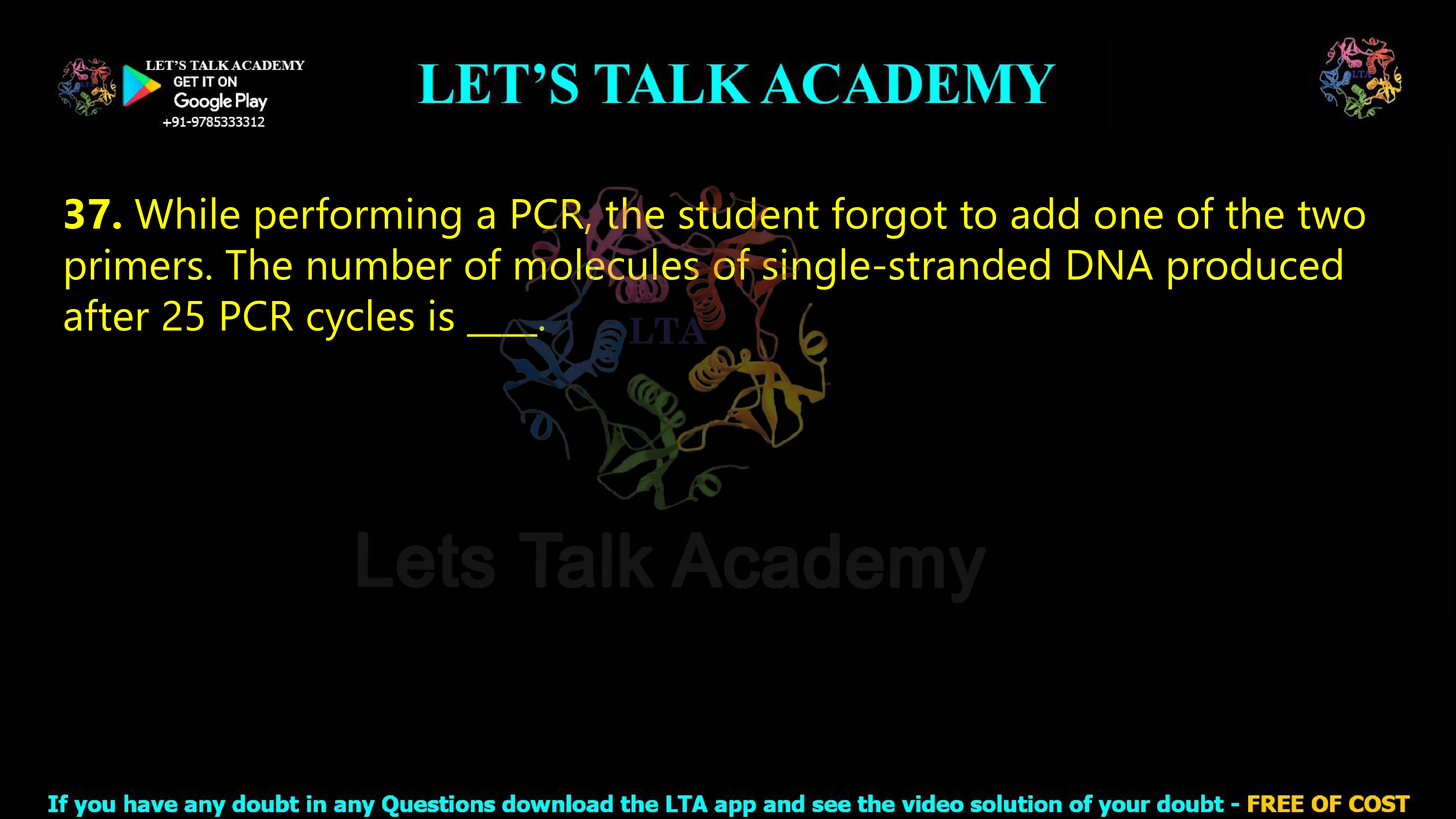
36. While performing a PCR, the student forgot to add one of the two primers. The number of molecules of single-stranded DNA produced after 25 PCR cycles is ____.
PCR with One Missing Primer: Number of Single-Stranded DNA Molecules Produced After 25 PCR Cycles Explained
Understanding the Concept of PCR Before Solving the Question
Polymerase Chain Reaction (PCR) is one of the most important molecular biology techniques used to amplify a specific DNA sequence. Under normal conditions, PCR requires five essential components: template DNA, DNA polymerase, deoxynucleotide triphosphates (dNTPs), buffer with magnesium ions, and most importantly, two primers. These two primers are designed to bind on opposite strands of the target DNA, allowing DNA polymerase to synthesize new complementary strands in opposite directions.
The presence of both primers is the reason why PCR exhibits exponential amplification. During every cycle, the newly synthesized DNA molecules themselves become templates for the next round of amplification, leading to a doubling of DNA molecules after each cycle. This exponential increase follows the well-known formula:
Number of DNA molecules = 2n
where n represents the number of PCR cycles.
What Happens When One Primer Is Missing?
If one of the two primers is accidentally omitted, the entire mechanism of PCR changes dramatically. DNA polymerase can only extend DNA from an existing primer because it cannot initiate DNA synthesis on its own. Since only one primer is present, DNA synthesis occurs on only one of the two template strands.
The newly synthesized strand does not possess the complementary primer-binding site needed for further exponential amplification. As a result, the newly formed DNA molecules cannot efficiently serve as templates in subsequent PCR cycles. Instead of doubling every cycle, only the original template strand continues to generate one additional single-stranded DNA molecule during each cycle.
Therefore, amplification changes from an exponential process to a linear process.
Difference Between Exponential and Linear PCR Amplification
Normal PCR with Two Primers
When both forward and reverse primers are present, every newly synthesized DNA molecule participates in the next PCR cycle. Consequently, the DNA quantity doubles during every cycle, producing exponential amplification. After 25 cycles, the theoretical number of DNA molecules would be 225, which equals 33,554,432 molecules.
PCR with Only One Primer
When only one primer is available, DNA polymerase synthesizes just one new single-stranded DNA molecule from the original template during each cycle. Since the newly synthesized strand cannot be amplified further without the second primer, amplification proceeds linearly rather than exponentially.
Thus, after every PCR cycle, only one additional single-stranded DNA molecule is produced.
Step-by-Step Calculation
Initial template DNA = 1 double-stranded DNA molecule
Number of PCR cycles = 25
Single-stranded DNA produced per cycle = 1 molecule
Total single-stranded DNA molecules produced after 25 cycles:
25 × 1 = 25 molecules
Final Answer = 25 single-stranded DNA molecules
Why Does PCR Become Linear Instead of Exponential?
The defining characteristic of exponential PCR is that both DNA strands are copied during every cycle. This requires both forward and reverse primers. Removing either primer prevents one strand from being copied repeatedly, eliminating the chain reaction responsible for exponential amplification.
Each PCR cycle merely extends the original template strand once, creating a single new DNA strand. Since these new strands cannot act as efficient templates without the missing primer, no doubling occurs. The amount of DNA therefore increases by a fixed amount after every cycle rather than multiplying.
Detailed Explanation of the PCR Mechanism
Denaturation
The double-stranded DNA is heated to approximately 94–95°C, causing hydrogen bonds between complementary bases to break. This separates the DNA into two single strands.
Primer Annealing
Normally, both primers bind to opposite DNA strands at specific locations. However, when one primer is absent, only one template strand receives a primer, leaving the other strand unable to initiate DNA synthesis.
Extension
DNA polymerase extends from the available primer in the 5′→3′ direction, producing one complementary DNA strand. Because the opposite primer is absent, this newly synthesized DNA cannot participate in exponential amplification during subsequent cycles.
Why This Question Is Frequently Asked in Competitive Exams
Questions involving missing PCR components are extremely common in competitive examinations because they test conceptual understanding rather than memorization. Students who understand why PCR requires two primers can easily solve similar numerical questions involving primer omission, missing DNA polymerase, absent dNTPs, or incorrect annealing temperatures.
This concept is particularly important for CSIR NET Life Science, DBT JRF, GATE Biotechnology, IIT JAM Biotechnology, ICMR JRF, SET examinations, and university entrance tests where PCR-based analytical questions are frequently included.
Concept Summary
PCR requires two primers to achieve exponential amplification. If one primer is missing, DNA polymerase can synthesize DNA from only one strand of the template. Since the newly synthesized DNA lacks the second primer-binding site, it cannot undergo repeated amplification. Consequently, DNA synthesis becomes linear, generating one additional single-stranded DNA molecule during each cycle. Therefore, after 25 PCR cycles, exactly 25 single-stranded DNA molecules are produced from a single initial double-stranded DNA template.
Final Answer
Number of single-stranded DNA molecules produced after 25 PCR cycles = 25.


