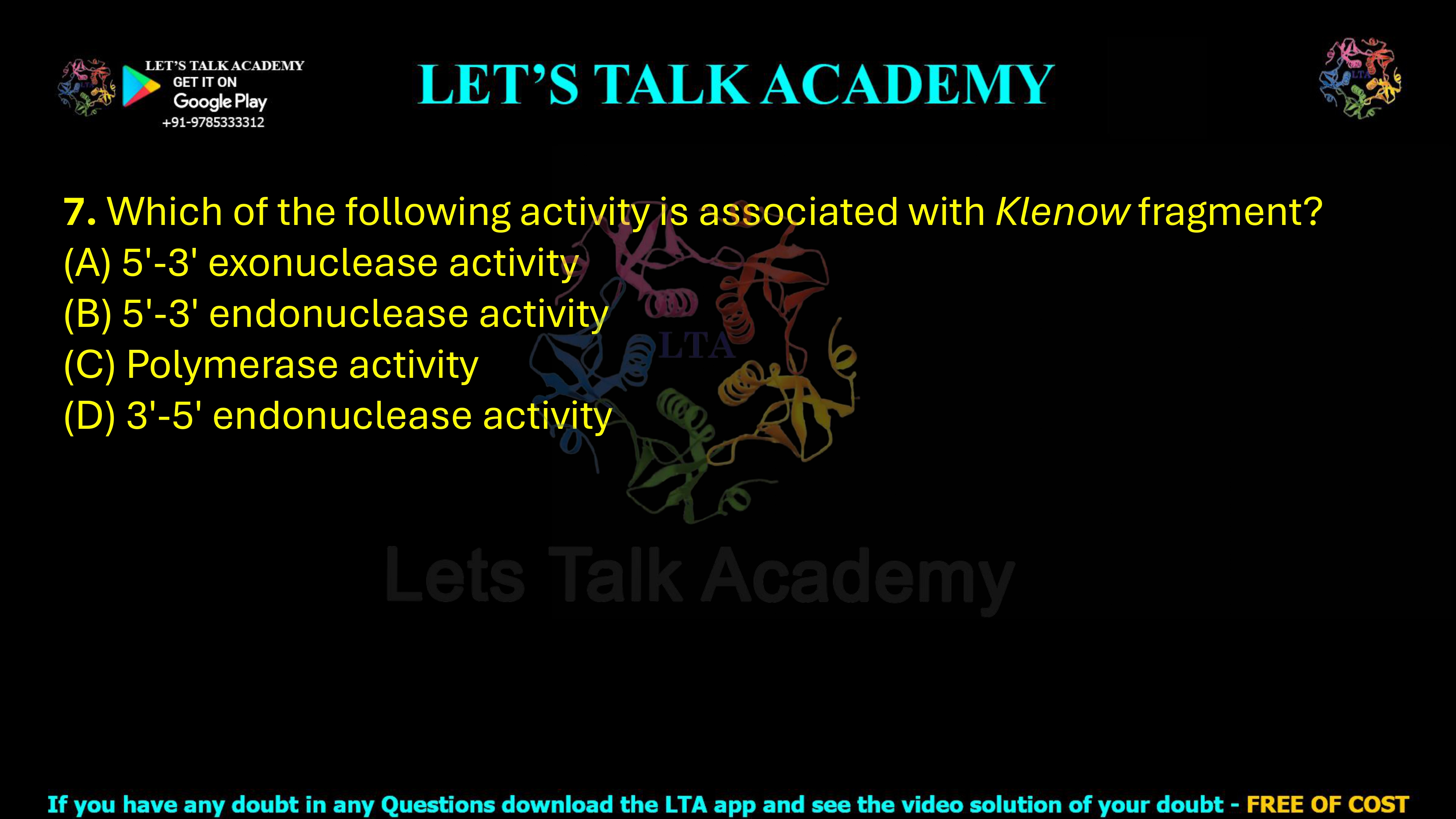
7. Which of the following activity is associated with Klenow fragment?
(A) 5′-3′ exonuclease activity
(B) 5′-3′ endonuclease activity
(C) Polymerase activity
(D) 3′-5′ endonuclease activity
Klenow Fragment: Activities, Functions, and Applications in Molecular Biology
Introduction
The Klenow fragment is one of the most widely used enzymes in molecular biology and recombinant DNA technology. It is a large proteolytic fragment of Escherichia coli DNA Polymerase I generated after enzymatic cleavage with subtilisin. Although it lacks one of the exonuclease activities present in the intact DNA Polymerase I enzyme, it retains DNA polymerase activity and proofreading capability, making it extremely useful for DNA synthesis, DNA labeling, second-strand cDNA synthesis, blunt-end formation, and numerous cloning procedures.
Correct Answer
Correct Answer: (C) Polymerase activity
Detailed Explanation
The Klenow fragment is obtained by removing the N-terminal region of DNA Polymerase I. The removed portion contains the 5’→3′ exonuclease activity, whereas the remaining Klenow fragment retains two important enzymatic activities:
- 5’→3′ DNA polymerase activity
- 3’→5′ exonuclease (proofreading) activity
Because the question asks which activity is associated with the Klenow fragment, the correct answer is polymerase activity. Although the Klenow fragment also possesses 3’→5′ exonuclease activity, option (D) incorrectly mentions endonuclease, making it incorrect.
Explanation of Option (A): 5’→3′ Exonuclease Activity
This option is incorrect.
The full-length DNA Polymerase I possesses 5’→3′ exonuclease activity, which is responsible for removing RNA primers and damaged DNA during DNA repair. This activity resides in the N-terminal domain that is removed during the production of the Klenow fragment.
Therefore, the Klenow fragment does not possess 5’→3′ exonuclease activity.
Explanation of Option (B): 5’→3′ Endonuclease Activity
This option is incorrect.
The Klenow fragment does not possess 5’→3′ endonuclease activity. In fact, DNA Polymerase I itself contains a 5’→3′ exonuclease activity, not an endonuclease activity. Endonucleases cleave internal phosphodiester bonds, whereas exonucleases remove nucleotides from the ends of DNA molecules.
Explanation of Option (C): Polymerase Activity
This option is correct.
The principal activity retained by the Klenow fragment is 5’→3′ DNA polymerase activity. This activity enables the enzyme to synthesize DNA by adding nucleotides to the 3′ hydroxyl end of a growing DNA strand.
This property makes the Klenow fragment useful for DNA labeling, filling recessed 3′ ends, synthesizing complementary DNA strands, blunt-end formation, and many recombinant DNA techniques.
Explanation of Option (D): 3’→5′ Endonuclease Activity
This option is incorrect.
The Klenow fragment possesses 3’→5′ exonuclease activity, which functions as a proofreading mechanism by removing incorrectly incorporated nucleotides during DNA synthesis.
However, the option incorrectly states endonuclease rather than exonuclease. Since endonucleases and exonucleases perform fundamentally different reactions, this statement is incorrect.
Summary of Each Option
| Option | Correct/Incorrect | Reason |
|---|---|---|
| (A) 5’→3′ exonuclease activity | Incorrect | Removed during formation of the Klenow fragment. |
| (B) 5’→3′ endonuclease activity | Incorrect | Klenow fragment has neither this activity nor does DNA Polymerase I contain a 5’→3′ endonuclease. |
| (C) Polymerase activity | Correct | Retains DNA polymerase activity for DNA synthesis. |
| (D) 3’→5′ endonuclease activity | Incorrect | Klenow possesses 3’→5′ exonuclease activity, not endonuclease activity. |
Activities of DNA Polymerase I and the Klenow Fragment
| Activity | DNA Polymerase I | Klenow Fragment |
|---|---|---|
| 5’→3′ Polymerase | Present | Present |
| 3’→5′ Exonuclease (Proofreading) | Present | Present |
| 5’→3′ Exonuclease | Present | Absent |
Major Applications of the Klenow Fragment
| Application | Purpose |
|---|---|
| Blunt-End Formation | Converts sticky DNA ends into blunt ends. |
| DNA Labeling | Incorporates radioactive or fluorescent nucleotides. |
| Second-Strand cDNA Synthesis | Produces double-stranded DNA from cDNA. |
| Primer Extension | Synthesizes complementary DNA strands. |
| Gap Filling | Fills recessed DNA ends during cloning. |
Difference Between Exonuclease and Endonuclease
| Feature | Exonuclease | Endonuclease |
|---|---|---|
| Site of Cleavage | DNA ends | Internal phosphodiester bonds |
| Directionality | 5’→3′ or 3’→5′ | No directional requirement |
| Example | Proofreading enzymes | Restriction enzymes |
Biological Significance
The Klenow fragment is an indispensable enzyme in molecular cloning because it synthesizes DNA while simultaneously proofreading newly incorporated nucleotides through its 3’→5′ exonuclease activity. The absence of 5’→3′ exonuclease activity prevents degradation of DNA templates, making the enzyme highly suitable for controlled DNA synthesis and laboratory-based genetic engineering applications.
Final Answer
The Klenow fragment retains 5’→3′ DNA polymerase activity and 3’→5′ exonuclease proofreading activity. Among the given options, only polymerase activity is correctly stated.
Correct Answer: (C) Polymerase activity


