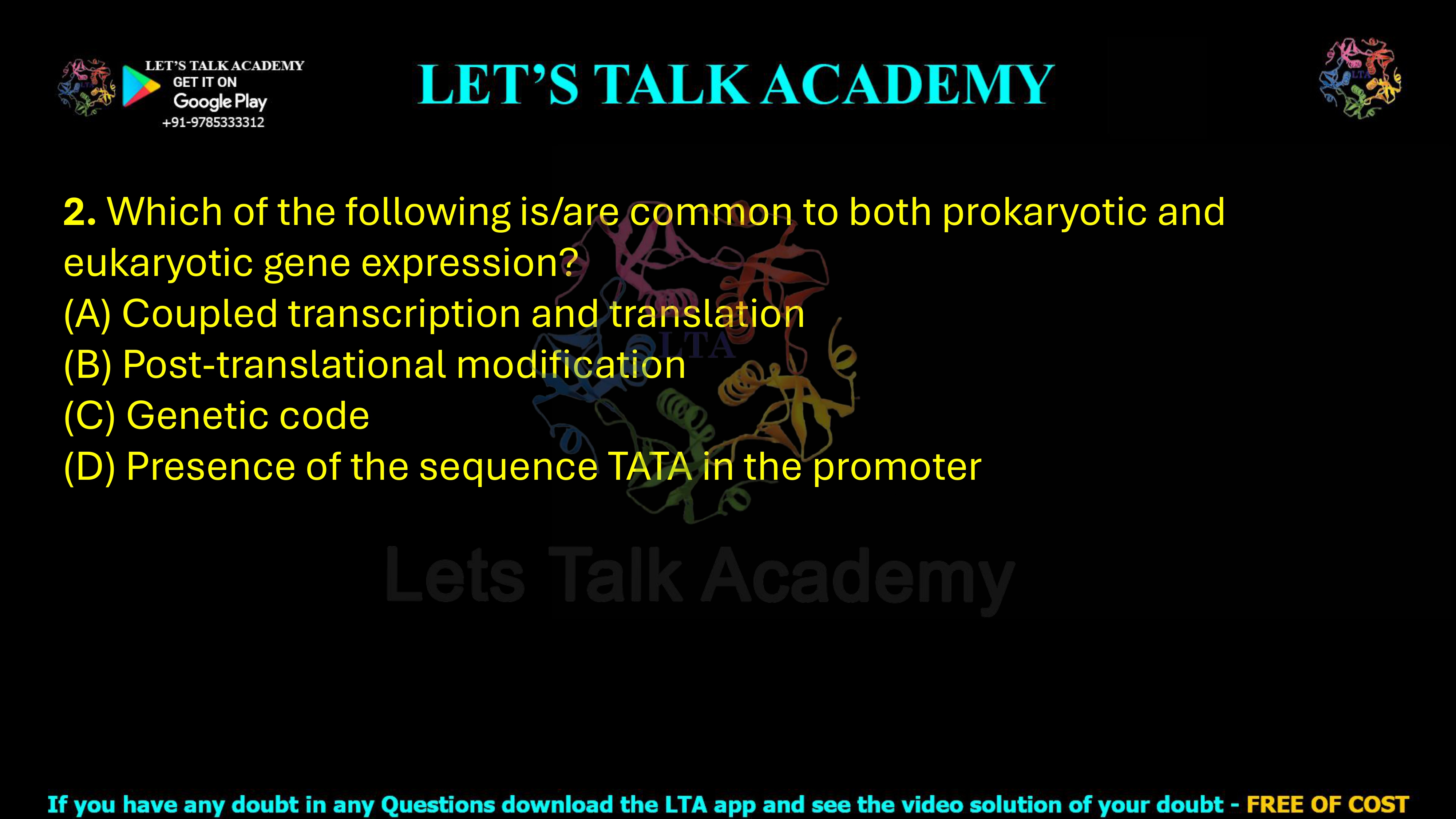
2. Which of the following is/are common to both prokaryotic and eukaryotic gene expression?
(A) Coupled transcription and translation
(B) Post-translational modification
(C) Genetic code
(D) Presence of the sequence TATA in the promoter
Common Features of Prokaryotic and Eukaryotic Gene Expression
Introduction
Gene expression is the biological process through which the genetic information encoded in DNA is converted into functional RNA and proteins. Although prokaryotic and eukaryotic organisms differ significantly in cellular organization and gene regulation mechanisms, several fundamental principles of gene expression are conserved across all living organisms. These conserved features reflect the common evolutionary origin of life and ensure that genetic information is accurately translated into proteins.
While bacteria possess a relatively simple gene expression system in which transcription and translation occur simultaneously, eukaryotic cells exhibit greater complexity because transcription occurs inside the nucleus, whereas translation takes place in the cytoplasm. Despite these differences, both systems rely on the nearly universal genetic code and both synthesize proteins that often undergo post-translational modifications to become biologically active.
Correct Answer
Correct Answer: (B) and (C)
Detailed Explanation
Although prokaryotes and eukaryotes differ in several aspects of gene regulation, they share many fundamental biochemical mechanisms. Among the given options, the universal genetic code and post-translational modification of proteins are common to both systems. In contrast, coupled transcription and translation occur only in prokaryotes, whereas the classical TATA box promoter is primarily a characteristic of eukaryotic genes.
Explanation of Option (A): Coupled Transcription and Translation
This option is incorrect.
In prokaryotic cells, the absence of a nuclear membrane allows ribosomes to begin translating an mRNA molecule while it is still being transcribed. This simultaneous occurrence of transcription and translation is known as coupled transcription and translation.
In eukaryotic cells, transcription occurs inside the nucleus, whereas translation occurs only after mature mRNA is exported into the cytoplasm. Because these two processes are separated by the nuclear envelope, they cannot occur simultaneously. Therefore, coupled transcription and translation are not common to both systems.
Explanation of Option (B): Post-translational Modification
This option is correct.
Proteins synthesized on ribosomes often require additional chemical modifications before becoming fully functional. These modifications include phosphorylation, glycosylation, acetylation, methylation, lipidation, proteolytic cleavage, and disulfide bond formation.
Although post-translational modifications are considerably more diverse in eukaryotes, prokaryotes also modify proteins after translation. Consequently, post-translational modification is a feature shared by both prokaryotic and eukaryotic gene expression.
Explanation of Option (C): Genetic Code
This option is correct.
The genetic code is nearly universal among all living organisms. The same codons generally specify the same amino acids in bacteria, plants, animals, fungi, and humans. This remarkable conservation reflects the common evolutionary origin of life.
For example, the codon AUG functions as the initiation codon and specifies methionine (or formyl-methionine in bacteria), while codons such as UAA, UAG, and UGA serve as termination codons in both prokaryotes and eukaryotes.
Therefore, the genetic code is common to both groups.
Explanation of Option (D): Presence of the Sequence TATA in the Promoter
This option is incorrect.
The classical TATA box (TATAAA) is a characteristic promoter element of many eukaryotic genes recognized by the TATA-binding protein (TBP) within transcription factor TFIID.
In bacteria, promoters typically contain the -10 Pribnow box (TATAAT) and the -35 consensus sequence (TTGACA). Although the bacterial -10 region is rich in adenine and thymine residues, it is structurally and functionally different from the eukaryotic TATA box. Therefore, the presence of the TATA promoter sequence is not considered a common feature of both systems.
Summary of Each Option
| Option | Correct/Incorrect | Reason |
|---|---|---|
| (A) Coupled transcription and translation | Incorrect | Occurs only in prokaryotes because there is no nuclear membrane. |
| (B) Post-translational modification | Correct | Occurs in both prokaryotes and eukaryotes. |
| (C) Genetic code | Correct | The genetic code is nearly universal in all living organisms. |
| (D) Presence of TATA promoter sequence | Incorrect | Classical TATA box is mainly a eukaryotic promoter element. |
Comparison of Gene Expression in Prokaryotes and Eukaryotes
| Feature | Prokaryotes | Eukaryotes |
|---|---|---|
| Transcription | Cytoplasm | Nucleus |
| Translation | Cytoplasm | Cytoplasm |
| Coupled Transcription & Translation | Present | Absent |
| Post-translational Modification | Present | Present |
| Genetic Code | Universal | Universal |
| Classical TATA Box | Absent | Present in many promoters |
Why Is the Genetic Code Nearly Universal?
The genetic code is considered nearly universal because the same codons specify the same amino acids in almost all organisms. This conservation strongly supports the concept that all modern organisms evolved from a common ancestor. Only a few exceptions occur in mitochondrial genomes and certain protozoans, where a small number of codons have been reassigned.
Biological Significance
The conservation of the genetic code and many aspects of protein synthesis has enabled scientists to transfer genes between completely unrelated organisms using recombinant DNA technology. Human insulin can be produced in bacteria because bacterial ribosomes interpret the genetic code in essentially the same way as human cells. Likewise, post-translational modifications regulate protein stability, activity, localization, and interactions in both prokaryotic and eukaryotic organisms, although these modifications are generally more elaborate in eukaryotes.
Final Answer
Among the given options, the features common to both prokaryotic and eukaryotic gene expression are:
(B) Post-translational modification
(C) Genetic code
Correct Answer: (B) and (C)


