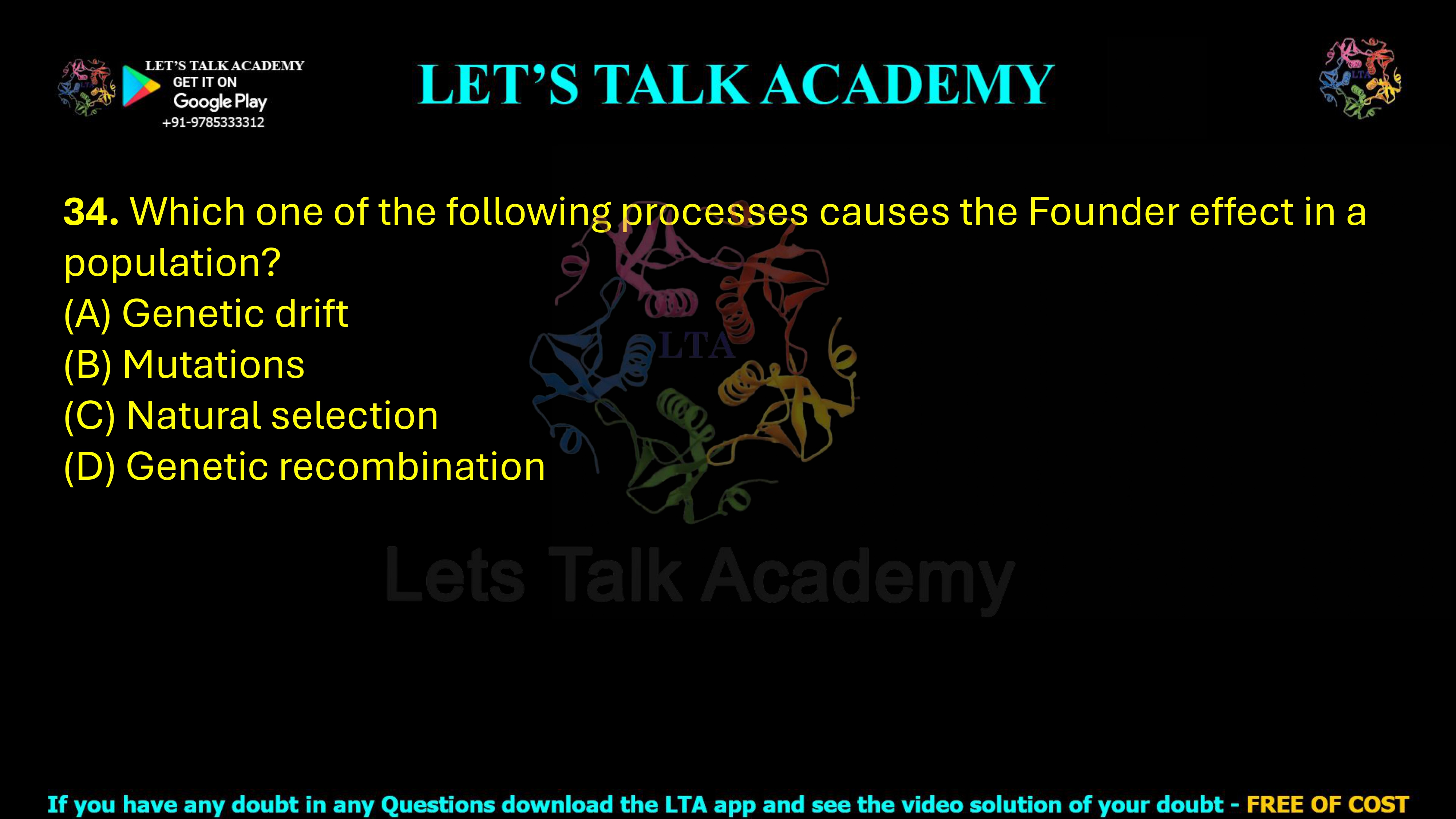
34. Which one of the following processes causes the Founder effect in a population?
(A) Genetic drift
(B) Mutations
(C) Natural selection
(D) Genetic recombination
Founder Effect in Population Genetics: Understanding the Role of Genetic Drift
Introduction
The Founder Effect is one of the most important concepts in evolutionary biology and population genetics. It describes a situation in which a small group of individuals becomes isolated from a much larger population and establishes a new population elsewhere. Since only a few individuals contribute genetically to the newly formed population, the allele frequencies of the new population often differ significantly from those of the original population. This phenomenon is not caused by adaptation or natural selection but by random sampling of alleles.
The Founder Effect is considered a special case of genetic drift, an evolutionary force that causes random fluctuations in allele frequencies, especially in small populations. Genetic drift can increase or decrease the frequency of alleles purely by chance, even if those alleles provide no selective advantage. Because the founder population contains only a fraction of the genetic diversity of the original population, rare alleles may become common while some common alleles may disappear entirely.
Correct Answer
Correct Answer: (A) Genetic drift
Detailed Explanation
The Founder Effect occurs when a small number of individuals separate from a large population and establish a new population. Because the founding group carries only a limited sample of the original gene pool, allele frequencies in the new population are determined largely by chance. This random sampling of alleles is known as genetic drift.
Unlike natural selection, which favors advantageous alleles, genetic drift is a random evolutionary process. Its effects are strongest in small populations because chance events have a much greater influence on allele frequencies when population size is limited.
For example, if only ten individuals colonize an isolated island, they may carry an unusually high frequency of a rare allele simply by chance. As the population grows, this allele may become common even though it provides neither an advantage nor a disadvantage.
Explanation of Option (A): Genetic Drift
This option is correct.
Genetic drift refers to random changes in allele frequencies due to chance events. The Founder Effect is one of the two classic examples of genetic drift, the other being the bottleneck effect. In both situations, random sampling rather than natural selection determines which alleles are passed to future generations.
Explanation of Option (B): Mutations
This option is incorrect.
Mutations generate new alleles by altering DNA sequences. Although mutations introduce genetic variation into populations, they do not cause the Founder Effect. The Founder Effect results from the random sampling of existing alleles rather than the creation of new ones.
Explanation of Option (C): Natural Selection
This option is incorrect.
Natural selection changes allele frequencies by favoring individuals with traits that increase survival or reproductive success. The Founder Effect, however, occurs independently of fitness and is entirely due to random sampling. Therefore, natural selection is not responsible for the Founder Effect.
Explanation of Option (D): Genetic Recombination
This option is incorrect.
Genetic recombination occurs during meiosis when homologous chromosomes exchange genetic material through crossing over. Recombination creates new combinations of existing alleles but does not produce the Founder Effect or alter allele frequencies through random sampling.
Summary of Each Option
| Option | Correct/Incorrect | Reason |
|---|---|---|
| (A) Genetic drift | Correct | Founder Effect is a classic example of random genetic drift. |
| (B) Mutations | Incorrect | Create new alleles but do not produce founder populations. |
| (C) Natural selection | Incorrect | Acts through differential survival rather than random sampling. |
| (D) Genetic recombination | Incorrect | Produces new allele combinations but does not cause Founder Effect. |
Founder Effect vs Bottleneck Effect
| Feature | Founder Effect | Bottleneck Effect |
|---|---|---|
| Cause | Small group establishes a new population | Population size drastically reduced |
| Evolutionary Process | Genetic drift | Genetic drift |
| Population Size | Small founder population | Large population becomes small |
| Genetic Diversity | Reduced | Reduced |
| Allele Frequencies | Change by chance | Change by chance |
Characteristics of Genetic Drift
| Characteristic | Description |
|---|---|
| Random Process | Changes occur by chance. |
| Most Effective | Small populations. |
| Effect on Diversity | Usually reduces genetic variation. |
| Influences Evolution | Can fix or eliminate alleles randomly. |
| Examples | Founder Effect and Bottleneck Effect. |
Biological Significance
The Founder Effect has played an important role in the evolution of many isolated populations. Island species, newly established populations, and certain human communities often exhibit unusually high frequencies of specific genetic traits because they originated from a small number of founders. Understanding this phenomenon helps explain the distribution of inherited disorders, the evolution of isolated species, and patterns of genetic diversity observed across the world.
Final Answer
The Founder Effect results from the random sampling of alleles when a small number of individuals establish a new population. This process is a classic example of genetic drift.
Correct Answer: (A) Genetic drift


