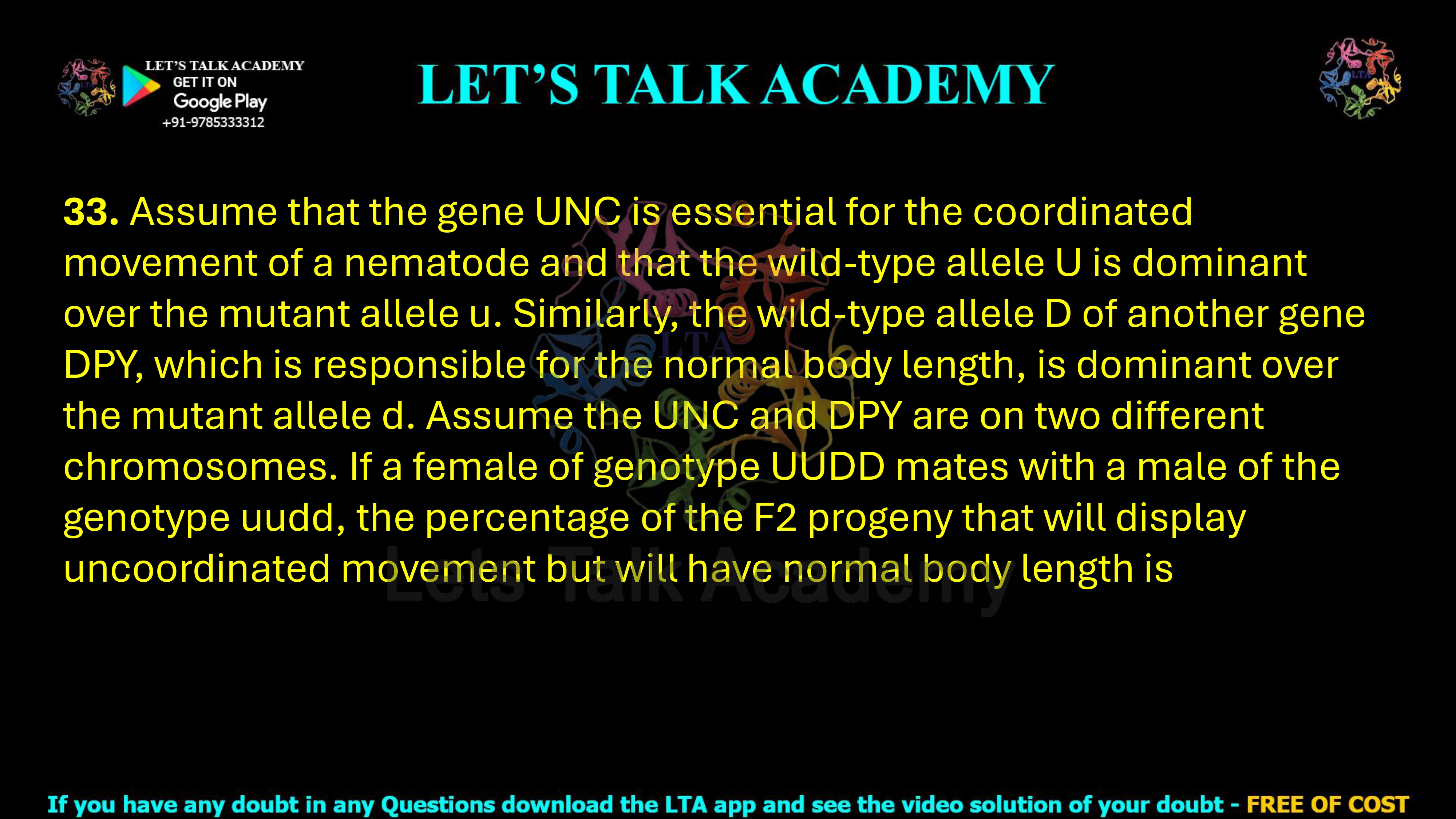
33. Assume that the gene UNC is essential for the coordinated movement of a nematode and that the wild-type allele U is dominant over the mutant allele u. Similarly, the wild-type allele D of another gene DPY, which is responsible for the normal body length, is dominant over the mutant allele d. Assume the UNC and DPY are on two different chromosomes. If a female of genotype UUDD mates with a male of the genotype uudd, the percentage of the F2 progeny that will display uncoordinated movement but will have normal body length is
Dihybrid Cross Probability: Calculating the Percentage of F₂ Progeny with Uncoordinated Movement and Normal Body Length
Introduction
The dihybrid cross is one of the most important concepts in classical genetics because it demonstrates Mendel’s Law of Independent Assortment. According to this law, genes located on different chromosomes assort independently during meiosis, producing new combinations of alleles in the offspring. This independent segregation enables geneticists to calculate the probability of obtaining specific phenotypes by considering each gene separately and then applying the multiplication rule of probability.
In this problem, two independently assorting genes control two different traits in a nematode. The first gene (UNC) determines coordinated movement, whereas the second gene (DPY) determines normal body length. Since the two genes are located on different chromosomes, they follow independent assortment, making probability calculations straightforward.
Correct Answer
Correct Answer: 18.75% (3/16)
Detailed Explanation
The parental cross is:
UUDD × uudd
The female contributes only UD gametes, whereas the male contributes only ud gametes.
Therefore, every F1 offspring has the genotype:
UuDd
Since both dominant alleles are present, all F1 individuals show coordinated movement and normal body length.
When the F1 individuals are self-fertilized, the cross becomes:
UuDd × UuDd
Because the two genes are located on different chromosomes, they assort independently during meiosis.
Step 1: Probability of Uncoordinated Movement
Uncoordinated movement is produced only by the homozygous recessive genotype:
uu
For the cross:
Uu × Uu
The genotypic ratio is:
1 UU : 2 Uu : 1 uu
Therefore,
P(uu) = 1/4
Step 2: Probability of Normal Body Length
Normal body length is expressed by either:
DD or Dd
For the cross:
Dd × Dd
The phenotypic ratio is:
3 Normal : 1 Dwarf
Therefore,
P(D−) = 3/4
Step 3: Apply the Multiplication Rule
Since the genes assort independently, multiply the probabilities of the two required phenotypes.
P(uu and D−) = P(uu) × P(D−)
= (1/4) × (3/4)
= 3/16
= 0.1875
Converting into percentage:
0.1875 × 100 = 18.75%
Step-by-Step Calculation
Parental Cross
UUDD × uudd
F1 = UuDd
F1 Self Cross
UuDd × UuDd
Probability for Each Trait
| Trait | Required Phenotype | Probability |
|---|---|---|
| UNC | Uncoordinated (uu) | 1/4 |
| DPY | Normal Body Length (D−) | 3/4 |
Combined Probability
(1/4) × (3/4) = 3/16
= 18.75%
Calculation Summary
| Parameter | Value |
|---|---|
| Probability of uu | 1/4 |
| Probability of D− | 3/4 |
| Combined Probability | 3/16 |
| Decimal Value | 0.1875 |
| Percentage | 18.75% |
Why Is the Multiplication Rule Used?
The UNC and DPY genes are located on different chromosomes. Therefore, they obey Mendel’s Law of Independent Assortment, which states that the segregation of one gene pair does not influence the segregation of another gene pair. As a result, the probability of obtaining both desired phenotypes simultaneously is calculated by multiplying their individual probabilities.
Expected F₂ Phenotypic Ratio
| Phenotype | Fraction |
|---|---|
| Coordinated, Normal | 9/16 |
| Coordinated, Dwarf | 3/16 |
| Uncoordinated, Normal | 3/16 |
| Uncoordinated, Dwarf | 1/16 |
Biological Significance
Dihybrid crosses demonstrate how independent assortment generates new genetic combinations in sexually reproducing organisms. This process increases genetic diversity within populations and forms the basis of modern breeding programmes, evolutionary genetics, and inheritance studies. Probability calculations derived from Mendelian principles are widely applied in plant breeding, animal breeding, medical genetics, and genetic counseling.
Final Answer
Probability of uncoordinated movement (uu) = 1/4
Probability of normal body length (D−) = 3/4
Combined probability = (1/4) × (3/4) = 3/16
= 0.1875
= 18.75%
Correct Answer: 18.75% (3/16)


