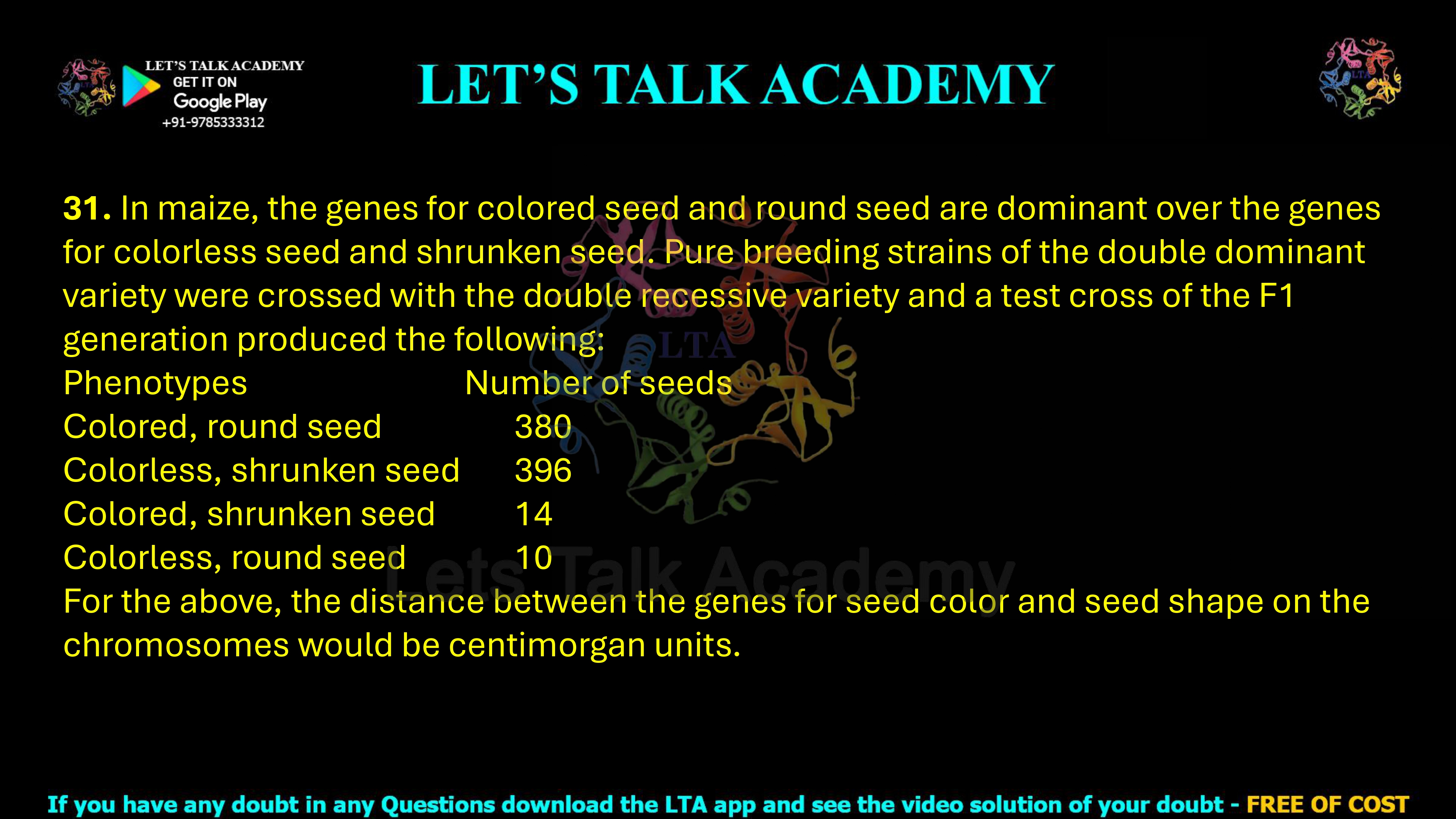
31. In maize, the genes for colored seed and round seed are dominant over the genes for colorless seed and shrunken seed. Pure breeding strains of the double dominant variety were crossed with the double recessive variety and a test cross of the F1 generation produced the following:
Phenotypes Number of seeds
Colored, round seed 380
Colorless, shrunken seed 396
Colored, shrunken seed 14
Colorless, round seed 10
For the above, the distance between the genes for seed color and seed shape on the chromosomes would be centimorgan units.
Genetic Linkage and Gene Mapping: Calculating the Distance Between Seed Color and Seed Shape Genes in Maize
Introduction
Genetic linkage refers to the tendency of genes located on the same chromosome to be inherited together. Unlike genes located on different chromosomes, linked genes do not assort independently because they remain physically connected unless crossing over occurs during meiosis. The frequency of crossing over between two linked genes depends on the physical distance separating them. Consequently, recombination frequency provides a direct estimate of the genetic distance between genes and forms the basis of chromosome mapping.
One of the most reliable methods for studying linkage is the test cross, where a heterozygous individual is crossed with a homozygous recessive individual. Since the recessive parent contributes only recessive alleles, every offspring directly represents one gamete produced by the heterozygous parent. By identifying parental and recombinant offspring, geneticists can calculate recombination frequency and determine the relative positions of genes on chromosomes.
This principle was first established through the pioneering work of Thomas Hunt Morgan and Alfred Sturtevant, who demonstrated that recombination frequencies could be used to construct linkage maps. Today, linkage mapping remains an essential tool in genetics, plant breeding, animal breeding, disease gene identification, and genome analysis.
Correct Answer
Correct Answer: 3 centimorgan (3 cM)
Detailed Explanation
The parental cross is between a homozygous dominant plant and a homozygous recessive plant.
CCRR × ccrr
The F1 genotype is therefore:
CcRr
Because the dominant alleles originated from one parent and the recessive alleles from the other, the linked genes are present in the coupling (cis) arrangement:
CR / cr
The F1 plant is then test crossed with the double recessive parent:
CcRr × ccrr
In a test cross, the phenotype of each offspring directly reflects the gamete produced by the heterozygous F1 plant. Therefore, the two most abundant classes represent parental gametes, whereas the two least abundant classes represent recombinant gametes produced by crossing over.
Identification of Parental and Recombinant Classes
The highest-frequency phenotypes are:
- Colored, Round = 380
- Colorless, Shrunken = 396
These are the parental classes.
The least frequent phenotypes are:
- Colored, Shrunken = 14
- Colorless, Round = 10
These represent the recombinant classes produced by crossing over.
Step-by-Step Calculation
Step 1: Calculate Recombinant Offspring
Recombinant offspring = 14 + 10 = 24
Step 2: Calculate Total Offspring
Total offspring = 380 + 396 + 14 + 10 = 800
Step 3: Calculate Recombination Frequency
Recombination Frequency (%) = (Recombinant Offspring ÷ Total Offspring) × 100
= (24 ÷ 800) × 100
= 3%
Step 4: Convert Recombination Frequency into Genetic Distance
One percent recombination corresponds to one centimorgan.
Genetic Distance = 3 cM
Calculation Summary
| Parameter | Value |
|---|---|
| Parental Offspring | 380 + 396 = 776 |
| Recombinant Offspring | 14 + 10 = 24 |
| Total Offspring | 800 |
| Recombination Frequency | 3% |
| Genetic Distance | 3 cM |
Formula Used
Recombination Frequency (%) =
(Number of Recombinant Offspring ÷ Total Number of Offspring) × 100
1% Recombination = 1 centimorgan (cM)
Identification of Parental and Recombinant Phenotypes
| Phenotype | Classification | Reason |
|---|---|---|
| Colored, Round | Parental | Highest frequency |
| Colorless, Shrunken | Parental | Highest frequency |
| Colored, Shrunken | Recombinant | Produced by crossing over |
| Colorless, Round | Recombinant | Produced by crossing over |
Relationship Between Recombination Frequency and Gene Distance
| Recombination Frequency | Genetic Distance |
|---|---|
| 1% | 1 cM |
| 3% | 3 cM |
| 10% | 10 cM |
| 20% | 20 cM |
| 50% | Independent assortment |
Why Are Recombinant Offspring Less Frequent?
The genes controlling seed color and seed shape are located close together on the same chromosome. Because they are physically linked, they usually pass together into the same gamete. Recombinant offspring appear only when crossing over occurs between the two genes during Prophase I of meiosis. Since the genes are separated by only a short distance, crossing over occurs infrequently, producing a low recombination frequency of only 3%. This indicates strong genetic linkage.
Biological Significance
Genetic linkage mapping has transformed our understanding of chromosome organization. By measuring recombination frequencies, researchers can determine the relative positions of genes, identify genes associated with economically important traits, construct genetic linkage maps, and accelerate plant and animal breeding programmes. In modern genomics, linkage analysis continues to play an important role in locating disease genes and understanding chromosome evolution.
Final Answer
Recombinant offspring = 14 + 10 = 24
Total offspring = 800
Recombination Frequency = (24 ÷ 800) × 100 = 3%
Genetic Distance = 3 centimorgan (3 cM)
Correct Answer: 3 cM


