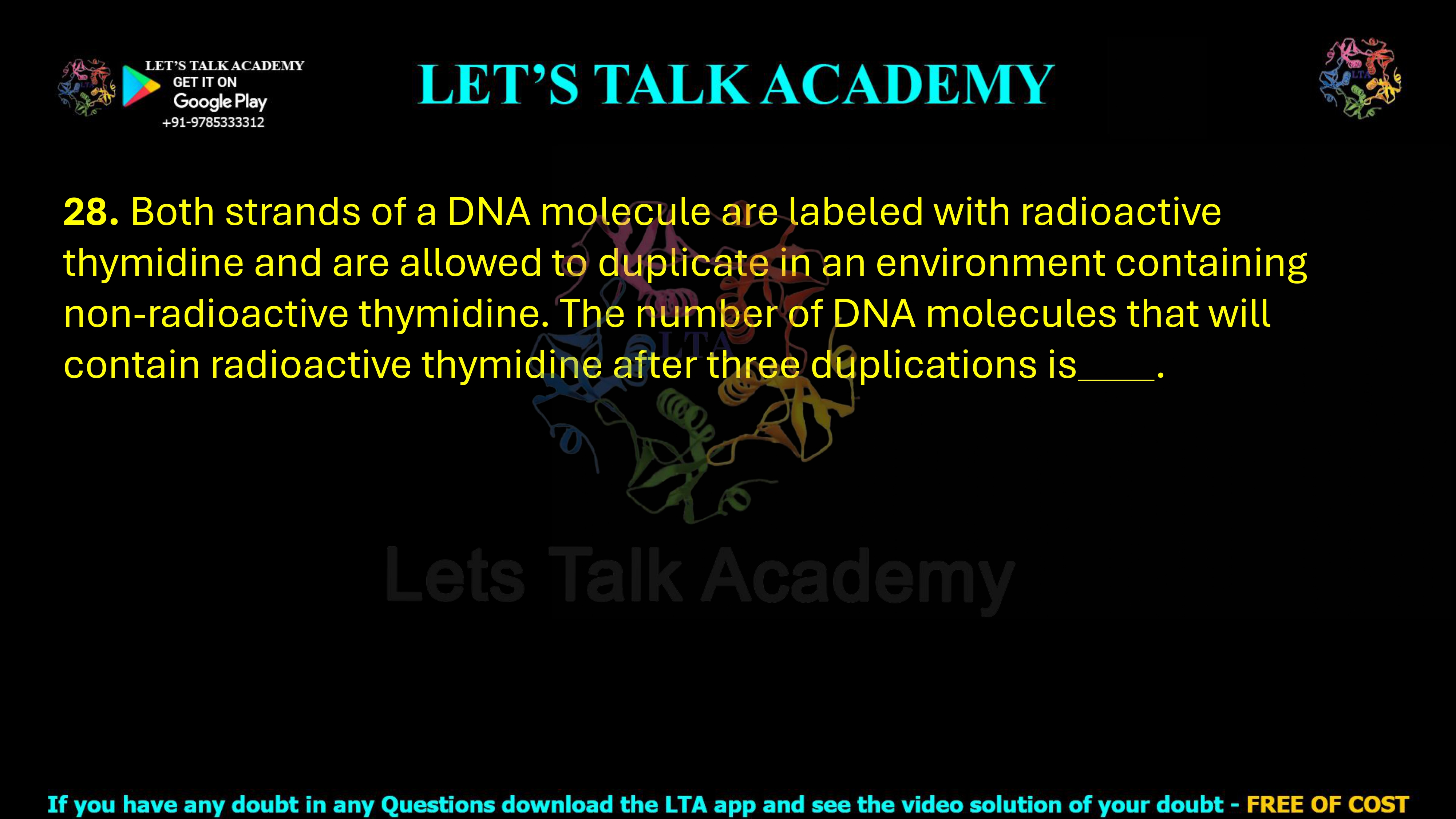
28. Both strands of a DNA molecule are labeled with radioactive thymidine and are allowed to duplicate in an environment containing non-radioactive thymidine. The number of DNA molecules that will contain radioactive thymidine after three duplications is .
Semiconservative DNA Replication: Number of DNA Molecules Containing Radioactive Thymidine After Three Replication Cycles
Introduction
DNA replication is one of the most fundamental biological processes because it ensures that genetic information is faithfully transmitted from one generation of cells to the next. The universally accepted model of DNA replication is the semiconservative model, proposed by Watson and Crick and experimentally confirmed by the famous Meselson-Stahl experiment. According to this model, each newly synthesized DNA molecule consists of one parental strand and one newly synthesized strand.
Radioactive labeling experiments using radioactive thymidine have played a major role in understanding DNA replication. Since thymidine is incorporated only into newly synthesized DNA strands, radioactive thymidine can be used to trace the fate of DNA molecules through successive rounds of replication.
Correct Answer
Correct Answer: 2
Detailed Explanation
Initially, there is a single double-stranded DNA molecule in which both parental strands are radioactive. The DNA is then allowed to replicate three times in a medium containing only non-radioactive thymidine. Therefore, every newly synthesized DNA strand will be non-radioactive, while the original parental strands remain radioactive throughout the experiment.
According to the semiconservative model of DNA replication, each parental strand serves as a template for the synthesis of one new complementary strand. Importantly, the original radioactive strands are never destroyed or diluted; instead, they are inherited by one daughter DNA molecule during each replication cycle.
Step 1: Before Replication
Initially there is:
1 DNA molecule
Both strands are radioactive.
| DNA Molecule | Strand 1 | Strand 2 |
|---|---|---|
| Original DNA | Radioactive | Radioactive |
Step 2: After First Replication
Each radioactive strand acts as a template for synthesizing one non-radioactive strand.
Therefore:
| DNA Molecule | Composition |
|---|---|
| DNA 1 | Radioactive + Non-radioactive |
| DNA 2 | Radioactive + Non-radioactive |
Total DNA molecules = 2
DNA molecules containing radioactivity = 2
Step 3: After Second Replication
Each hybrid DNA molecule replicates.
The radioactive parental strand always remains associated with one newly synthesized non-radioactive strand.
The non-radioactive strand produces an entirely non-radioactive DNA molecule.
| DNA Type | Number |
|---|---|
| Radioactive + Non-radioactive | 2 |
| Non-radioactive + Non-radioactive | 2 |
Total DNA molecules = 4
DNA molecules containing radioactivity = 2
Step 4: After Third Replication
The same process occurs again.
The radioactive strands are still retained in exactly two DNA molecules.
| DNA Type | Number |
|---|---|
| Radioactive + Non-radioactive | 2 |
| Non-radioactive + Non-radioactive | 6 |
Total DNA molecules = 8
DNA molecules containing radioactive thymidine = 2
Step-by-Step Summary
| Replication Cycle | Total DNA Molecules | DNA Molecules Containing Radioactive Strands |
|---|---|---|
| Initial | 1 | 1 |
| After 1st Replication | 2 | 2 |
| After 2nd Replication | 4 | 2 |
| After 3rd Replication | 8 | 2 |
Why Does the Number Remain Constant?
The original radioactive strands are never replicated into additional radioactive strands because all new DNA synthesis occurs using non-radioactive thymidine. During every replication cycle, each radioactive parental strand becomes part of only one daughter DNA molecule. Since the original DNA contained two radioactive strands, there will always be exactly two DNA molecules containing radioactive thymidine, regardless of the number of subsequent replication cycles.
Connection with the Meselson-Stahl Experiment
This problem is based on the same principle demonstrated by the Meselson-Stahl experiment, which proved that DNA replication is semiconservative. In semiconservative replication, every daughter DNA molecule inherits one parental strand and one newly synthesized strand. The experiment originally used heavy nitrogen (15N) isotopes instead of radioactive thymidine, but the inheritance pattern remains exactly the same.
Biological Significance
Semiconservative DNA replication ensures the faithful transmission of genetic information while minimizing replication errors. Every newly formed DNA molecule contains one original parental strand that serves as a template for accurate synthesis. Radioactive isotope labeling experiments have greatly contributed to our understanding of DNA replication, chromosome duplication, DNA repair, and molecular genetics, forming the basis of numerous modern techniques in biological research.
Final Answer
After three rounds of semiconservative DNA replication:
Total DNA molecules = 8
DNA molecules containing radioactive thymidine = 2
Correct Answer: 2


