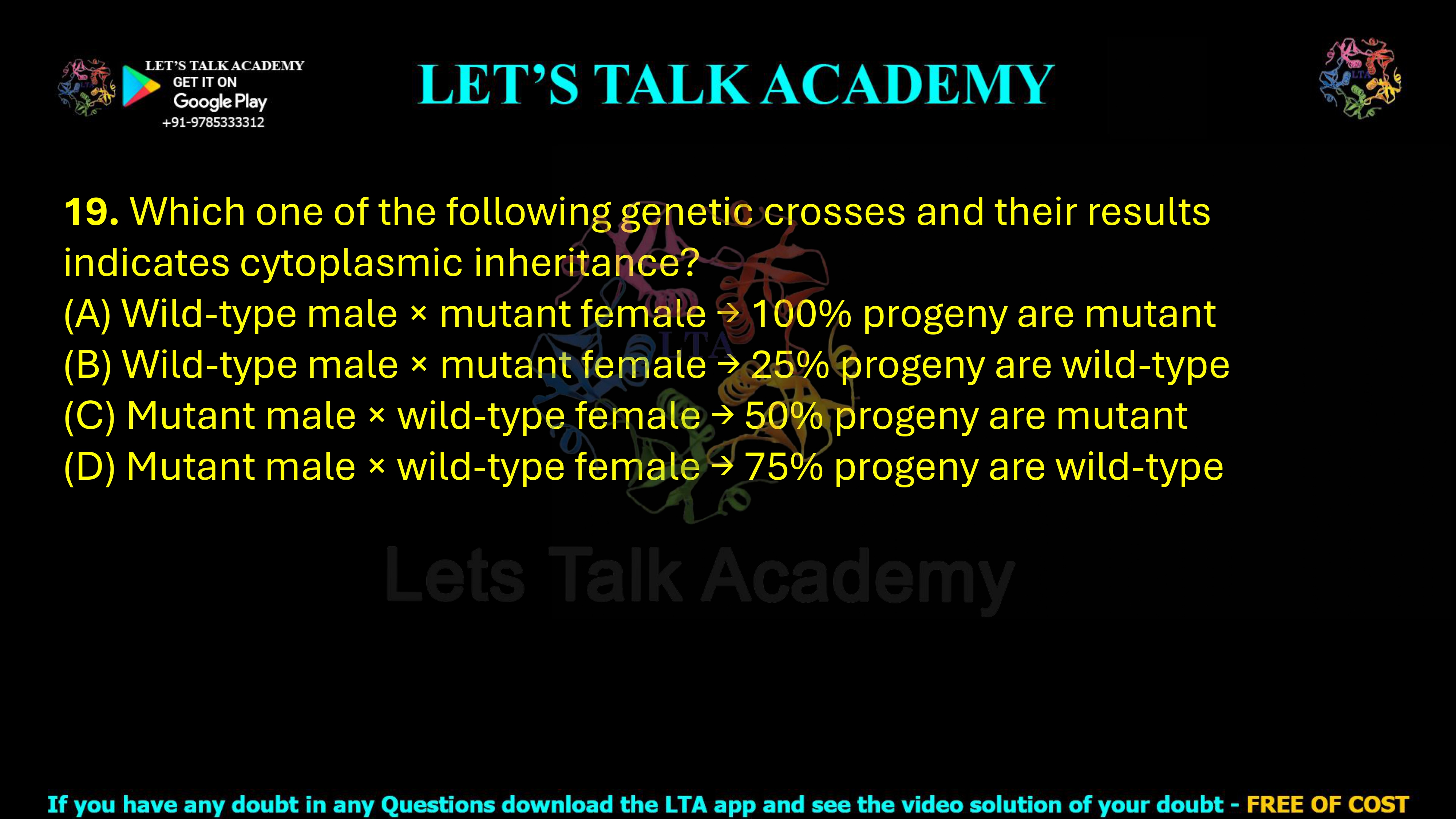
19. Which one of the following genetic crosses and their results indicates cytoplasmic inheritance?
(A) Wild-type male × mutant female → 100% progeny are mutant
(B) Wild-type male × mutant female → 25% progeny are wild-type
(C) Mutant male × wild-type female → 50% progeny are mutant
(D) Mutant male × wild-type female → 75% progeny are wild-type
Cytoplasmic Inheritance Explained: Identifying Maternal Inheritance Through Genetic Crosses
Introduction
Most inherited characteristics follow the classical Mendelian laws, where genes located on nuclear chromosomes are transmitted equally from both parents. However, not all hereditary traits follow this pattern. Some genes are located outside the nucleus in cellular organelles such as mitochondria and chloroplasts. Since these organelles are usually inherited almost exclusively from the mother, traits governed by these genes exhibit cytoplasmic inheritance, also known as maternal inheritance or extranuclear inheritance.
Cytoplasmic inheritance differs fundamentally from Mendelian inheritance because the phenotype of the offspring depends primarily on the genotype of the mother rather than the father. During fertilization, the egg contributes nearly all of the cytoplasm, including mitochondria and chloroplasts, whereas the sperm contributes mainly nuclear DNA. As a result, mutations present in maternal organelles are transmitted to all offspring, while mutations present only in the father are generally not inherited.
Correct Answer
Correct Option: (A) Wild-type male × mutant female → 100% progeny are mutant
Detailed Explanation
In cytoplasmic inheritance, organelles such as mitochondria and chloroplasts are inherited almost entirely from the mother because the egg contributes nearly all of the cytoplasm to the developing zygote. Consequently, if the mother carries mutant mitochondrial or chloroplast DNA, every offspring receives these mutant organelles regardless of the father’s genotype.
In the given cross, the female parent is mutant while the male parent is wild type. Since the mutant cytoplasm originates from the mother, all offspring inherit the mutant cytoplasmic genome. Therefore, the observation that 100% of the progeny are mutant is the characteristic pattern expected for cytoplasmic inheritance.
This pattern cannot be explained by simple Mendelian inheritance because nuclear genes inherited from heterozygous parents usually produce segregation ratios such as 3:1, 1:1, or 9:3:3:1 rather than uniform maternal transmission.
Why Maternal Inheritance Occurs
During fertilization, the ovum contributes not only half of the nuclear chromosomes but also almost the entire cytoplasm containing mitochondria, ribosomes, and other organelles. The sperm contributes primarily its nucleus, while its mitochondria either do not enter the egg or are selectively degraded after fertilization. Consequently, mitochondrial DNA and chloroplast DNA are inherited almost exclusively from the mother.
Characteristics of Cytoplasmic Inheritance
| Characteristic | Description |
|---|---|
| Mode of Inheritance | Maternal |
| Genes Involved | Mitochondrial or chloroplast DNA |
| Reciprocal Crosses | Produce different results |
| Mendelian Ratios | Generally absent |
| Father’s Contribution | Usually negligible for organelle genomes |
Explanation of Each Option
Option (A): Wild-type Male × Mutant Female → 100% Progeny are Mutant
This option is correct. Since the mutant mother contributes all cytoplasmic organelles to the offspring, every progeny inherits the mutant cytoplasm and therefore expresses the mutant phenotype. This is the classical pattern of maternal or cytoplasmic inheritance.
Option (B): Wild-type Male × Mutant Female → 25% Progeny are Wild-type
This option is incorrect. A mixture of mutant and wild-type offspring suggests segregation of nuclear genes rather than maternal inheritance. Cytoplasmic inheritance typically does not produce Mendelian segregation ratios.
Option (C): Mutant Male × Wild-type Female → 50% Progeny are Mutant
This option is incorrect. In cytoplasmic inheritance, the father’s mitochondria are generally not transmitted to offspring. Therefore, a mutant father does not normally pass the mutant cytoplasmic genome to the next generation.
Option (D): Mutant Male × Wild-type Female → 75% Progeny are Wild-type
This option is incorrect. This pattern resembles Mendelian inheritance and cannot be explained by cytoplasmic inheritance because paternal cytoplasmic genomes are typically not inherited.
Why Option (A) is Correct
The defining feature of cytoplasmic inheritance is that the phenotype of the offspring depends almost entirely on the mother’s cytoplasmic genotype. Since the mutant female contributes all mitochondria or chloroplasts to the zygote, every offspring inherits the mutant organelles. Therefore, a cross between a wild-type male and a mutant female producing 100% mutant offspring is the classical example of cytoplasmic inheritance.
Comparison of All Options
| Option | Cross | Indicates Cytoplasmic Inheritance? |
|---|---|---|
| A | Wild-type male × Mutant female → 100% mutant | Yes |
| B | Wild-type male × Mutant female → 25% wild-type | No |
| C | Mutant male × Wild-type female → 50% mutant | No |
| D | Mutant male × Wild-type female → 75% wild-type | No |
Cytoplasmic Inheritance vs Mendelian Inheritance
| Feature | Cytoplasmic Inheritance | Mendelian Inheritance |
|---|---|---|
| Location of Genes | Mitochondria or chloroplasts | Nuclear chromosomes |
| Inheritance Pattern | Maternal | Both parents contribute equally |
| Reciprocal Crosses | Different results | Usually identical results |
| Typical Ratios | No Mendelian ratios | 3:1, 1:1, 9:3:3:1 etc. |
Examples of Cytoplasmic Inheritance
| Trait or Disorder | Organelle |
|---|---|
| Leber Hereditary Optic Neuropathy (LHON) | Mitochondria |
| MELAS Syndrome | Mitochondria |
| Variegated Leaves in Four O’Clock Plant (Mirabilis jalapa) | Chloroplasts |
| Cytoplasmic Male Sterility | Mitochondria |
Biological Significance
Cytoplasmic inheritance has profound importance in evolution, medicine, and agriculture. Mitochondrial inheritance explains several inherited human diseases, while chloroplast inheritance influences plant pigmentation and photosynthesis. Cytoplasmic male sterility is extensively used in hybrid seed production because it facilitates the development of high-yielding crop varieties without manual emasculation. The study of mitochondrial DNA has also become a powerful tool in evolutionary biology and forensic science due to its maternal mode of transmission.
Final Answer
Cytoplasmic inheritance is characterized by maternal transmission because the egg contributes almost all of the cytoplasm to the offspring. Therefore, a cross between a wild-type male and a mutant female resulting in 100% mutant progeny is the hallmark of cytoplasmic inheritance.
Correct Option: (A) Wild-type male × mutant female → 100% progeny are mutant


