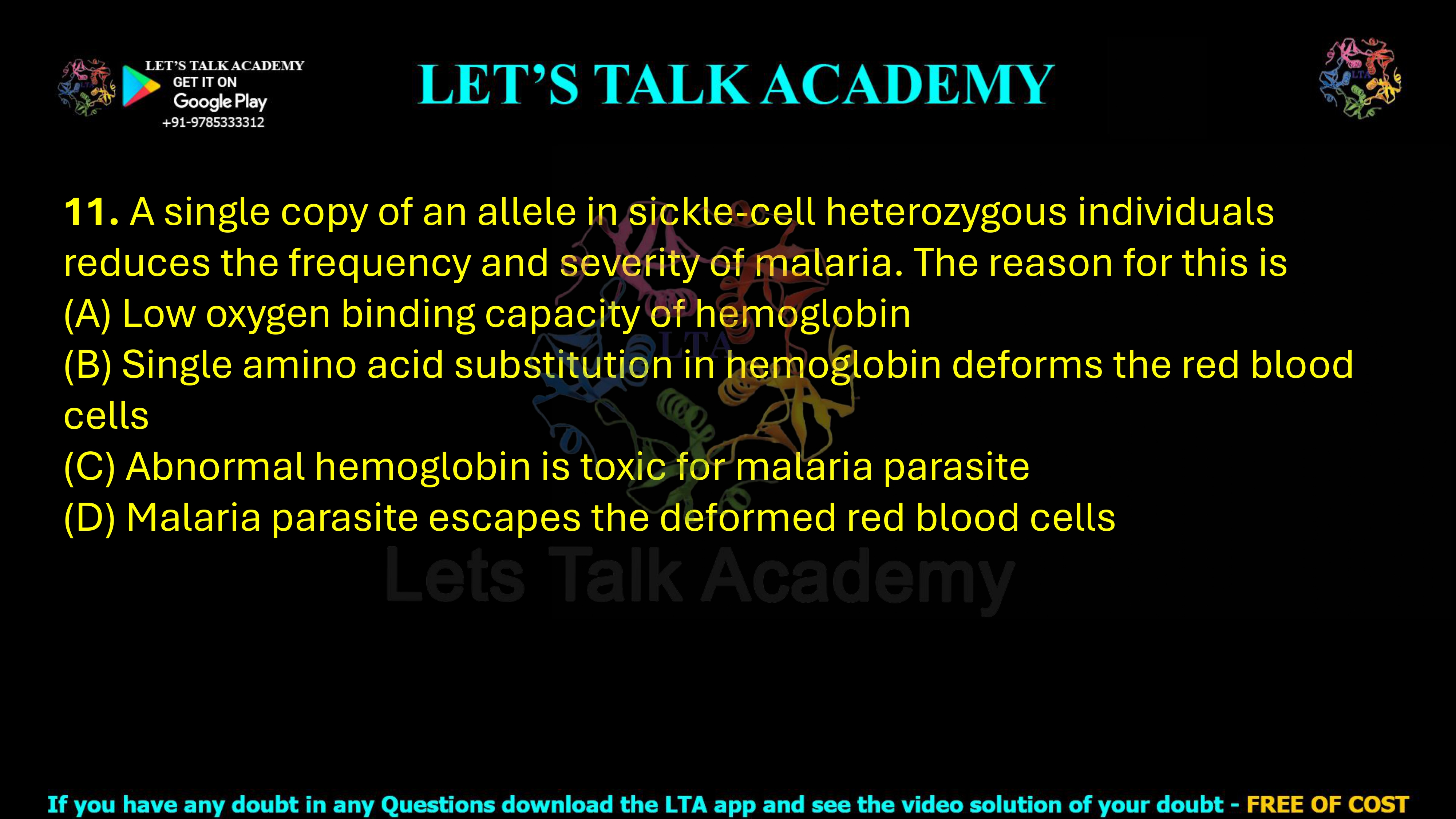
11. A single copy of an allele in sickle-cell heterozygous individuals reduces the frequency and severity of malaria. The reason for this is
(A) Low oxygen binding capacity of hemoglobin
(B) Single amino acid substitution in hemoglobin deforms the red blood cells
(C) Abnormal hemoglobin is toxic for malaria parasite
(D) Malaria parasite escapes the deformed red blood cells
Sickle Cell Trait and Malaria Resistance Explained: Why Heterozygous Individuals are Protected
Introduction
The relationship between sickle cell anemia and malaria is one of the most fascinating examples of natural selection in humans. It illustrates how a harmful genetic mutation can be maintained in a population because it provides a survival advantage under specific environmental conditions. Individuals carrying one normal hemoglobin allele (HbA) and one sickle cell allele (HbS) are known as heterozygotes (HbAHbS) or individuals with the sickle cell trait. These individuals usually remain healthy but exhibit remarkable resistance to severe malaria caused by Plasmodium falciparum.
Sickle cell anemia results from a single nucleotide substitution in the β-globin gene that replaces glutamic acid with valine at the sixth amino acid position of the β-globin chain. This apparently minor molecular change alters the structure and properties of hemoglobin. Under low oxygen conditions, hemoglobin S polymerizes, causing red blood cells to become sickle-shaped. In heterozygous individuals, only a small proportion of red blood cells undergo temporary sickling, which creates an unfavorable environment for malaria parasites without causing severe disease.
Correct Answer
Correct Option: (B) Single amino acid substitution in hemoglobin deforms the red blood cells
Detailed Explanation
Sickle cell anemia is caused by a mutation in the HBB gene encoding the β-globin chain of hemoglobin. This mutation changes the DNA codon from GAG to GTG, replacing glutamic acid with valine at the sixth position of the β-globin protein.
In individuals with the sickle cell trait (HbAHbS), this altered hemoglobin is present together with normal hemoglobin. Under conditions of reduced oxygen concentration, some red blood cells become temporarily sickle-shaped due to polymerization of hemoglobin S. When Plasmodium falciparum infects these cells, the infected erythrocytes sickle more readily and are rapidly recognized and removed by the spleen before the parasite can complete its life cycle.
Thus, the protective effect against malaria arises because the single amino acid substitution causes deformation of infected red blood cells, leading to early destruction of parasite-containing erythrocytes. This reduces parasite multiplication and decreases both the frequency and severity of malaria.
Molecular Basis of the Mutation
| Normal Hemoglobin (HbA) | Sickle Hemoglobin (HbS) |
|---|---|
| Glutamic acid at position 6 | Valine at position 6 |
| Hydrophilic amino acid | Hydrophobic amino acid |
| Normal red blood cell shape | Sickling under low oxygen tension |
Mechanism of Malaria Resistance
When Plasmodium falciparum infects red blood cells in heterozygous individuals, oxygen tension inside the infected cells decreases. This promotes polymerization of hemoglobin S, causing the infected erythrocytes to become sickle-shaped. These abnormal cells are rapidly removed by splenic macrophages before the malaria parasite can multiply efficiently. Consequently, parasite density remains low, and severe malaria is prevented.
Explanation of Each Option
Option (A): Low Oxygen Binding Capacity of Hemoglobin
This option is incorrect. Although hemoglobin S differs structurally from normal hemoglobin, the protection against malaria is not primarily due to reduced oxygen-binding capacity.
Option (B): Single Amino Acid Substitution in Hemoglobin Deforms the Red Blood Cells
This option is correct. The substitution of valine for glutamic acid causes hemoglobin S polymerization under low oxygen conditions, leading to deformation of infected red blood cells and rapid removal of malaria parasites.
Option (C): Abnormal Hemoglobin is Toxic for Malaria Parasite
This option is incorrect. Hemoglobin S is not directly toxic to the parasite. Protection results mainly from accelerated destruction of infected sickled erythrocytes.
Option (D): Malaria Parasite Escapes the Deformed Red Blood Cells
This option is incorrect. The parasite does not escape from sickled cells. Instead, infected sickled erythrocytes are removed from circulation by the spleen before the parasite completes its developmental cycle.
Why Option (B) is Correct
The sickle mutation introduces a single amino acid substitution that alters hemoglobin structure. During malaria infection, this structural change causes infected red blood cells to sickle and undergo early destruction, thereby limiting parasite survival. This is the accepted explanation for malaria resistance in individuals with the sickle cell trait.
Comparison of All Options
| Option | Statement | Status |
|---|---|---|
| A | Low oxygen binding capacity of hemoglobin | Incorrect |
| B | Single amino acid substitution deforms red blood cells | Correct |
| C | Abnormal hemoglobin is toxic to the parasite | Incorrect |
| D | Parasite escapes deformed red blood cells | Incorrect |
Genotypes and Clinical Outcomes
| Genotype | Condition | Malaria Resistance |
|---|---|---|
| HbAHbA | Normal | Low |
| HbAHbS | Sickle Cell Trait | High Protection |
| HbSHbS | Sickle Cell Anemia | Severe Disease |
Balanced Polymorphism and Heterozygote Advantage
| Concept | Explanation |
|---|---|
| Balanced Polymorphism | Both HbA and HbS alleles persist in populations due to selective advantage. |
| Heterozygote Advantage | HbAHbS individuals survive better than either homozygote in malaria-endemic regions. |
| Natural Selection | Maintains the HbS allele where malaria is common. |
Biological Significance
The sickle cell–malaria relationship is one of the strongest examples demonstrating how environmental pressures influence human evolution. In regions where malaria is endemic, heterozygous individuals have higher survival rates because they are protected against severe malaria without developing the full symptoms of sickle cell anemia. This selective advantage explains why the HbS allele remains relatively common in many tropical populations despite causing a serious genetic disease in homozygous individuals.
Final Answer
A single amino acid substitution (glutamic acid → valine) in hemoglobin S causes infected red blood cells to become sickle-shaped. These deformed erythrocytes are rapidly removed from circulation, reducing the multiplication of Plasmodium falciparum and protecting heterozygous individuals from severe malaria.
Correct Option: (B) Single amino acid substitution in hemoglobin deforms the red blood cells


