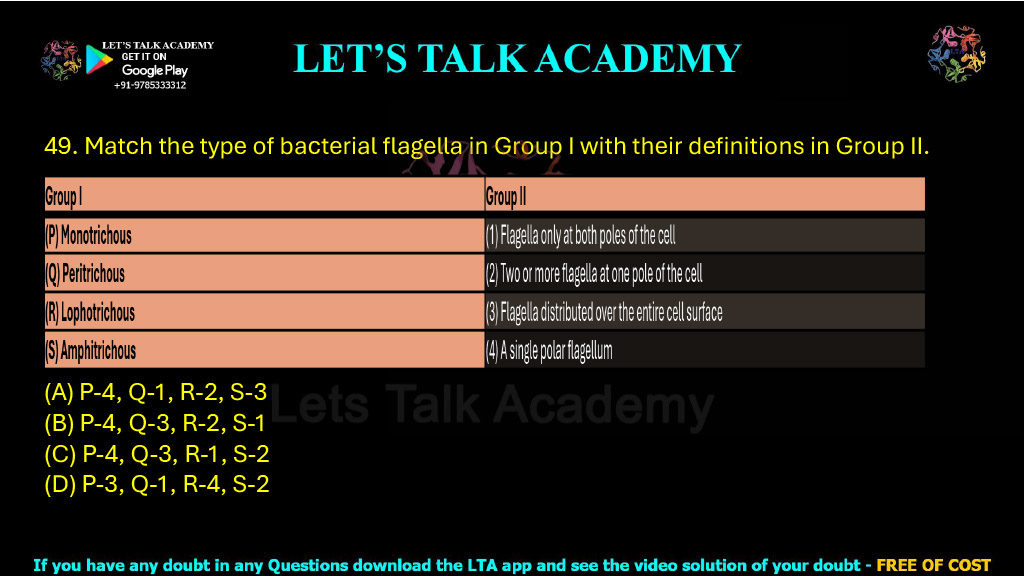
49. Match the type of bacterial flagella in Group I with their definitions in Group II.
| Group I | Group II |
| (P) Monotrichous | (1) Flagella only at both poles of the cell |
| (Q) Peritrichous | (2) Two or more flagella at one pole of the cell |
| (R) Lophotrichous | (3) Flagella distributed over the entire cell surface |
| (S) Amphitrichous | (4) A single polar flagellum |
(A) P-4, Q-1, R-2, S-3
(B) P-4, Q-3, R-2, S-1
(C) P-4, Q-3, R-1, S-2
(D) P-3, Q-1, R-4, S-2
Bacterial Flagella Types Explained: Monotrichous, Peritrichous, Lophotrichous, and Amphitrichous
Introduction
Bacterial flagella are long, thin, whip-like appendages that enable bacteria to move actively in liquid or semi-solid environments. They are composed primarily of the protein flagellin and function as rotary motors powered by the proton motive force or, in some marine bacteria, by sodium ion gradients. Motility allows bacteria to locate nutrients, escape harmful environmental conditions, colonize host tissues, and form biofilms. Because bacterial movement contributes directly to survival and pathogenicity, the arrangement of flagella is an important characteristic used in bacterial identification and classification.
The distribution of flagella on the bacterial cell surface varies among different species. Based on their arrangement, bacterial flagella are classified into four major types: monotrichous, lophotrichous, amphitrichous, and peritrichous.
Correct Answer
Correct Option: (B)
P-4, Q-3, R-2, S-1
Detailed Explanation
Bacterial flagella are classified according to their number and position on the cell surface. A bacterium possessing a single flagellum at one pole is described as monotrichous. This arrangement provides rapid directional movement and is commonly observed in bacteria such as Vibrio cholerae.
When multiple flagella emerge as a tuft from a single pole, the bacterium is called lophotrichous. This arrangement generates greater propulsive force than a single flagellum and is seen in organisms such as Helicobacter pylori and certain species of Pseudomonas.
A bacterium possessing one flagellum at each pole is described as amphitrichous. The organism can reverse its direction of movement by switching the active flagellum from one pole to the other.
In peritrichous bacteria, numerous flagella are distributed over the entire cell surface. During movement, these flagella bundle together to propel the bacterium forward. Well-known examples include Escherichia coli, Salmonella, and Bacillus subtilis.
Therefore, the correct matching is:
- Monotrichous → A single polar flagellum (4)
- Peritrichous → Flagella distributed over the entire cell surface (3)
- Lophotrichous → Two or more flagella at one pole (2)
- Amphitrichous → Flagella at both poles (1)
Explanation of Each Match
P. Monotrichous → (4) A Single Polar Flagellum
This match is correct. Monotrichous bacteria possess one flagellum at one end of the cell.
Q. Peritrichous → (3) Flagella Distributed Over the Entire Cell Surface
This match is correct. Numerous flagella arise from all parts of the bacterial surface.
R. Lophotrichous → (2) Two or More Flagella at One Pole
This match is correct. A tuft of flagella originates from one pole.
S. Amphitrichous → (1) Flagella Only at Both Poles of the Cell
This match is correct. Amphitrichous bacteria possess flagella at both ends of the cell.
Why Option (B) is Correct
Option (B) correctly matches each flagellar arrangement with its corresponding definition:
- Monotrichous → Single polar flagellum
- Peritrichous → Flagella all over the cell surface
- Lophotrichous → Tuft of flagella at one pole
- Amphitrichous → Flagella at both poles
Why the Other Options are Incorrect
Option (A)
This option incorrectly matches peritrichous bacteria with flagella at both poles and amphitrichous bacteria with flagella over the entire surface.
Option (C)
This option incorrectly exchanges the definitions of lophotrichous and amphitrichous flagella.
Option (D)
This option incorrectly matches monotrichous bacteria with peritrichous arrangement and several other definitions.
Comparison of All Options
| Option | Matching | Status |
|---|---|---|
| A | P-4, Q-1, R-2, S-3 | Incorrect |
| B | P-4, Q-3, R-2, S-1 | Correct |
| C | P-4, Q-3, R-1, S-2 | Incorrect |
| D | P-3, Q-1, R-4, S-2 | Incorrect |
Types of Bacterial Flagella
| Flagellar Type | Arrangement | Example |
|---|---|---|
| Monotrichous | Single flagellum at one pole | Vibrio cholerae |
| Lophotrichous | Tuft of flagella at one pole | Helicobacter pylori |
| Amphitrichous | One flagellum at each pole | Alcaligenes faecalis |
| Peritrichous | Flagella distributed over entire surface | Escherichia coli, Salmonella |
Biological Significance
Flagellar arrangement influences bacterial swimming efficiency, chemotaxis, colonization, and pathogenicity. Motile bacteria can move toward nutrients and away from harmful chemicals, increasing their survival in diverse environments. Flagella also contribute to biofilm formation, host invasion, and bacterial virulence. Consequently, flagellar organization is an important taxonomic and diagnostic characteristic used in microbiology.
Final Answer
The correct matching is:
- P (Monotrichous) → 4
- Q (Peritrichous) → 3
- R (Lophotrichous) → 2
- S (Amphitrichous) → 1
Correct Option: (B)


